Short answer: starting your own social group in Malta takes about four weeks and four to eight people. Pick one simple format (a walk, a games night, a dinner or a language table), choose a public place and a fixed day, send a specific first message, say clearly who pays, and turn up at the same time every week. Most groups here fade because the organiser stops after week three, not because nobody is interested. This playbook gives you the format table, a week-by-week plan with costs, messages you can copy, and ways to keep the group alive once the novelty wears off. It sits next to our guides on joining existing clubs and associations in Malta and the wider pillar on loneliness after moving to Malta.
I have watched this play out for years. Newcomers wait to be invited to something, find that most groups are already full of people who know each other, and conclude that Malta is closed. It is not. The islands are small, many expats are in the same position, and a person who simply says “I am doing this on Thursday at 19:00, come along” becomes the centre of a circle within a month. Hosting feels risky. In practice it is the fastest way to meet people, because everyone else is waiting for somebody to go first.
Starting your own social group in Malta instead of joining one
Joining an existing group is the right first move, and our guides to board game groups in Malta and how to meet people in Malta cover that. But there are three situations where hosting your own works better:
- The group you want does not exist near you. Many hobby groups meet in Sliema, St Julian’s or Valletta. If you live in the south, in Gozo or in a village, the nearest one can be a long bus ride away.
- Existing groups are big. A meetup with forty people is hard to break into. A table of five is not.
- Expats leave. Many newcomers are on fixed-term contracts or short courses. A group you run yourself is one you can keep recruiting for, so it survives people moving on.
Starting your own social group in Malta also changes how people see you. The person who organises is remembered, thanked and invited back. That matters when you are the new face and nobody knows you yet.
Pick a format that fits you
The best format is the one you can run every week without dreading it. Choose something with a built-in activity, so the conversation does not depend on you being the funniest person in the room.
| Format | Group size | Typical cost per person | Best for |
|---|---|---|---|
| Coastal or countryside walk | 4 to 8 | Free (bus fare if you do not have a free card) | Introverts, anyone who wants conversation without eye contact |
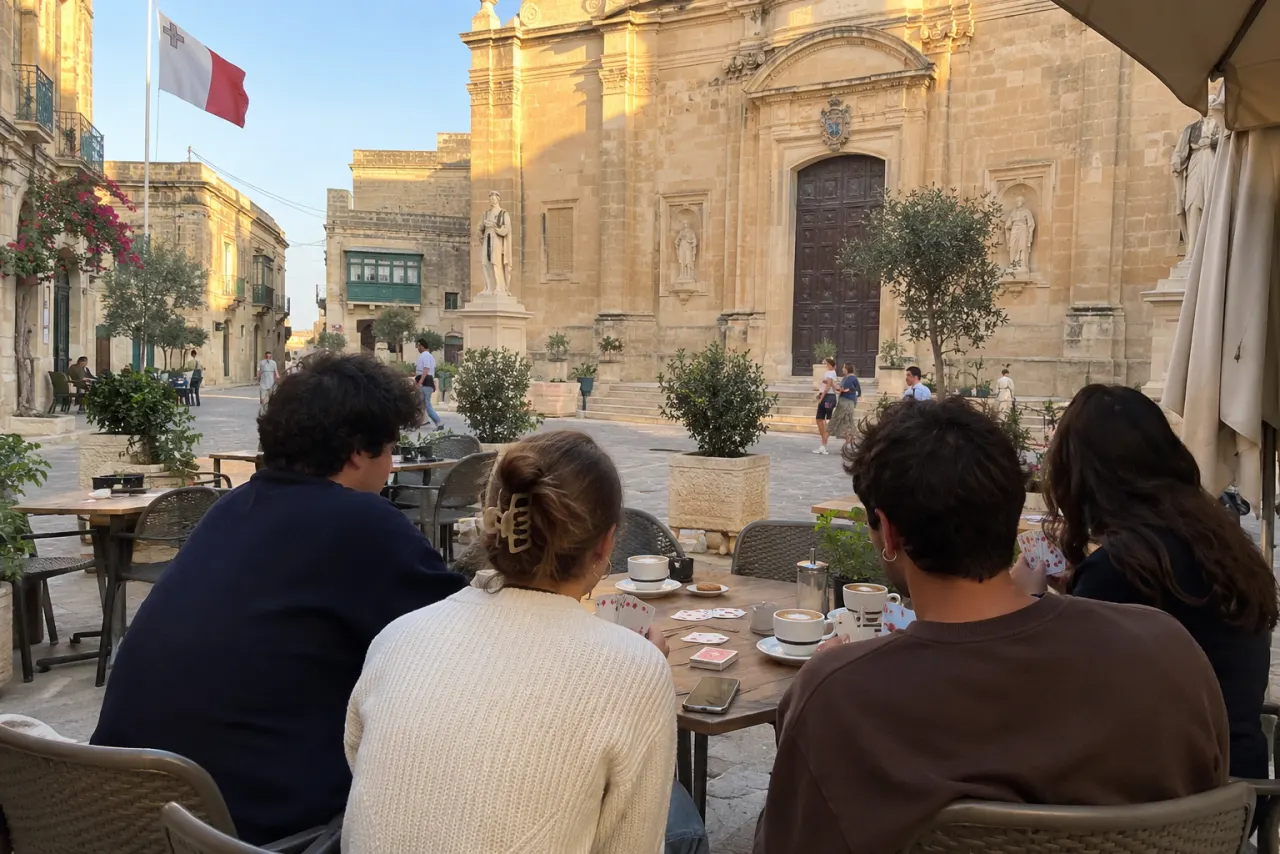
| Board or card games at a café | 4 to 6 | The price of a drink | Winter evenings, small spaces |
| Shared dinner or potluck | 4 to 8 | Pay your own, or one dish each | People who like food and a slower pace |
| Language table | 4 to 8 | The price of a drink | Students, newcomers learning Maltese or practising English |
| Coffee and laptop morning | 3 to 5 | The price of a coffee | Remote workers who miss colleagues |
| Sunday swim or beach morning | 3 to 8 | Free | Warm months, early risers |
Costs depend on the venue and what you order. Check prices at the place before you announce it.
If you are unsure, start with a walk. It needs no booking, no table and no money, and a small group in the open is the easiest setting for people who find big rooms tiring. Our guide to spending weekends alone in Malta has ideas for where to walk.
Choose a place, a day and a size
The place
Choose somewhere public, easy to find and reachable by bus. A promenade bench, a garden gate, a café with outdoor seating, a well-known square. Avoid private homes until you know people. Pick a meeting point that is specific enough to find (“by the main gate”, “outside the café with the green awnings”) and have a plan B for rain. If you are meeting at a café or restaurant, check that it is open at that time and that they are happy with a table for your group size, especially in summer and in the busy weeks before Christmas.
The day and time
Use a fixed slot so people can plan around it: “every second Thursday at 19:00” works better than “whenever”. Weekday evenings suit people with jobs; Saturday and Sunday mornings suit walks and swims. Malta’s sunset is early in winter and late in summer, so move outdoor plans earlier in the day from November to February.
The size
Four to eight people is the sweet spot. With fewer than four, one cancellation can sink the evening. With more than eight, the group splits into two conversations and the quieter people drop out. Invite six to get four. Most people who say yes will not come, especially in the first two weeks.
A week-by-week plan with costs
This plan assumes a weekly walk or a games evening. Change the activity, keep the shape. Costs are per person and assume everyone pays their own.
| Week | Action | Where | Cost (EUR) |
|---|---|---|---|
| Before week 1 | Decide format, day and time; pick two possible places; write your first message | At home | €0 |
| Week 1 | Invite six people you have already met once (colleagues, classmates, neighbours, people from a class) | Messaging apps, in person at work or school | €0 |
| Week 2 | Host the first meetup; keep it to 90 minutes; end by fixing the next date | Your chosen public place | Price of a drink or free |
| Week 3 | Same day, same time, same place. Message everyone the day before. Add one new person each | Same place | Price of a drink or free |
| Week 4 | Ask what people enjoyed; let someone else pick the place or the game; start a group chat if there is not one | Same area, new spot | Price of a drink or free |
| Week 5 onwards | Repeat. Every fourth week, invite a new person from outside the group | Rotate | Varies |
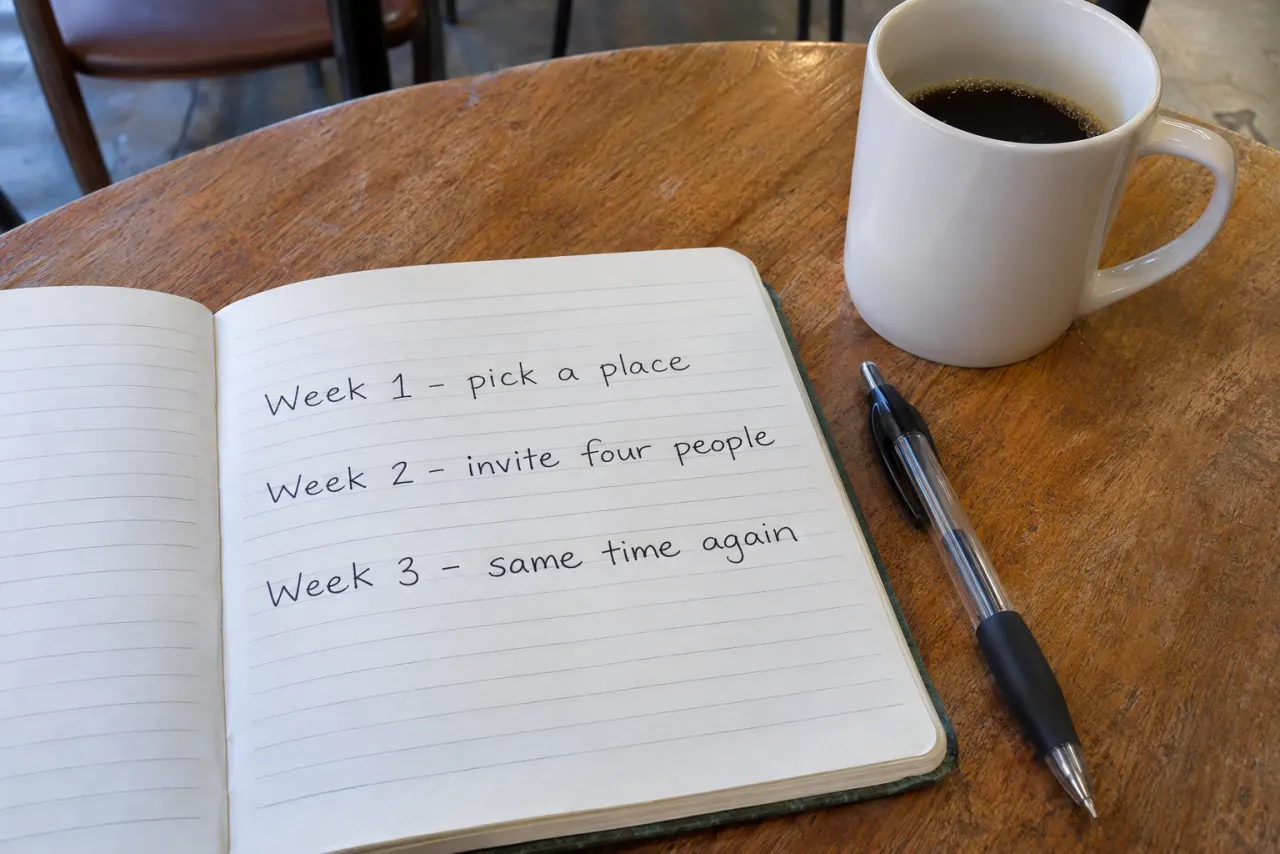
The only real work happens in week 1 and week 3. In week 1 you overcome inertia. In week 3 you prove the group is a habit and not a one-off, and that is the moment most groups quietly die. Plan your week 3 message before you host week 2.
Copy-paste messages for the first invitation
The first message decides whether anyone shows up. Make it specific: a day, a time, a place, an activity and who pays. Replace the details and send.
To a colleague or classmate: “I’m starting a small walk on Saturday mornings. First one is this Saturday at 09:00, meeting by the Sliema ferry stop, about 90 minutes at an easy pace, coffee after if you want one. Everyone pays their own. Want to come?”
To a neighbour: “We’ve said hello a few times and I’d like to do something regular with a few people from the block. Games evening at the café on the corner this Thursday at 19:30, four or five of us, pay your own. Would you like to join?”
To someone you met once at a class or event: “It was good talking to you on Tuesday. I’m putting together a small dinner on the 12th, six people, everyone brings one dish to my place in Gżira. Bring a drink if you like. Interested?”
To a group chat: “I’m trying a weekly language table: 30 minutes in English, 30 in anything else. Wednesdays at 18:30 at the café by the bus terminus. Free to join, buy your own coffee. Reply with a thumbs up if you’re in and I’ll send the pin.”
To the whole group after week one: “Thanks for coming. Same time next week, same place. Reply yes or no by Wednesday so I know whether to book a bigger table. Bring one person you think would enjoy it.”
Two tips. First, always ask for a yes or no and a deadline. “Let me know” gets silence; “reply by Wednesday” gets replies. Second, send a reminder the day before. People are not ignoring you when they forget; they are busy.
Who pays: say it every time
Money is the quiet reason many invitations get declined. If people are unsure whether they are guests or customers, they stay home. Put one of these in every invitation:
- Pay your own: the default for cafés, restaurants and anything with a bill. Say it plainly.
- Host pays: if you invite people to your home and cook, say so. Guests still bring something small, such as a drink or a dessert.
- Split: for a shared meal, agree before you order that the bill is divided evenly, or by item. Do not leave it to the end.
- Free: for walks, swims and anything outdoors, “free, bring water” is a complete answer.
If you are hosting at a café or restaurant, check that it is happy to run separate bills or to take one payment before you announce the plan. A table that argues over the bill rarely returns.
Running the first meetup
You do not need to entertain anyone. Your job is to start things and finish them well.
- Arrive 15 minutes early. Standing alone waiting is much easier when you are the one who chose the spot.
- Greet each person by name and introduce them to someone else in the first five minutes. “This is Marta, she also just moved from Poland” does half the work.
- Use the activity. Walking, a game or a menu gives people something to talk about besides themselves.
- Ask open questions that help you plan the next one: “What would you like to do next time?”
- End on time and name the next date before anyone leaves. A meetup that ends with “see you same time next week” survives; one that ends with “we should do this again” does not.
If only two people come, hold the meetup anyway. Two people who turn up become the core of a group, and they will tell you what to change. Many strong groups started that way.
Keeping it going after week three
Weeks one and two run on enthusiasm. Week three onwards runs on routine. A few habits help the group outlast the first month:
- Keep the time and place the same. Familiarity beats variety. People should not have to read a message to know where to be.
- Share the organising. By week four, ask someone to choose the place or lead the next walk. People who contribute feel the group belongs to them.
- Recruit one new person a month. Expats leave. Every group needs a trickle of new people to replace the ones who move on or drift away.
- Do not take no-shows personally. A group of six will often be four on the day. Plan for it.
- Let the group evolve. A walking group may drift into a Sunday brunch club. That is fine if the people are still turning up.
- Know when to pause. Over the summer many people travel. Announce a break and a restart date rather than letting the group fade.
Once you have a regular core of three or four people, think about how the group fits into the rest of your week. Our 90-day plan for a social life in Malta shows how to combine a group you run with one you simply attend, which spreads the load and widens your circle.
Posting your first plan on MeetNow
If you would rather not chase people through a dozen separate chats, MeetNow is built for exactly this step. It is a free app for meeting people in person, live on the web and starting in Malta. You post a plan at a real public place, set the date, time and number of seats, and say who pays: host pays, split, pay your own or free. People in Malta ask to join with a short note, you pick who comes, and the people you accept get a group chat. It is plans, not profiles, so the plan does the talking. The host sees who is asking and how they have shown up before, and anyone can report or block another user.
For a first group this removes the hardest part: finding the first four strangers. Write the plan the way you would write the messages above, with the place, the time, the seats and the money, and let people respond to something concrete.
When it does not work, and staying safe
Some groups will not take off, and that tells you something about the format, the time or the place, not about you. If nobody turns up twice, change one thing: the day, the activity or the area. If it still does not work after two attempts, join an existing group for a while and try again later. Our guide to making friends in Malta has other routes in.
Safety when you meet new people
- Meet in a public place for the first few meetings.
- Tell a friend or flatmate where you are going and when you expect to be home.
- Keep your own way home: check the last bus or have a ride-hailing app ready.
- Do not share your home address with people you have just met.
- Leave whenever you feel uncomfortable. You do not owe anyone an explanation.
If your group grows and you want a more formal structure, such as a name, a bank account or fundraising, the Commissioner for Voluntary Organisations explains how an association can enrol on its official website. For a group of friends who meet over coffee, none of that is needed.
Want to turn this into an actual plan? Open MeetNow (it runs in your browser, no download needed). Plans start in Malta: join one or post your own.
Frequently asked questions (FAQ)
How many people do I need to start a social group in Malta?
Two is enough to start and four to eight is the ideal size. Invite about six people to get four on the day, because many people who say yes will not come, especially at the beginning.
Where can I host a group meetup in Malta?
Choose a public place that is easy to reach by bus: a promenade, a garden, a café with space for a group or a well-known square. Avoid private homes until you know people, and always have a plan B for rain.
Who pays when I organise a meetup?
Whoever you say. The simplest options are pay your own, host pays, split the bill or free. Put your choice in the invitation so people know what to expect.
How often should the group meet?
Weekly or every second week. A fixed day and time matters more than the frequency, because people can plan around it and begin to see the group as a habit.
What if nobody replies to my invitation?
Make the message more specific: a day, a time, a place, an activity and who pays. Ask for a yes or no by a deadline and invite people you have already met at least once. A cold invitation to strangers is the hardest to answer.
Do I need to register my group in Malta?
Not for an informal group of friends meeting over coffee or a walk. If you later want a formal association, check the Commissioner for Voluntary Organisations’ website for how enrolment works.