Short answer: the Maltese phrases for beginners worth learning first are the ones you can use every day: bonġu (good morning), grazzi (thank you), jekk jogħġbok (please), kif inti? (how are you?) and saħħa (bye, or cheers).
Almost everyone in Malta speaks English, so you do not need Maltese to get by. You learn these phrases because a newcomer who greets the bus driver, the pastizzeria owner and the neighbours in Maltese gets a different, warmer reaction, and that is often how a polite exchange turns into a conversation. Below are more than 60 phrases grouped by situation, with simple pronunciation and the situations where they actually come up.
I learned my first Maltese words at a bus stop in Msida, from an older woman who wanted to know why the bus was late and was delighted that I could at least answer ma nafx (I don’t know). That is the realistic goal for your first months: not fluency, but enough phrases to show you are making an effort. If you want to go further, our guide to learning Maltese as an expat compares courses, apps and classes. This page is the phrasebook.
Maltese phrases for beginners: pronunciation in five minutes
Maltese is written in the Latin alphabet with 30 letters, and spelling is very regular: once you know the handful of special letters, you can read almost any word aloud. The language has Semitic roots with a large Italian and English vocabulary, so words like skola (school), karozza (car) and biljett (ticket) will look familiar.
| Letter | Sounds like | Example |
|---|---|---|
| ċ | “ch” in church | ċaw (bye) |
| ġ | “j” in jump | bonġu (good morning) |
| g | “g” in gone | grazzi (thank you) |
| ħ | a breathy “h” in hold | saħħa (bye, cheers) |
| h | usually silent | hawn (here), said “awn” |
| għ | usually silent, lengthens the vowel next to it | jogħġbok, said roughly “YOH-jbok” |
| q | a glottal stop, like the Cockney “tt” in bottle | triq (street) |
| x | “sh” in shore | ma nifhimx (I don’t understand) |
| j | “y” in yellow | jekk (if), said “yek” |
| z | “ts” in cats | grazzi, said “GRATS-ee” |
| ż | “z” in zero | skużi (excuse me) |
| ie | “ea” in mean | wieħed (one) |
Two tips make a bigger difference than perfect vowels. First, stress usually falls on the second-to-last syllable. Second, do not pronounce the għ or the h like an English “g” or “h”; in most words you simply skip them. The pronunciation guides below are approximations for English speakers; the Wikivoyage Maltese phrasebook uses the same spellings if you want a second reference.

Greetings and small talk
Greetings are where you will get the most mileage. A bonġu to the person who sells you bread every morning is noticed within a week.
| Maltese | Say it | English |
|---|---|---|
| Bonġu | BON-joo | Good morning (also a general daytime hello) |
| Bonswa | BON-swa | Good evening |
| Il-lejl it-tajjeb | il-LAYL it-TIE-yeb | Good night |
| Aw | OW | Hi (very informal, between friends) |
| Kif inti? | keef IN-tee | How are you? |
| Tajjeb, grazzi | TIE-yeb, GRATS-ee | Fine, thanks |
| X’jismek? | SHYIS-mek | What’s your name? |
| Jisimni … | yi-SIM-nee | My name is … |
| Għandi pjaċir | AHN-dee pya-CHEER | Nice to meet you |
| Saħħa | SAH-ha | Bye (it also means “health” and “cheers”) |
| Ċaw | CHOW | Bye (informal) |
You will also hear plain English “hello” and “bye” mixed into Maltese sentences all the time. Code-switching between the two languages is completely normal here, so do not worry about keeping your sentences “pure”.
Please, thank you and sorry
| Maltese | Say it | English |
|---|---|---|
| Jekk jogħġbok | yek YOH-jbok | Please |
| Grazzi | GRATS-ee | Thank you |
| Grazzi ħafna | GRATS-ee HAF-na | Thank you very much |
| Mhux problema | moosh pro-BLEH-ma | No problem / you’re welcome |
| Iva | EE-va | Yes |
| Le | leh | No |
| Skużi | SKOO-zee | Excuse me (to get attention) |
| Skużani | skoo-ZAH-nee | Excuse me / pardon me |
| Jiddispjaċini | yid-dis-pya-CHEE-nee | I’m sorry |
When you get stuck
These five phrases do two jobs: they rescue you when the conversation runs ahead of you, and they tell the other person you are learning, which almost always makes them kinder and slower.
| Maltese | Say it | English |
|---|---|---|
| Qed nitgħallem il-Malti | ed nit-AHL-lem il-MAL-tee | I’m learning Maltese |
| Ma nitkellimx bil-Malti tajjeb | ma nit-kel-LIMSH bil-MAL-tee TIE-yeb | I don’t speak Maltese well |
| Ma nifhimx | ma nif-IMSH | I don’t understand |
| Bil-mod, jekk jogħġbok | bil-MOD, yek YOH-jbok | Slowly, please |
| Titkellem bl-Ingliż? | tit-KEL-lem blin-GLEEZ | Do you speak English? |
In practice, the last one is almost never needed; English is an official language and nearly everyone you meet in shops, offices and on buses speaks it. Use it as a polite way to switch, not because you expect a “no”.
At the café and pastizzeria
The pastizzeria is the friendliest classroom on the island: short exchanges, the same staff every day and a menu you will quickly know by heart. Pastizzi come with two classic fillings, ricotta and mushy peas.
| Maltese | Say it | English |
|---|---|---|
| Kafè, jekk jogħġbok | ka-FEH, yek YOH-jbok | A coffee, please |
| Pastizz tal-irkotta | pas-TEETS tal-ir-KOT-ta | A ricotta pastizz |
| Pastizz tal-piżelli | pas-TEETS tal-pi-ZEL-lee | A pea pastizz |
| Ilma | IL-ma | Water |
| Kemm hu, jekk jogħġbok? | kem oo, yek YOH-jbok | How much is it, please? |
| Il-kont, jekk jogħġbok | il-KONT, yek YOH-jbok | The bill, please |
| Tajjeb ħafna! | TIE-yeb HAF-na | Very good! (a compliment to the cook) |
Plural is pastizzi: “żewġ pastizzi tal-irkotta” (zeh-OOJ pas-TEETS-ee tal-ir-KOT-ta) gets you two ricotta ones. Numbers are worth learning early for exactly this reason; wieħed (one), tnejn (two) and tlieta (three) cover most orders. (Żewġ is the form of “two” used directly in front of a noun.)

On the bus
Bus drivers deal with tourists all day and usually answer in English, but a Maltese question is a nice surprise. If you are still working out the network, our guide to Malta bus routes for newcomers covers routes and cards.
| Maltese | Say it | English |
|---|---|---|
| Din tieqaf …? | din TEE-af … | Does this (bus) stop in …? |
| Għal fejn hi din? | al FAYN ee din | Where does this one go? |
| Biljett wieħed għal …, jekk jogħġbok | bil-YET WEE-hed al …, yek YOH-jbok | One ticket to …, please |
| Kif nasal sa …? | keef NA-sal sa … | How do I get to …? |
| Fejn hi l-fermata? | FAYN ee il-fer-MA-ta | Where is the bus stop? |
| Nieżel hawn | NEE-zel awn | I’m getting off here |
In shops and at the market
| Maltese | Say it | English |
|---|---|---|
| Kemm jiswa? | kem YEES-wa | How much does it cost? |
| Għandek …? | AHN-dek … | Do you have …? |
| Dan, jekk jogħġbok | dan, yek YOH-jbok | This one, please |
| Ftit | fteet | A little |
| Iktar | IK-tar | More |
| Ħobż | hopps | Bread |
At the Sunday fish market in Marsaxlokk or your local vegetable van, prices are usually said in English or in Maltese numbers. Do not panic if you only catch half; ask “kemm?” again, or simply look at the scale.
With your neighbours
Neighbours are the most underrated source of local friends. In apartment blocks and village streets alike, a few weeks of consistent greetings is usually all it takes before someone asks where you are from.
| Maltese | Say it | English |
|---|---|---|
| Jien il-ġar il-ġdid / il-ġara l-ġdida | yeen il-JAR il-JDEED / il-JA-ra il-JDEE-da | I’m the new neighbour (man / woman) |
| Il-ġurnata t-tajba | il-joor-NA-ta it-TIE-ba | Have a good day |
| Grazzi tal-għajnuna | GRATS-ee tal-ay-NOO-na | Thanks for the help |
| Narawk | na-ROWK | See you |
| Narawk għada | na-ROWK AH-da | See you tomorrow |
| Ma nafx | ma NAFSH | I don’t know |
At the village festa
Summer festas are the best place to hear Maltese spoken loudly and happily. Our guide to meeting Maltese people beyond the expat bubble explains how volunteering for festa preparations opens doors; these phrases help once you are there.
| Maltese | Say it | English |
|---|---|---|
| Il-festa t-tajba! | il-FES-ta it-TIE-ba | Happy feast! (said to locals during their festa) |
| Evviva! | ev-VEE-va | Hooray! / long live! (shouted for the patron saint and the band) |
| Prosit! | PRO-sit | Well done! (to the band, the cook, the fireworks team) |
| Meta hu n-nar? | MEH-ta oo in-NAR | When are the fireworks? |
Christmas and New Year greetings
From early December you will see and hear these everywhere, from shop windows to office emails.
| Maltese | Say it | English |
|---|---|---|
| Il-Milied it-Tajjeb | il-mee-LEED it-TIE-yeb | Merry Christmas |
| Is-Sena t-Tajba | is-SEH-na it-TIE-ba | Happy New Year |
| Awguri! | ow-GOO-ree | Best wishes! / congratulations! (birthdays, weddings, new jobs) |
Maltese phrases for making friends
Here is the part most phrasebooks skip: the phrases you need to turn a familiar face into an actual plan. Inviting someone in their language, even clumsily, is memorable. Being clear about who pays avoids the awkward moment when the bill arrives.
| Maltese | Say it | English |
|---|---|---|
| Nixorbu kafè flimkien? | ni-SHOR-boo ka-FEH flim-KEEN | Shall we have a coffee together? |
| Għandek ħin is-Sibt? | AHN-dek HEEN is-SIBT | Are you free on Saturday? |
| Inħallas jien | in-HAL-las YEEN | I’ll pay |
| Naqsmu l-kont? | NAS-moo il-KONT | Shall we split the bill? |
| Kulħadd iħallas tiegħu | kool-HAT ee-HAL-las TEE-oo | Everyone pays for their own |
| Saħħa! | SAH-ha | Cheers! (when you raise a glass) |
Counting every row from the greetings table to this one gives you 63 phrases in total. You do not need all of them in your first month; the plan further down picks the order.
When people switch to English (and mistakes to avoid)
Almost every learner goes through the same moment: you say your carefully rehearsed sentence, and the reply comes back in perfect English. It is not a rejection. People switch because they want to help, because they hear your accent and assume you will be more comfortable, or simply because English is a normal part of their day. The culture shock most newcomers notice in Malta includes exactly this bilingual back-and-forth.
A few things help you keep the Maltese going, and avoid the usual mistakes:
- Say you are learning. “Qed nitgħallem il-Malti” is an invitation for the other person to slow down and stay in Maltese for a sentence or two.
- Do not force it at busy moments. A packed bus or a queue at the pharmacy is not the place for practice. The quiet bakery mid-morning is.
- Do not pronounce “għ” and “h” as English letters. It is the single most common beginner giveaway.
- Do not copy slang you are unsure of. Some popular expressions are rude or strongly informal. Stick to standard phrases until a Maltese friend explains the rest.
- Do not expect one variety. Pronunciation varies between villages and between Malta and Gozo. If something sounds different from this page, the local version wins.
- Accept the English reply gracefully. Answer in English, then end with a grazzi, saħħa. You still made the effort, and people remember it.
A first 30 days phrase plan
Learning phrases works best when each week is attached to real situations you already have. This plan pairs a small set of phrases with one social step, so the language and the social life grow together.
| Days | Phrases to use | Social step |
|---|---|---|
| 1–7 | Bonġu, bonswa, grazzi, jekk jogħġbok, saħħa | Greet the same café, bakery and bus driver every day |
| 8–14 | Kif inti?, tajjeb grazzi, jisimni …, għandi pjaċir | Introduce yourself to two neighbours |
| 15–21 | Café and shop phrases, numbers one to ten | Order fully in Maltese at your regular place |
| 22–30 | Nixorbu kafè flimkien?, naqsmu l-kont?, narawk | Invite one person you now see often for a coffee |
Checklist for your first month:
- One regular café or pastizzeria where the staff know your face.
- Two neighbours whose names you know.
- One weekly activity (a class, a walk, a club) with the same people.
- One coffee or lunch invitation sent, in Maltese or English.
- One list on your phone of new words people taught you.
For a broader version of this plan, including expat groups and weekly activities, see our 30-day plan for making friends in Malta.
Using your Maltese on first meet-ups
Your phrases are most useful when you are meeting someone new: a coursemate, a colleague’s friend or someone from a hiking group. Starting with “Bonġu! Jisimni …” and admitting that it is about half of your Maltese is a good icebreaker; most Maltese people will happily teach you two more words on the spot, and you now have something to talk about.
Some small habits make first meet-ups easier:
- Agree on the money upfront. “I’ll pay”, “let’s split” or “everyone pays their own” said before ordering is better than an awkward silence over the bill.
- Keep it short and specific. A coffee in Valletta on Saturday morning is easier to say yes to than “let’s hang out sometime”.
- Meet in public. A café, a promenade or a busy square. Tell a friend where you are going, plan your own way home and leave if you feel uncomfortable.
- Follow up. A message the next day with “grazzi, narawk!” is a natural way to suggest a second meeting.
For the day-to-day side of settling in, from rent to routines, our overview of everyday expat life in Malta fills in the rest.
Want to turn this into an actual plan? MeetNow is a free app for meeting people in person: a host posts a plan at a public place, says who pays (host pays, split, pay your own or free) and picks who joins. It is live on the web, starting in Malta, so it works in your browser: open MeetNow and see the plans posted in Malta.
Frequently asked questions (FAQ)
Do I need to learn Maltese to live in Malta?
No. Maltese and English are both official languages, and English is used in government, business and most workplaces. Learning a few phrases is about goodwill and connection, not necessity.
What is the most useful Maltese phrase for beginners?
Grazzi (thank you) and bonġu (good morning) are the two you will use most. Add jekk jogħġbok (please) and saħħa (bye, cheers) and you can handle most small daily exchanges politely.
How do you say hello in Maltese?
Most people say bonġu in the morning and bonswa in the evening. Between friends you will hear the informal aw, and plain English “hello” or “hi” is also very common.
Is Maltese hard to pronounce?
Less than it looks. Spelling is regular, so once you learn the special letters (ċ, ġ, ħ, għ, q, x, ż) you can read words aloud. The glottal stop for q and the silent għ take a little practice.
Why do Maltese people answer me in English?
Usually to be helpful. Most people are bilingual and switch automatically when they hear an accent. Saying “qed nitgħallem il-Malti” (I’m learning Maltese) often encourages them to keep going in Maltese.
How do you say Merry Christmas in Maltese?
Il-Milied it-Tajjeb means Merry Christmas, and Is-Sena t-Tajba means Happy New Year. Both are widely used from early December.
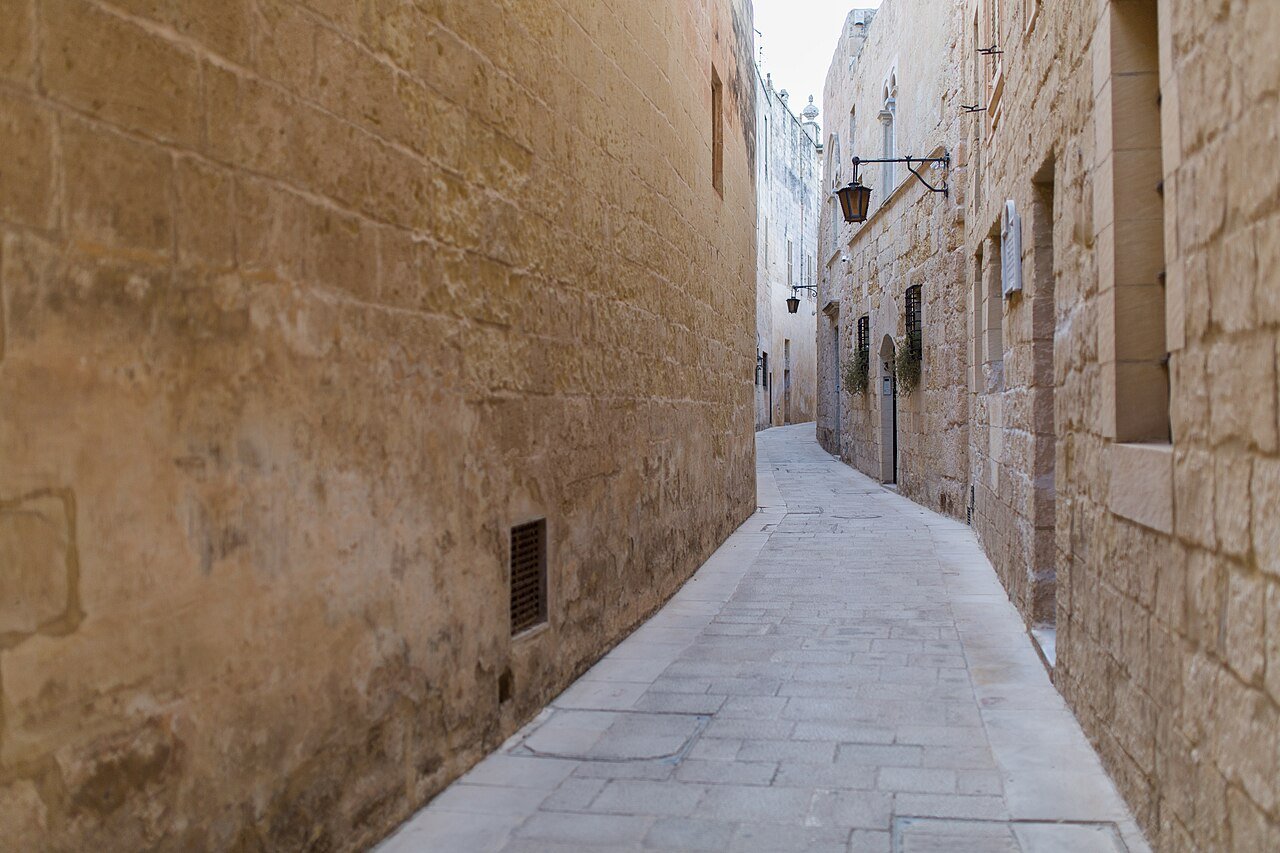
Featured photo: A street in Mdina, by Sebastiaan ter Burg from Utrecht, The Netherlands, CC BY 2.0, via Wikimedia Commons.