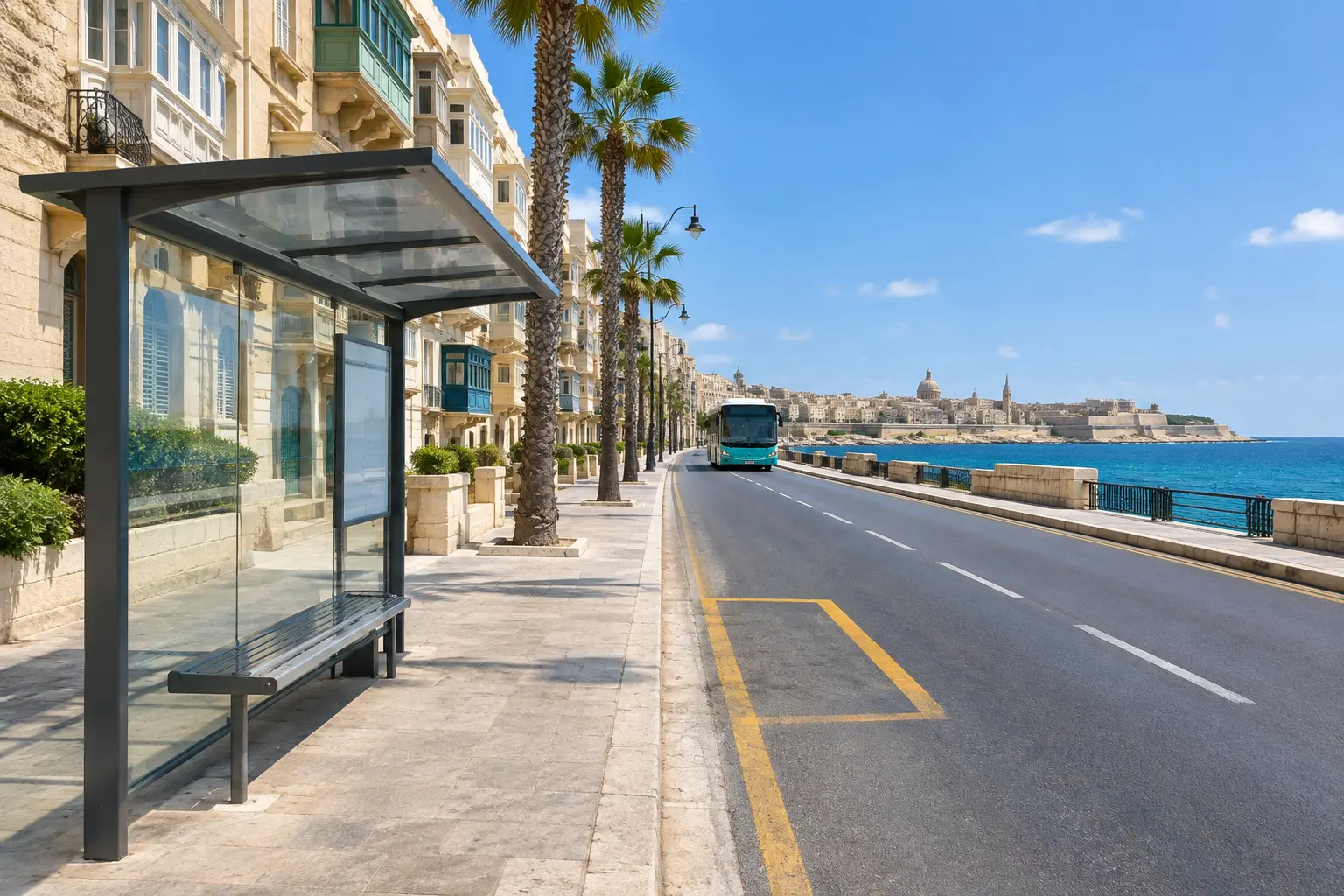
Short answer: Malta’s buses are run by Malta Public Transport, and most of the network fans out from the Valletta terminus, with a second hub at Sliema Ferries. For daily life you only need a handful of routes: 13, 15 and 21 between Valletta and Sliema; 13A and 16 towards St Julian’s and Swieqi; 41, 42 and 222 to Ċirkewwa for the Gozo ferry; 45 and 48 to Buġibba; and the Airport Direct routes TD2, TD3 and TD4 to and from the airport. A single day-route fare is €2.50 in summer and €2.00 in winter, valid for two hours, and residents with a personalised tallinja card ride most routes free. Below: how to plan a trip, the key routes in one table, fares, the airport, night buses and the mistakes newcomers make.
I have ridden these buses for years, through the summer crowds and the quiet winter evenings. They are cheap, they go almost everywhere and they are the reason many of us never bother with a car. They are also slow in traffic and sometimes full. Knowing the core routes makes the difference.
How the network works
Think of it as a star with a few cross-lines. Most routes start or end at the Valletta terminus just outside the city gate. A second set starts at Sliema Ferries, on the Sliema seafront opposite Valletta. Other important terminals listed by Malta Public Transport are Buġibba, Ċirkewwa (for the Gozo ferry), the airport, Pembroke and the park-and-ride sites at Pembroke and Marsa, plus Victoria and Mġarr on Gozo.
Route types you will see on timetables:
- Day routes (plain numbers such as 13, 41, 212): the core network.
- Night routes (N, such as N13 or N212): late-evening and overnight services.
- tallinja Direct (TD, such as TD2 or TD13): faster services with fewer stops, including the Airport Direct buses. These are not covered by the free resident scheme.
- X routes (such as X300 and X1A): express or special-purpose services on specific timetables.
- Gozo routes (300s, such as 301 and 303 to the ferry at Mġarr, shown on signs as “Vapur”).
How to plan a bus trip in Malta, step by step
- Get the tallinja app. The official tallinja app has a journey planner, live bus tracking on a map and service alerts for detours. Google Maps also shows routes, but the official app picks up detours faster.
- Check the stop and direction. Stops have names and numbers. Make sure you are on the right side of the road: route names show both ends (for example “Valletta – Sliema” and “Sliema – Valletta”).
- Check the service alerts. Detours for construction and events are common. When I checked in October 2026 the official site listed detours on several routes around the Three Cities and on route 25.
- Signal the driver. Raise your arm clearly as the bus approaches. Buses do not always stop if nobody signals.
- Pay or tap. Tap your tallinja card on the reader, or pay the driver by contactless card or cash. Keep the ticket: a single fare covers two hours.
- Press the bell before your stop. Watch the screen or the app; drivers only stop when requested.
- Allow margin. In rush hour and summer, a 20-minute trip can take far longer. For anything that matters, leave early.

Key Malta bus routes for newcomers
These are the routes most newcomers use in their first months. Route names and ends are taken from the official routes and timetables list. Frequencies are approximate daytime gaps from the timetables I checked; they vary by day and season, so always check the app.
| Route | From – to | Useful for | Approx. daytime frequency |
|---|---|---|---|
| 13 | Valletta – Baħar iċ-Ċagħaq | Msida, Gżira, Sliema, St Julian’s coast | about every 20 min |
| 13A | Valletta – St Julian’s | Msida and on to St Julian’s | about every 12 min |
| 15 | Sliema – Valletta | Gżira, Ta’ Xbiex, Msida, Pietà | about every 30 min |
| 16 | Valletta – Swieqi | Swieqi residential area | about every 20 min |
| 21 | Valletta – Sliema | Msida, Gżira, Sliema | about every 20 min |
| 41 / 42 | Valletta – Ċirkewwa | The north and the Gozo ferry | about every 20 min each |
| 45 / 48 | Valletta – Buġibba | St Paul’s Bay, Buġibba, Qawra | 45 about every 30 min; 48 about every 12 min |
| 203 / 212 | Sliema – Buġibba | Coast-to-north without going via Valletta | 203 about every 30 min; 212 about every 20 min |
| 222 | Sliema – Ċirkewwa | Mellieħa and the Gozo ferry from Sliema | about every 20 min |
| 202 | Sliema – Rabat | Rabat and Mdina from the coast | about every 30 min |
| 51 / 52 | Valletta – Mtarfa / Dingli | Rabat, Mdina, Dingli Cliffs | about every 30 min |
| 122 | Valletta – Mater Dei | Mater Dei Hospital | check timetable |
| 88 | Valletta – Gudja – Airport | Airport on a regular day route | about every 20 min |
Source: Malta Public Transport route pages, last checked October 2026. Timetables change with summer and winter schedules.
Two practical notes. First, the Sliema routes (203, 212, 222, 225) start at Sliema Ferries, which saves you going into Valletta if you live on the coast. Second, if you are heading for the university, several routes serve Msida and Mater Dei Hospital, and route 150 runs between Valletta (Lascaris) and MCAST on weekdays.
Malta bus fares 2026
Fares are set by Malta Public Transport and change by season. Here is what the official fares and tickets page listed when I checked.
| Ticket | Price | What you get |
|---|---|---|
| Single journey, day routes (summer) | €2.50 | Valid 2 hours when paid by cash or contactless |
| Single journey, day routes (winter) | €2.00 | Valid 2 hours; the 2025–26 winter fare ran from 19 October 2025 to 13 June 2026 |
| Night routes, special services, tallinja Direct | €3.00 | Per journey |
| TD1 (Airport – Ċirkewwa) | €3.50 | Per journey |
| 12 Single Day Journeys | €19.00 | 12 trips on day routes, shareable, valid six months from first use |
| Explore Flex, 4 days | from €21.00 | Unlimited bus travel, not shareable |
| Explore Flex, 7 days | €27.00 | Unlimited bus travel, not shareable |
| Personalised tallinja card | €25 registration (adult) | Free travel on day and night routes for cardholders |
Last checked October 2026 on publictransport.com.mt. The official page had not yet published the start date of the 2026–27 winter fare when I checked; confirm it in the app before you rely on the €2.00 fare.
The tallinja card in one paragraph
If you live here, get a personalised tallinja card as soon as you can. According to Malta Public Transport, cardholders travel free on day routes, night routes and selected special services, on the Valletta ferries and on the Barrakka Lift. tallinja Direct routes (including the Airport Direct buses) and On Demand services are not included; you can top up the card for those. Registration costs €25 for adult, student and Gozo resident cards, and cards typically arrive within two weeks. A full guide to eligibility and applying is coming to this site shortly.

Airport buses: getting to Sliema, St Julian’s and Valletta
The airport is served by the Airport Direct buses, which leave from the bus terminal outside arrivals. Our Malta airport to Sliema guide walks through that trip step by step. They have luggage space, fewer stops and cost €3 per passenger (€3.50 on TD1), paid by cash or contactless on board. No booking is needed.
| Airport Direct route | Key stops | Frequency (official) |
|---|---|---|
| TD2 | St Julian’s, Pembroke | every 30 minutes |
| TD3 | St Julian’s, Sliema, Gżira, Msida | every 30 minutes |
| TD4 | Valletta, Gozo Fast Ferry | every 30 minutes |
| TD5 | Rabat, Buġibba | every 60 minutes |
| TD1 | Airport – Ċirkewwa | check timetable |
Last checked October 2026 on publictransport.com.mt.
So for “Malta airport to Sliema by bus”, take TD3; for “Malta airport to St Julian’s”, TD2 or TD3; for Valletta, TD4. If you hold a personalised tallinja card and want to ride free, regular day routes also serve the airport: route 88 to Valletta via Gudja, routes 117, 135, 208 and 218 to Mater Dei and the University area, and 201 and 214 to Rabat. They are slower but free with the card.
Which routes you will use, by area
Most newcomers end up using two or three routes almost every day. Here is a quick guide by where you live, based on the official route list.
Sliema and Gżira
Routes 13, 15 and 21 link the Sliema and Gżira seafront with Valletta via Msida. For the north, routes 203 and 212 run from Sliema Ferries to Buġibba, and 222 continues to Ċirkewwa for the Gozo ferry. For Rabat and Mdina, take 202 from Sliema. The free ferry to Valletta is often the quickest option of all.
St Julian’s, Paceville and Swieqi
Route 13A runs between Valletta and St Julian’s, 13 continues along the coast towards Baħar iċ-Ċagħaq, and 16 serves Swieqi. The airport is one Airport Direct ride away on TD2 or TD3.
Msida, the university and Mater Dei
Many Valletta routes pass through Msida, and route 122 runs between Valletta and Mater Dei Hospital. Students heading for MCAST can use route 150 from Valletta on weekdays.
St Paul’s Bay, Buġibba and Qawra
Routes 45 and 48 run to Valletta, and 203 and 212 run to Sliema. Expect longer journeys into the harbour area at rush hour, so build that into any plan.
Night buses (one paragraph)
Night routes carry an N prefix and cost €3 a journey for people without a personalised card. Examples on the official list include N13 between Valletta and St Julian’s, N212 between Sliema and Buġibba, N11 from St Julian’s to Ċirkewwa and N3 from Valletta to Kalkara. The timetables I checked showed departures from late evening into the early hours. For the full picture of getting home after a night out, our sister site maltasocial.com covers nightlife; here the advice is simple: check the last bus in the app before you go out, and have a ride-hailing app as a backup.
Common mistakes newcomers make
Avoid these
- Not flagging the bus. Stand where the driver can see you and raise your arm early.
- Forgetting to tap. With a tallinja card you still need to tap on every bus.
- Assuming the airport bus is free. Airport Direct (TD) routes are not part of the free resident scheme. Use route 88 or the other day routes if you want to travel free.
- Trusting old route numbers. Routes and airport services change from time to time, so older blog posts can list routes that no longer run the same way. Check the official app or website.
- Underestimating summer. Buses on coastal and beach routes fill up in July and August, and full buses sometimes pass stops. Start early or walk to the start of the route.
- Ignoring Sunday and holiday timetables. Frequencies differ at weekends; check before you set off.
Buses, ferries and the rest of your week
Buses connect neatly with the Valletta ferries: the ferry between Sliema and Valletta and the one to the Three Cities are free for personalised tallinja cardholders, and the crossing is often quicker than the road round the harbour. The Barrakka Lift links the Grand Harbour waterfront, where the Three Cities ferry lands, with the Upper Barrakka Gardens, and it is also free for cardholders.
Where you live shapes how much you depend on all this. If you are still choosing an area, our guide to moving to Malta step by step compares areas, rents and bus links. And once you know the routes, use them: a free bus ride to Dingli Cliffs or a swim in the north is one of the easiest weekend plans to suggest to new friends. Our 30-day plan for making friends in Malta has more ideas like that.

Frequently asked questions
How much is a bus ticket in Malta in 2026?
A single journey on day routes costs €2.50 in summer and €2.00 in winter, valid for two hours when paid by cash or contactless. Night routes and tallinja Direct cost €3.00, and TD1 costs €3.50 (official fares, checked October 2026).
Which bus goes from Malta airport to Sliema?
Airport Direct TD3 runs from the airport to St Julian’s, Sliema, Gżira and Msida, every 30 minutes according to Malta Public Transport. It costs €3 per passenger and you pay on board.
Which bus goes from the airport to St Julian’s?
Take Airport Direct TD2 (St Julian’s and Pembroke) or TD3 (St Julian’s, Sliema, Gżira and Msida). Both ran every 30 minutes when checked in October 2026.
Are buses free in Malta for residents?
Yes, on most of the network. Holders of a personalised tallinja card travel free on day routes, night routes, selected special services, the Valletta ferries and the Barrakka Lift. tallinja Direct routes, including the Airport Direct buses, are not included.
What is the best Malta bus app?
The official tallinja app from Malta Public Transport. It has a journey planner, live bus tracking and service alerts for detours, and you can manage travel offers on your tallinja card through it.
Do I need to flag down the bus in Malta?
Yes. Raise your arm as the bus approaches so the driver knows to stop, and press the bell before your own stop.
Want to turn this into an actual plan? MeetNow is a free app for meeting people in person: a host posts a plan at a public place, says who pays (host pays, split, pay your own or free) and picks who joins. It works in your browser and on Android through Google Play, starting in Malta; the iPhone app is not in the App Store yet. Open MeetNow and see the plans in Valletta, Sliema and St Julian’s.
We may mention products we are connected with; see our affiliate and product disclosure.