A masters degree in Malta for international students is a realistic, mid-priced option in 2026: the University of Malta (UM) teaches in English, most master’s programmes run one to two years, and the non-EU fee for many courses sits around €10,800 for the whole programme rather than per year.
The catch is timing and paperwork. If you need a visa, UM’s deadline for the October 2027 intake is 1 July 2027, and you will be budgeting roughly €1,360 to €2,530 a month to live here. This guide walks through where to study, what it costs, how the deadlines work, how to budget, and how to build a life outside the lecture room once you arrive.
I have watched a lot of postgraduate students land in Msida in late September with a laptop, an offer letter and no idea how the island works. The ones who settle fastest are the ones who sorted three things early: the fee, the visa timeline and where they would live. Everything else can be fixed once you are here.
Where to do a master’s degree in Malta
For most international students the answer is the University of Malta. It is the island’s main public university, its largest campus is at Msida (with smaller sites elsewhere, including Valletta and Gozo), and it runs the widest range of postgraduate programmes, from law and public policy to engineering, ICT, health sciences, education and the humanities. If you want the overview of undergraduate life, campus services and fees for every level, read our guide for University of Malta international students first; this article focuses on postgraduate study only.
The second public option is MCAST, the Malta College of Arts, Science and Technology. It is mainly a vocational and applied college, and its offer at master’s level is smaller and more professionally focused than UM’s. If you are weighing an applied route, our guide to MCAST for international students explains how its courses and campus work.
Beyond those two, Malta has a number of private higher education institutions, several of them branches or partners of foreign universities, offering MBAs and business, IT and health-related master’s degrees. Quality varies a lot. Before you pay a deposit anywhere, check that both the institution and the specific programme appear on the register of the Malta Further and Higher Education Authority (MFHEA), the national regulator. A licensed institution with an unaccredited programme is not the same as an accredited degree, and immigration and employers will look at the programme, not the logo.

Questions to ask before you choose
- Is the programme full-time or part-time? Many UM master’s degrees are offered both ways, and part-time evening programmes are designed for people already working in Malta. A student visa generally needs a full-time course.
- How many ECTS credits and semesters? A 90 ECTS master’s typically takes three semesters full-time; 120 ECTS usually means two academic years.
- Does the course have an intake in October only, or in February too?
- Is it taught, by research, or a mix? This changes how you apply and when you can start.
Taught master’s vs master’s by research
UM runs two broad types of master’s programme, and the difference matters for international students.
Taught master’s (often listed as “taught and research”) have a fixed curriculum of study units, assessed by exams and assignments, followed by a dissertation. They start with an intake, mostly in October, and you apply through the normal application window. This is the right choice if you want structure, a cohort of classmates who start with you, and a predictable finish date.
Master’s by research are built around a supervised research project. UM says most of them have multiple entry points during the year, so you can apply at any time, but you need a research proposal and, in practice, a willing supervisor in the department. They suit people who already know their topic, but they can feel isolated: there is no class that starts with you. If you go this way, plan your social life on purpose from week one (more on that below).
| Feature | Taught master’s | Master’s by research |
|---|---|---|
| Structure | Study units + dissertation | Supervised research project + thesis |
| Start dates | Fixed intake (mostly October, some February) | Multiple entry points for most programmes |
| Application extra | Course-specific requirements | Research proposal required |
| English test timing | By the published deadline | Before the course starts |
| Typical length (full-time) | 3–4 semesters | Often around 3 semesters |
| Who it suits | Career changers, people who want a cohort | People with a defined topic and supervisor |
Fees: masters degree in Malta for international students vs EU students
The single biggest difference in cost is your nationality. EU and EEA citizens (and some others treated the same way) pay much lower tuition than non-EU applicants, and some local and EU students pay nothing for particular full-time programmes. Non-EU and non-EEA students pay full fees.
Two details catch people out. First, UM quotes master’s tuition as a total for the programme, not per year. Second, the course page can show the whole amount due in year one. For example, the UM course page for the full-time Master of Arts in Humanities and Medical Sciences (2026/27 intake, 90 ECTS, three semesters, by research) lists total tuition for non-EU applicants of €10,800, all of it in year one and nothing in year two. Other programmes, especially in engineering and ICT, are higher: a UM Faculty of ICT student handbook for 2026/27 lists €13,400 for the full MSc in Telecommunications Engineering for non-EU applicants.
| Item | EU/EEA | Non-EU/non-EEA | Source |
|---|---|---|---|
| MA Humanities and Medical Sciences (full-time, by research, 90 ECTS) | Shown on the course page’s EU view | €10,800 total (all in year 1) | UM course page |
| MSc Telecommunications Engineering | See course page | €13,400 total | UM Faculty of ICT student handbook |
| Extension of studies (master’s) | €400 a year | €400 a year | UM fees and funding |
| PhD, for comparison (full-time, per year) | €600 | €11,000 | UM fees and funding |
| Bench fees (research programmes) | Set case by case for lab-heavy research | UM fees and funding | |
My advice: open the exact course page on UM’s course finder, switch between the EU and non-EU fee views, and screenshot the fee block with the date. Fees are set per academic year and intake, so a figure from a 2024/25 page is not a promise for 2027/28.
Scholarships, waivers and paying in instalments
This is where expectations need resetting. When I last checked in October 2026, UM’s own scholarships page stated plainly that there are currently no scholarships available at the university, and that new ones will be published on that page when they open. You will see older blog posts promising automatic 40–100% waivers for international research students; do not plan your budget around a waiver unless it appears in writing on um.edu.mt or in your offer.
What does exist, according to UM’s fees and funding page:
- Government of Malta scholarships for tertiary study, including doctoral level. Eligibility is set in each call, and many are aimed at Maltese or long-term residents, so read the criteria before you get excited.
- Funded studentships attached to research projects, advertised by research entities and departments. These are the most realistic route to a paid research master’s or PhD place.
- Fee exemptions, full or partial, which UM says can only be granted by the Ministry for Education and Sports, not by the university.
- Instalments for students whose scholarship or funding is paid later, if you tell the Finance Office in advance; each request is assessed case by case.
Your home country is often the better source of money: national scholarship agencies, employers and Erasmus+ mobility funding (for EU students on exchange) are all worth checking before you assume you will pay the full fee yourself.
Entry requirements and English tests
Each programme sets its own academic requirements, usually a relevant bachelor’s degree at a stated classification, sometimes plus work experience, a portfolio or an interview. UM treats each overseas application on its own merits and accepts qualifications that give access to recognised universities in your home country, if they are of a comparable standard. When you apply with a non-Maltese qualification, you choose the “Overseas Qualifications” option on the online application.
If you completed your schooling outside Malta, you also need a Secure English Language Test (SELT). UM’s published minimums for postgraduate and doctoral study are:
| Test | Minimum for postgraduate |
|---|---|
| Academic IELTS | 6.5 overall, at least 6.0 in writing, reading, listening and speaking |
| TOEFL iBT (pre-January 2026 scale) | 95 overall, 24 in writing |
| TOEFL iBT (January 2026 onwards scale) | 5 overall, 5 in writing |
| Pearson PTE Academic | 71, with at least 65 in each element |
| Cambridge | Advanced Certificate, overall grade C or better |
| Trinity ISE | ISE III, Merit in all skills |
IELTS, TOEFL and ISET results only count if issued within two years of your course start date. Some programmes, notably postgraduate courses in the Department of English, have their own higher requirements, and there is a separate exemptions page if your previous degree was taught in English. Check both on UM’s English language requirements page.
Application timeline and visa deadlines
UM’s academic year starts in October and online applications open around mid-November of the year before. For postgraduate programmes, the published deadlines for the next cycle are below. Note the earlier date for non-EU applicants who need a visa: miss it and you are effectively waiting another year.
| Intake | Applications open | General deadline | Non-EU applicants who need a visa |
|---|---|---|---|
| February 2027 | Around mid-November 2026 | 29 January 2027, 14:00 | Non-EU applicants living outside the EU cannot apply (not enough time for the visa) |
| October 2027 | Around mid-November 2026 | 21 July 2027, 14:00 | 1 July 2027, 14:00 |
| Master’s by research | Most have multiple entry points; apply any time with a research proposal | ||
Source: UM dates and deadlines. Medicine and dentistry have their own, earlier dates.
A realistic timeline for a non-EU student aiming at October 2027
- November–December 2026: shortlist programmes, check fees on the course pages, book your IELTS or TOEFL.
- January–March 2027: apply online with transcripts, degree certificate, passport copy, test result and anything the course asks for (CV, references, statement, research proposal).
- Spring 2027: receive your offer, pay the fee or deposit as instructed, and request the documents you need for the visa.
- Before 1 July 2027: have everything submitted to UM, including the English test result.
- Summer 2027: apply for the national student visa through the Maltese embassy, consulate or visa centre that covers your country; once in Malta you apply for a residence permit through Identità. Check the current document list on official pages, because it changes.
- Late September 2027: arrive, collect your residence card when issued, and register for orientation.
EU and EEA citizens do not need a visa, but they still register their residence after arrival. Our pillar on studying in Malta has the admin checklist for the first weeks.
Monthly budget and accommodation
UM’s International Office publishes a monthly cost guide and describes it as a more realistic figure than the minimum amounts needed as proof of funds for a visa or residence permit. Here it is, with my own notes.
| Item | Per month | Note |
|---|---|---|
| Shared accommodation | €550–€700 | Based on 2–3 people sharing an apartment |
| Single accommodation (residence or apartment) | €800–€1,600 | Studios near Msida and the harbour sit at the higher end |
| Food and drink | €450 | Groceries only; eating out is extra |
| Mobile and Wi-Fi | €30 | |
| Public transport | Free or fares | Free with a personalised tallinja card for most residents; Budget 2027 announced that third-country nationals resident for less than five years lose free travel, so non-EU students should check current fares |
| Laundry | €80–€100 | Less if your flat has a washing machine |
| Electricity and water | €50 | Basic rate; air conditioning in summer pushes it up |
| Other (toiletries, detergents, stationery) | €200–€300 | |
| Total | about €1,360–€2,530 | In a shared flat, plan on roughly €1,400–€1,700 |
Source: UM International Office, living costs. The total is my sum of UM’s ranges.
Where postgraduate students live
| Option | Rough monthly cost | Pros | Cons |
|---|---|---|---|
| Room in a shared flat (Msida, Gżira, San Ġwann, Swieqi) | €550–€700 (UM guide) | Cheapest, walkable or one bus to campus | Flatmate lottery, short-let landlords |
| Campus Hub residence next to the Msida campus | Within UM’s single range (€800–€1,600) | Zero commute, other students around you | Fills early; check current rates directly |
| Studio or one-bed flat | €800–€1,600 (UM guide) | Quiet for writing a dissertation | Expensive, can be isolating |
Our guide to student accommodation in Malta compares residences, homestays and flat-shares in more detail, including how to avoid deposit scams. If you plan to work alongside your studies, read the rules on part-time jobs for students in Malta before you count that income: the permit conditions for non-EU students are specific.

Social life: meeting coursemates outside class
Postgraduate life in Malta is different from undergraduate life. Many of your classmates will be Maltese professionals studying part-time in the evening, who leave straight after the lecture to collect children or get to work. Full-time international students are often a small group. That is great for networking and terrible for spontaneous friendship, unless somebody makes the first move.
What works, in my experience:
- Use the first two weeks. Orientation and welcome events organised by the university and the students’ council (KSU) are when everyone is open to meeting people. Go to all of them, even the awkward ones.
- Turn the cohort chat into one real plan. Most courses end up with a group chat. Instead of “we should meet up sometime”, suggest a specific thing: Friday coffee after the seminar at a café near campus, a Sunday swim at the Sliema rocks, a pastizzi run before the library. Say who pays: everyone pays their own is the easiest default with people you barely know.
- Join one society that is not about your subject. A sports club, a choir or a volunteering group gives you friends who are not also your deadline stress.
- Research students: build your own cohort. If you are on a master’s by research, find the other postgraduates in your department and propose a weekly writing session in the library followed by lunch.
- Look beyond campus. Malta is small; many international master’s students end up with friends from flat-shares, language exchanges and sports. Our guide to student life in Malta covers societies, ESN and cheap weekend ideas.
Keep first meetings in public places, tell someone where you are going, and do not feel obliged to stay longer than you want. The goal is not a perfect evening; it is a second coffee with the same people.
Want to turn this into an actual plan? MeetNow is a free app for meeting people in person: a host posts a plan at a public place, says who pays (host pays, split, pay your own or free) and picks who joins. It is live on the web, starting in Malta: open MeetNow and see the plans posted in Malta.
Frequently asked questions (FAQ)
How much does a master’s degree in Malta cost for international students?
For non-EU students, many UM master’s programmes in 2026/27 show a total fee of around €10,800 for the whole programme, while some engineering and ICT programmes are higher, for example €13,400. EU and EEA students pay much less. Always confirm the exact fee on the course page for your intake.
Are there scholarships for a master’s degree at the University of Malta?
When last checked in October 2026, UM’s scholarships page said no scholarships were currently available. Government of Malta schemes, funded research studentships and home-country scholarships are the realistic options, and fee exemptions can only be granted by the Ministry for Education and Sports.
When is the deadline to apply for a master’s in Malta?
For the October 2027 intake at UM, the general postgraduate deadline is 21 July 2027 at 14:00, but non-EU applicants who need a visa must apply by 1 July 2027 at 14:00. The February 2027 intake closes on 29 January 2027 and is not open to non-EU applicants living outside the EU.
What IELTS score do I need for a master’s at the University of Malta?
UM asks for Academic IELTS 6.5 overall with at least 6.0 in each component for postgraduate study, or an equivalent such as TOEFL iBT 95 (24 in writing) on the older scale or PTE Academic 71. Results must be issued within two years of your course start.
How long is a master’s degree in Malta?
Most full-time master’s programmes take three or four semesters, which is 90 or 120 ECTS. Part-time versions of the same programmes usually take longer and are mainly aimed at people already living and working in Malta.
Can I work in Malta while doing a master’s degree?
EU and EEA students can work freely. Non-EU students on a student residence permit can work only under specific conditions and limits, so check the current rules before relying on part-time income to pay fees or rent.
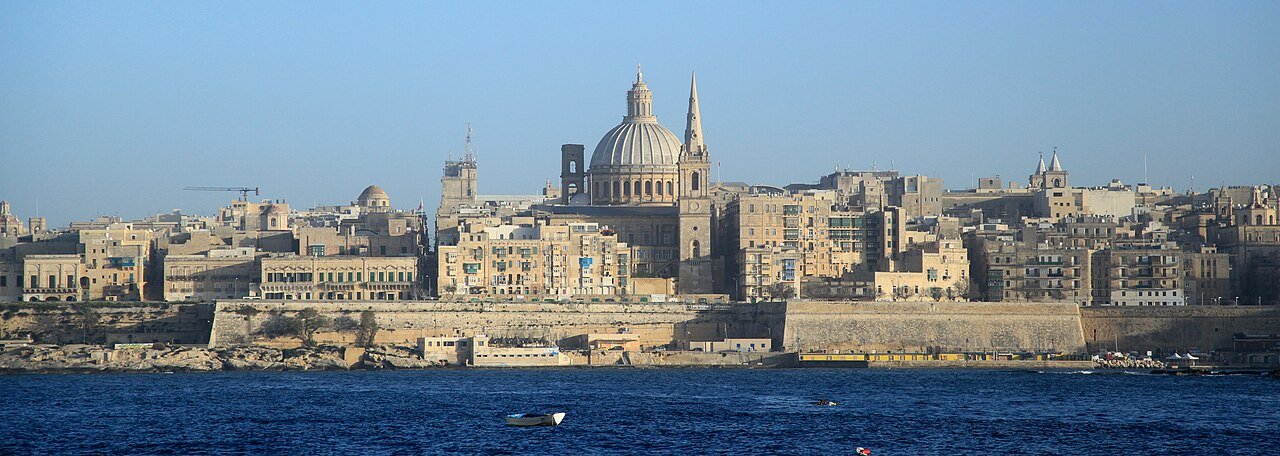
Featured photo: Valletta’s skyline seen across Marsamxett Harbour from Sliema, by Frank Vincentz, CC BY-SA 3.0, via Wikimedia Commons.