Short answer: for MCAST international students, the Malta College of Arts, Science and Technology offers vocational and professional programmes, from certificates to bachelor’s and master’s degrees, with strong links to industry. Its course pages state that no fees apply to Maltese and other EU nationals, while non-EU students pay fees set out in MCAST’s published fee structure, payable in instalments. Non-EU students on 3- or 4-year bachelor’s degrees can get their final year’s fees waived, and graduates who work and pay tax in Malta can apply for a 70% tuition refund through the Get Qualified scheme. The main campus is in Paola. Information last checked October 2026.
When friends’ children or younger colleagues ask me about studying in Malta, they almost always mean the University of Malta. MCAST is the option many people do not know about, and for practical, career-focused subjects it can be the better fit. Here is what international students should know.
MCAST at a glance
| What | Detail |
|---|---|
| What it is | Malta’s main vocational and professional college, with self-accrediting status from Malta’s national higher education commission |
| Levels | From foundation and certificate courses to bachelor’s and master’s degrees, aligned with the European Qualifications Framework |
| Main campus | Triq Kordin, Paola |
| Other campuses | Institute for the Creative Arts (Mosta), Gozo campus (Għajnsielem), Centre of Agriculture, Aquatics and Animal Sciences (Qormi) |
| EU students | No fees according to MCAST course pages |
| Non-EU students | Fees apply; instalments available; final-year fee exemption on 3- and 4-year bachelor’s degrees |
| Academic year | Main intake in October |
Sources: MCAST International Students page, fees and payments for non-EU candidates and course pages. Last checked October 2026.
Institutes and courses
MCAST’s Paola campus map lists institutes covering:
- Applied Sciences (with a dedicated centre for agriculture, aquatics and animal sciences in Qormi);
- Business Management and Commerce;
- Community Services (care, health and social fields);
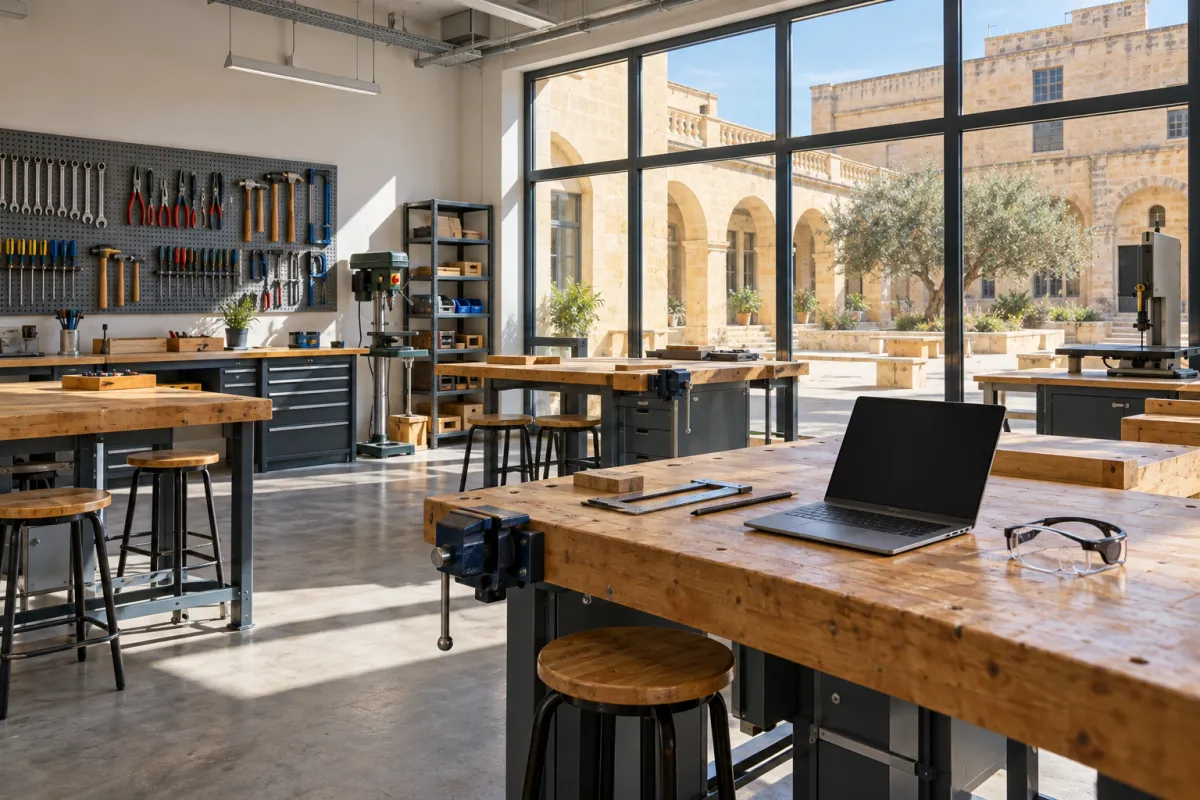
- Engineering and Transport, including electrical, mechanical, aviation, automotive, and building and construction;
- Information and Communication Technology;
- the Trades;
- and the Institute for the Creative Arts on its Mosta campus.
Programmes combine classroom learning with practical work, and many include work-based learning or placements with employers. MCAST also runs flexible study programmes with entry points through the year, alongside the main full-time intake. Browse the full course catalogue on MCAST’s website and check the language of instruction and entry requirements for each programme.

Fees, scholarships and the tax rebate
| Item | What MCAST says |
|---|---|
| EU students | No fees for Maltese and other EU nationals, based on their identity document |
| Non-EU students | Fees apply, per MCAST’s published full-time fee structure (the version linked in October 2026 was for 2024–2025) |
| Third-country nationals living in Malta | Fees also apply |
| Payment | Bank transfer, or card, local cheque or cash at the MG2I finance office on the Paola campus; instalment plans available |
| Scholarship | Final-year fee exemption for 3- or 4-year bachelor’s degrees (forfeited if you must add a year after failed resits) |
| Tax rebate | All students may apply for a 70% refund of tuition fees as a tax rebate after completing the course, if they pay tax in Malta and apply under the Get Qualified scheme |
Source: MCAST fees and payments page for non-EU candidates, checked October 2026. Third-party guides suggest non-EU fees in the region of several thousand euros a year, but ask MCAST’s international office for the current figure for your course.
Who MCAST suits
- Career changers who want a recognised, practical qualification in fields such as IT, engineering, business or care.
- School leavers who prefer hands-on learning to lecture-heavy degrees.
- People already living in Malta who want to upskill for local jobs; flexible programmes and part-time options help.
- Students aiming for industry rather than research, where placements and employer contacts matter.
It may suit you less if you want a traditional academic experience, a very large international student community or a degree in subjects MCAST does not teach, such as medicine or law. In that case the University of Malta is the better starting point. Many students also mix both over time: a vocational qualification at MCAST first, then a postgraduate route later. Whatever you choose, talk to current students on open days or through the college’s channels; their honest take on workload, placements and campus life is worth more than any brochure.
Applying and visas
- Choose a programme and check entry requirements and the start date.
- Apply online through MCAST’s portal. For the October 2026 intake, MCAST listed 30 June 2026 as the application deadline for international applicants.
- Receive your offer letter, which includes bank details for fees.
- Pay the first instalment if you need a student visa: MCAST issues the documents for the visa application after it receives this payment.
- Apply for your visa at least 75 days before the course starts, as MCAST advises. It warns it cannot accept late arrivals onto programmes.
- Arrange accommodation and health insurance, and plan your arrival before the academic year begins.
EU students do not need a visa but should register their residence with Identità if staying more than three months; our guide to studying in Malta covers the general steps for students.
Common mistakes MCAST applicants make
- Leaving the visa application too late: MCAST advises at least 75 days.
- Assuming fees are free because a friend from the EU paid nothing.
- Not checking whether a course includes placements, which affect your timetable and part-time work.
- Choosing accommodation far from Paola without checking the bus journey.
- Forgetting to keep records for the Get Qualified tax rebate after graduating.
Life on the Paola campus
The main campus at Kordin, Paola, is a large site with institute blocks, a resource centre and library, a cafeteria, gyms, a students’ house and youth hub, a childcare centre and a chaplaincy, according to MCAST’s campus map. Freshers’ events mark the start of the academic year. Paola itself is a residential town in the south of the harbour area, with its large parish basilica, shops and bus links to Valletta and beyond.

Where MCAST students live
Many international students rent rooms in shared flats. Areas close to Paola, such as Paola itself, Fgura, Tarxien and Ħamrun, can be cheaper than the northern harbour towns, while Sliema, Gżira and Msida offer more social life at a higher rent and a longer bus ride. The University of Malta’s planning estimate of €550 to €700 a month for a shared room in the harbour area is a useful upper guide. Whatever you choose, time the bus journey to Paola at 8:00 before you sign.
A monthly budget for an MCAST student
| Item | Monthly guide | Note |
|---|---|---|
| Room in a shared flat | €450 to €700 | Lower end in southern towns near Paola; upper end University of Malta harbour-area estimate |
| Food and drink | About €450 | University of Malta planning estimate |
| Bills, mobile and wifi | About €80 | University of Malta estimates |
| Transport | €0 | Free buses with a Student tallinja card |
| Course materials and tools | Varies | Higher for some practical courses; ask your institute |
| Total before fees | About €980 to €1,230 plus materials | Check against your own course and area |
Last checked October 2026. The lower rent figure is my planning range for areas near Paola, not an official statistic.
Practical courses sometimes need protective equipment, tools or software. Ask your institute for a kit list before term starts, and check whether second-hand items are allowed. For the full monthly picture across Malta, see our cost of living in Malta guide.
MCAST vs the University of Malta
| MCAST | University of Malta | |
|---|---|---|
| Focus | Vocational and professional, industry links, work-based learning | Academic degrees and research across many faculties |
| Main campus | Paola | Msida |
| EU fees | No fees according to course pages | Many full-time undergraduate courses fee-free; postgraduate fees vary |
| Non-EU fees | Per published fee structure; final-year exemption on bachelor’s | Set per course; €100 application fee for overseas qualifications |
| Best for | Hands-on careers: engineering, IT, business, care, creative trades | Academic paths, medicine, law, research |
For the university route, see our University of Malta guide for international students.
Working while you study
Non-EU students face limits on working hours tied to their permit, while EU students can work freely. Placements built into your course are separate from part-time jobs. Our guide to part-time jobs for students in Malta covers the 20-hour rule, pay and where to look.
Student life and making friends
MCAST’s student body is mostly Maltese, which is an advantage if you want local friends. Join the freshers’ events, use the students’ house and youth hub, and look for clubs linked to your institute. Outside college, our guide to student life in Malta covers weekly plans, cheap things to do and how international students build a circle. Small plans with classmates, such as a study session followed by pizza where everyone pays their own, are the easiest first step.
Making the most of your first term
Your first term sets the pattern for the rest of the course. Go to induction events, join any student clubs or activities your campus offers, and introduce yourself to classmates in your first week, especially those from Malta, who can explain how things work. Ask your lecturers how assessments are structured, keep track of deadlines from day one, and use student support services early if something is not working, whether it is housing, money or your course. International students who build a small routine quickly, with a regular study spot, a weekly activity and a few familiar faces, tend to settle much faster.
MCAST international students: FAQ
Is MCAST free for EU students?
MCAST’s course pages state that no fees apply to Maltese and other EU nationals, based on their identity document. Fees apply to other international applicants and to third-country nationals living in Malta.
How much does MCAST cost for non-EU students?
MCAST publishes a full-time fee structure for non-EU candidates on its fees page; the version linked in October 2026 was for 2024–2025. Fees can be paid in instalments, and students on 3- or 4-year bachelor’s degrees can benefit from a final-year fee exemption. Check the current fee structure with the international office.
Where is MCAST?
The main campus is on Triq Kordin in Paola. MCAST also has an Institute for the Creative Arts campus in Mosta, a Gozo campus in Għajnsielem and a Centre of Agriculture, Aquatics and Animal Sciences in Qormi.
When should non-EU students apply for a visa for MCAST?
MCAST advises applying for the student visa at least 75 days before the course starts, and requires the first instalment of tuition fees before issuing the documents needed for the visa. The college says it cannot accept late arrivals onto programmes.
What is the MCAST tax rebate for students?
MCAST says all students may apply for a 70% refund of tuition fees as a tax rebate after successfully completing their course, under the Get Qualified scheme, if they pay tax in Malta after graduating.
Is MCAST or the University of Malta better for international students?
It depends on your goals. MCAST focuses on vocational and professional programmes with strong industry links and work-based learning; the University of Malta is the traditional academic university with a broader range of degrees and research.
Want to turn this into an actual plan? MeetNow is a free app for meeting people in person: a host posts a plan at a public place, says who pays (host pays, split, pay your own or free) and picks who joins. It works in your browser and on Android through Google Play, starting in Malta; the iPhone app is not in the App Store yet. Open MeetNow and see the plans in Valletta, Sliema and St Julian’s.
Details from MCAST’s official pages, October 2026; fees, deadlines and requirements change, so confirm with MCAST’s international office. We may mention products we are connected with; see the affiliate and product disclosure page linked in the site footer.