Short answer: for University of Malta international students, the essentials in 2026 are these: you apply online and pay a €100 application processing fee if you hold overseas qualifications, tuition depends on your course and on whether you are an EU/EEA or non-EU citizen (UM lists it on each course page), most teaching is in English, and non-EU students need a study visa and residence permit. The main campus is in Msida, close to the harbour towns where most students rent. The University of Malta estimates €550 to €700 a month for a shared room and about €450 for food. Figures were last checked in October 2026.
I live a short walk from the Msida campus and have watched several intakes of international students arrive: excited in September, overwhelmed by paperwork in October, and settled by Christmas if they did a few things right. This guide is the practical version, from fees and permits to where people actually live and how they make friends.
The University of Malta at a glance
| Fact | Detail |
|---|---|
| Main campus | Msida, near the harbour towns of Gżira, Sliema and St Julian’s |
| Language of teaching | Mostly English |
| Academic year | Starts in October; KSU’s Freshers’ Week 2026 ran from 5 to 9 October |
| Application fee (overseas qualifications) | €100 before the first deadline; €200 for late applications |
| Tuition | Set per course, separately for EU/EEA and non-EU students |
| Student council | KSU (Kunsill Studenti Universitarji) |
Sources: University of Malta, fees and funding; KSU. Last checked October 2026.
Fees for University of Malta international students
Application fees
According to UM’s fees page, the application processing fee is €100 for applicants holding overseas qualifications until the first application deadline, and €200 for late applications to courses that still accept them. Applicants with local qualifications pay €35 (€75 late). Changing course after applying costs €25 to €45 depending on timing.
Tuition fees
UM does not publish one flat tuition fee. Instead, each course overview lists the fee for EU/EEA citizens and for non-EU/non-EEA citizens. Some practical rules of thumb:
- EU/EEA students: many full-time undergraduate courses carry no tuition fee, while most postgraduate courses charge one. Always check the specific course.
- Non-EU students: fees apply at every level and vary by subject, with science, health and technical courses generally costing more than arts-based ones. Third-party summaries published in 2026 put many non-EU bachelor’s degrees at roughly €8,000 to €11,000 a year, but treat the course page as the only figure that counts.
- Doctoral study: UM publishes a fixed annual fee: €11,000 full-time (€5,500 part-time) for non-EU students, and €600 full-time for EU/EEA students.
- Extensions: postgraduate students granted an extension pay €400 a year (Master’s) or €600 (doctoral).
UM’s fees are set by the University Fees Regulations (Subsidiary Legislation 327.177), and fee exemptions can only be granted by the Ministry for Education. If you rely on a scholarship that pays later, UM says you can ask the Finance Office in advance about paying in instalments.

Admission and English requirements
- Choose your course on UM’s website and read its entry requirements and fee section carefully.
- Check deadlines. UM publishes application dates each year; non-EU students should apply early to leave time for the visa.
- Prepare documents: certified qualifications, transcripts, passport, and translations where needed.
- Prove your English if required for your course. UM accepts recognised qualifications and runs its own International Student English Test.
- Apply online and pay the processing fee.
- Accept your offer and pay tuition by the date on your invoice.
UM also runs foundation studies for students who need a preparatory year before a degree. For a wider look at options, including English schools and vocational colleges, see our guide to studying in Malta. If a vocational route suits you better, read our guide for MCAST international students.
What studying at UM is like
International students often ask me what the teaching style is like. From what friends and neighbours studying there describe, expect:
- A mix of lectures and smaller seminars, with attendance taken more seriously on some courses than you might be used to.
- Continuous assessment plus exams: assignments, presentations and lab work through the semester, then exam sessions at the end of each semester.
- Classmates who know each other already. Many Maltese students went to school together, so friendship groups can look closed at first. Sitting with the same people every week and suggesting a study group usually breaks the ice.
- English as the working language, with Maltese sometimes heard in corridors and group chats. Ask classmates to switch to English in mixed groups; most will happily do so.
- Admin by email and online portals. Check your university email every day in the first weeks: timetable changes, registration steps and invoices all arrive there.
If your course has a placement or practical component, ask early how placements are arranged and whether any language requirement applies, especially in health, education and social work.
Visas and residence for non-EU students
EU, EEA and Swiss students can enrol and live in Malta under free-movement rules and register their residence with Identità once they arrive. Non-EU students generally need a study visa and a residence permit for courses longer than 90 days, applied for after acceptance through Identità. Expect to show your acceptance letter, proof of funds, accommodation and health insurance. Requirements change, so follow Identità’s current checklist rather than an older blog post, and start as soon as you have your offer letter.
Common mistakes international students make
- Assuming tuition is free because a friend from the EU paid nothing: non-EU fees are different, and postgraduate fees apply to most students.
- Applying late and leaving too little time for a visa.
- Signing a 12-month lease for a 9-month academic year without checking the break clause.
- Waiting until the second semester to join societies: Freshers’ Week is the easiest time.
- Budgeting for summer electricity at winter prices in a flat with air conditioning.
Life on the Msida campus
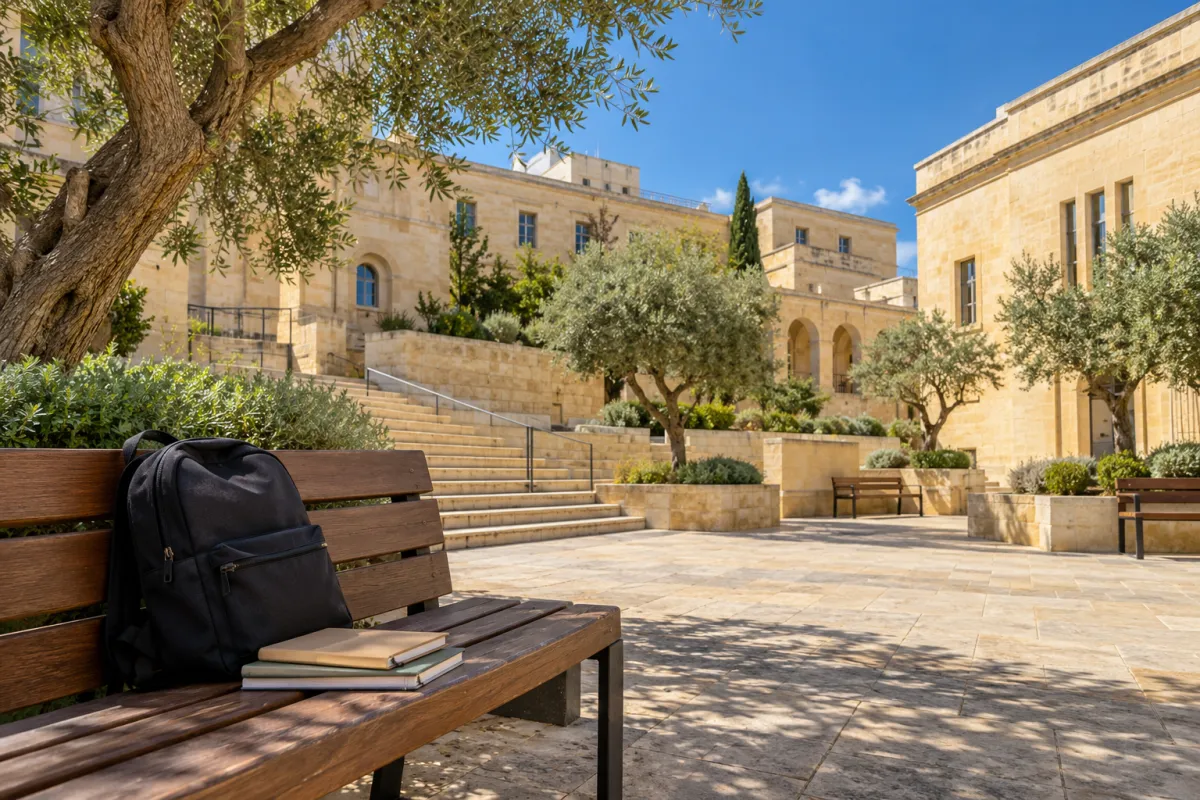
The Msida campus is busy on weekdays and quieter in the evenings, because many Maltese students live with their families and head home after lectures. For international students, that shapes social life: daytime is for lectures, libraries and coffee between classes; evenings tend to happen in Msida, Gżira, Sliema and St Julian’s.
What you will find on and around campus:
- KSU, the student council, which organises Freshers’ Week and supports student organisations.
- Faculty and interest societies, from academic groups to cultural, political, volunteering and sports organisations.
- Campus Hub, a newer development on the Msida campus with student residence buildings and other facilities.
- Bus links: several routes serve the University and Mater Dei Hospital area, including some from the airport. With a Student tallinja card, buses on day and night routes are free.

Where international students live
| Option | Typical cost | Pros | Cons |
|---|---|---|---|
| Room in a shared flat (Msida, Gżira, San Ġwann, Swieqi, Birkirkara) | €550 to €700 a month (UM estimate) | Independence, choice, mixing with non-students | Lease, deposit and utilities to manage |
| Campus Hub residence (Msida campus) | Check current rates with the operator | On campus, built-in community | Can fill up; rules on guests and stay length |
| Short let for the first weeks | Higher per night | Time to view flats in person | Expensive if it drags on |
Shared-room estimate from the University of Malta International Office, as used in our cost-of-living research. Last checked October 2026.
Each area has a different feel. Msida is the most practical: you can walk to lectures, but it is busy with traffic and less scenic. Gżira and Sliema put you on the seafront promenade with cafés and gyms, at a higher rent and a 15 to 30 minute bus or walk to campus. San Ġwann and Swieqi are quieter residential areas within reach of both campus and St Julian’s. Birkirkara is often cheaper and well connected by bus, but further from the sea. Visit at the time of day you would commute before you sign.
My advice: book a short let for two to four weeks, then view rooms in person. Never pay a deposit for a flat you have not seen or that has no registered lease.
A monthly budget for international students
| Item | Monthly | Notes |
|---|---|---|
| Room in a shared flat | €550 to €700 | UM estimate |
| Food and drink | €450 | UM estimate, excluding eating out |
| Electricity and water share | €50 | UM estimate; higher in summer |
| Mobile and wifi | €30 | UM estimate |
| Transport | €0 | Free buses with a Student tallinja card |
| Other living costs | €200 to €300 | UM estimate |
| Total | €1,280 to €1,530 | Before tuition, eating out and travel |
Sources: University of Malta International Office living-cost estimates; Malta Public Transport. The Student tallinja card normally costs €25 to register; Malta Public Transport’s Back to School campaign waives the fee, postage included, for Student and Child cards applied for online between 1 September and 30 October 2026. Last checked October 2026.
For the full picture of prices, including rents for couples and families, see our cost of living in Malta guide.

Your first two weeks: a checklist
- Get a local SIM so landlords, classmates and the university can reach you.
- Apply for a Student tallinja card with proof of enrolment; until it arrives, pay €2.00 to €2.50 per bus journey.
- Register your residence with Identità (EU students) or follow your permit’s biometrics steps (non-EU students).
- Sort health cover. EU students should carry their EHIC and check what it covers for a long stay; non-EU students need the insurance required by their permit.
- Find your faculty office and library, collect your student ID and set up your university email and learning platform.
- Go to at least two Freshers’ Week events or, if you arrive later, message the societies you are interested in directly.
- Open a local bank account if you will be paying rent for more than a few months.
Working while you study
Many international students want a part-time job to help with rent. Whether and how much you can work depends on your nationality and permit: EU students can generally work, while non-EU students face limits tied to their residence permit and need the right authorisation before starting. Check the current rules with Jobsplus and Identità before accepting shifts, and remember that your course comes first; first-year timetables can change at short notice. Typical student jobs are in hospitality, retail, call centres and tutoring, often paid close to the national minimum wage of €229.44 a week for adults in 2026 (pre-Budget 2027).
Exchange vs full-degree students
If you are coming for one or two semesters on Erasmus+, your home university handles tuition and much of the paperwork, and you will be part of a big, sociable exchange community from day one; our Erasmus in Malta guide is written for you. Full-degree international students have a different experience: three or more years here, a smaller international cohort, more Maltese classmates and more admin to handle yourself. That is harder at first and often more rewarding, because your friendships have time to deepen.
Making friends as an international student
- Use Freshers’ Week. Sign up for two or three societies at most, then actually go to their first events.
- Pick one weekly fixed point: a sports team, a choir, a volunteering shift. Repetition beats one-off parties.
- Organise small plans with coursemates: a study session followed by pizza, a Saturday swim, a ferry to Valletta. Say up front whether everyone pays their own.
- Get to know Maltese classmates. They know the island, the festas and the cheap places, and many will invite you home once you are friends.
- Expect a dip around November. The first excitement fades as coursework builds. That is normal; add a routine rather than retreating.
Our guide to student life in Malta covers weekly plans, Meetup groups and free things to do.
University of Malta international students: FAQ
How much does the University of Malta cost for international students?
The application processing fee for applicants with overseas qualifications is €100 before the first deadline (€200 for late applications). Tuition depends on the course and on whether you are an EU/EEA or non-EU citizen; UM publishes it in each course overview. Full-time doctoral study costs €11,000 a year for non-EU students and €600 for EU/EEA students.
Is the University of Malta free for EU students?
Many full-time undergraduate courses carry no tuition fee for EU/EEA citizens, while postgraduate courses usually charge fees. UM lists the fee for each course separately for EU/EEA and non-EU students, so check the overview of the course you want.
Are University of Malta courses taught in English?
Most courses are taught in English, which is an official language of Malta alongside Maltese. Some units, especially in Maltese studies, law and education, may involve Maltese. UM runs an International Student English Test for applicants who need to prove their level.
Do non-EU students need a visa to study at the University of Malta?
Yes. Non-EU students generally need a study visa and residence permit for courses longer than 90 days, applied for after acceptance through Identità. Requirements include proof of funds, accommodation and health insurance; check Identità’s current checklist.
Where do University of Malta students live?
Many international students rent rooms in shared flats in Msida, Gżira, San Ġwann, Swieqi and Birkirkara, which are a short walk or bus ride from campus. Campus Hub, a residence on the Msida campus, is another option. The University of Malta estimates €550 to €700 a month for shared accommodation.
How do international students make friends at the University of Malta?
Join societies during KSU’s Freshers’ Week at the start of the year, pick one weekly activity such as a sports team or volunteering group, and organise small plans with coursemates. Many Maltese students live with their families, so evening plans tend to happen around Msida, Gżira and St Julian’s.
Want to turn this into an actual plan? MeetNow is a free app for meeting people in person: a host posts a plan at a public place, says who pays (host pays, split, pay your own or free) and picks who joins. It works in your browser and on Android through Google Play, starting in Malta; the iPhone app is not in the App Store yet. Open MeetNow and see the plans in Valletta, Sliema and St Julian’s.
This guide is general information, not immigration or financial advice. Always confirm fees and requirements on the University of Malta and Identità websites. We may mention products we are connected with; see the affiliate and product disclosure page linked in the site footer.