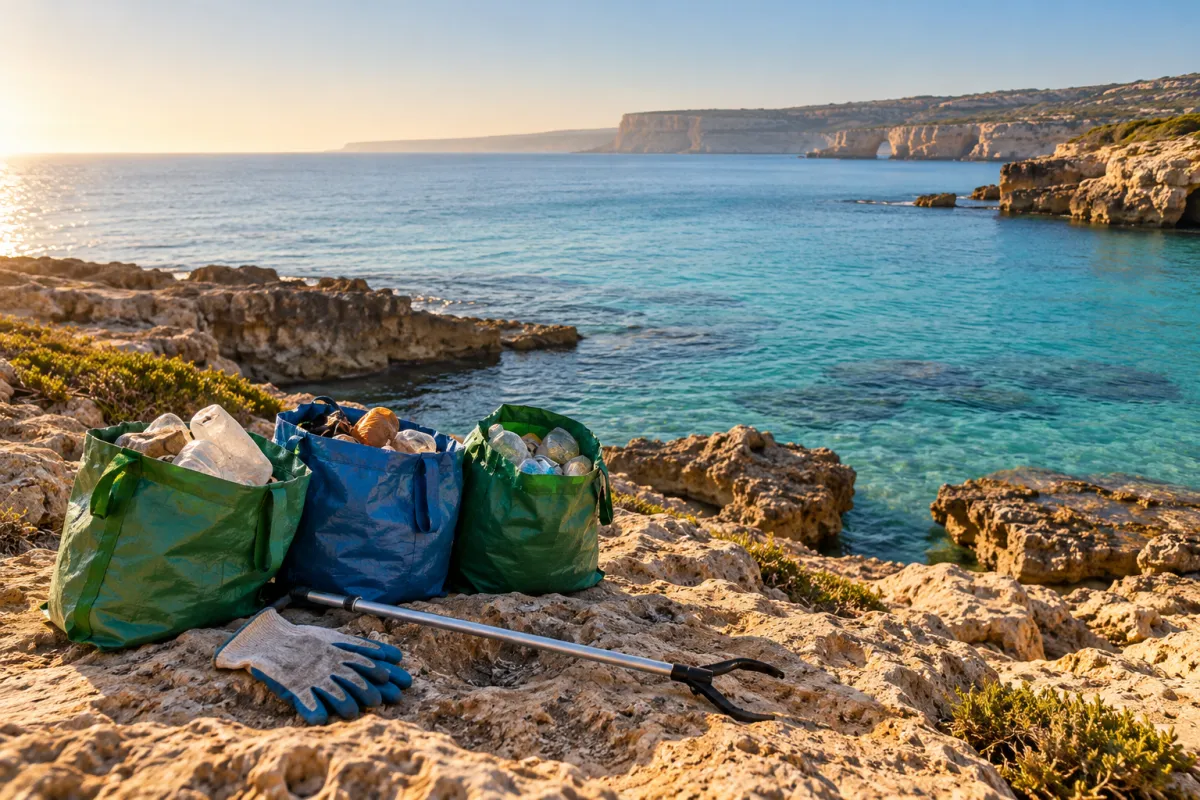
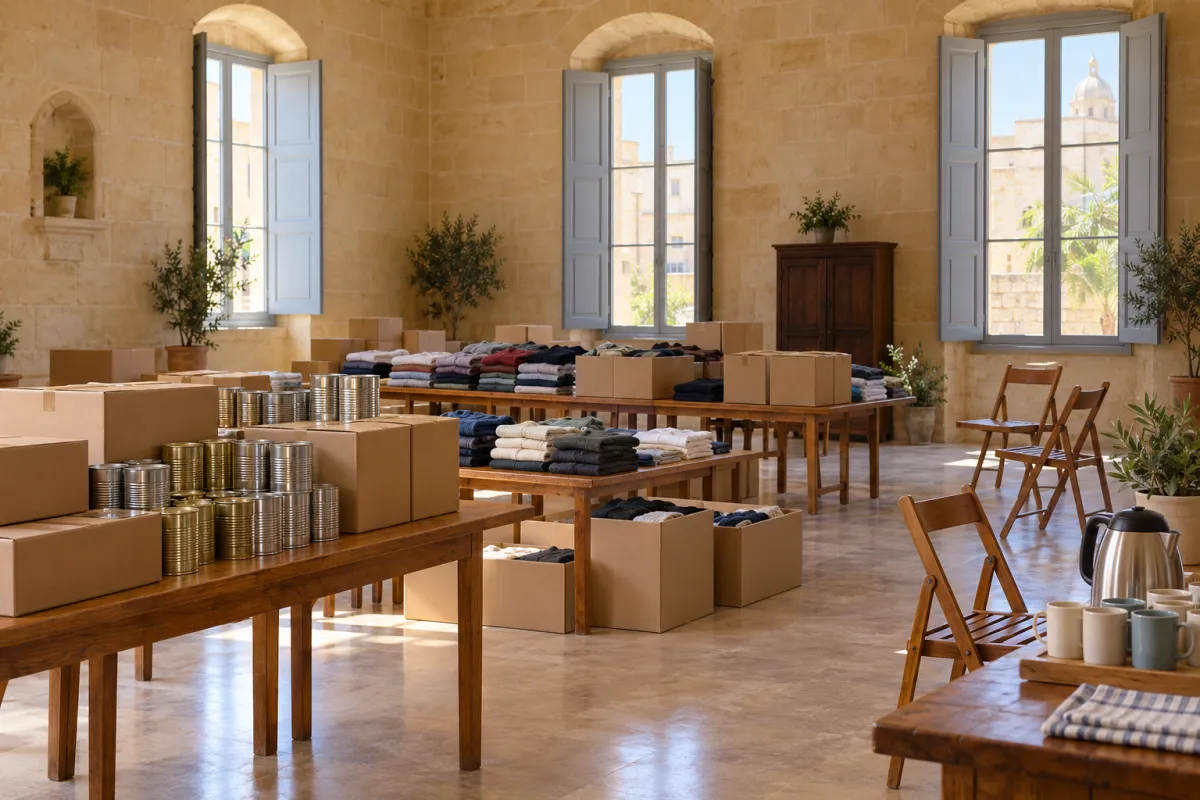
Volunteering in Malta for foreigners is one of the few ways to see the same faces every week without having to invent a reason to meet. A regular shift sorting donations, a monthly shore clean-up or a weekly slot helping at a community event gives you a role, a small group and a natural next step: coffee afterwards with the person who held the other end of the bin bag.
If you have been here a few months, you probably know the pattern. Work or classes fill the weekdays, then Saturday arrives and the flat is very quiet. You have tried a couple of big meet-ups, swapped numbers with people you never saw again, and watched one or two new friends leave the island when their contracts ended. None of that means something is wrong with you. It means you need a structure that repeats.
Below is the practical version: how the official volunteering system works, what non-EU nationals must check before signing up, how to pick a role that actually leads to friendships, a week-by-week plan, and copy-paste messages for the awkward moments.
Why is it hard to make friends in Malta?
People ask why it is hard to make friends in Malta as if the island should be easy: it is small, English is spoken everywhere and you bump into the same people at the same pastizzeria. The difficulty is real, though, and it has three main causes.
Expat turnover
A large share of the foreigners you meet are here on contracts, courses or a season. You put effort into a friendship, and six months later there is a leaving drink. After the second or third goodbye, many people quietly stop trying. Volunteering helps here because organisations have a stable core of long-term members, many of them Maltese, who are not going anywhere.
Established local networks
Maltese social life is often built around family, school friends, the village and the parish. Sunday lunch is with relatives, the closest friends date back to secondary school, and weekends fill up with family commitments. People are usually friendly and helpful, but their calendars are already full. You rarely break into these circles by asking; you get in by being around, reliably, doing something useful alongside them.
The summer and winter rhythm
Summer is busy, hot and outdoors, with beaches, festas and visitors. Winter is quieter, wetter and more indoors, and many newcomers find November to February the loneliest stretch. A weekly commitment keeps your social life going across both seasons instead of disappearing when the beach days end.
If you want a deeper look at the causes, our guide on why it feels hard to have no friends in Malta and what actually works covers them in more detail, and our 12-week plan for loneliness after moving to Malta looks at the wider picture beyond volunteering.
Why volunteering works when other plans fizzle
Friendships tend to form when you see the same people repeatedly, in a relaxed setting, with something to talk about that is not yourselves. Most one-off social events give you only one of those three. A regular volunteering slot gives you all of them.
- Repetition without effort. You do not have to organise anything. The shift happens whether you feel sociable or not, and the same people turn up.
- A shared task. Sorting, carrying, setting up or cleaning gives you something to do with your hands and a ready-made topic. Silence is not awkward when you are both busy.
- A natural mix. Voluntary organisations bring together Maltese residents, long-term foreigners and newcomers of very different ages. It is one of the more reliable routes out of the expat bubble, alongside the ideas in our guide on how to meet Maltese people beyond the expat bubble.
- A purpose on low days. When you feel flat, being useful to someone else is often easier than going to a party where you have to perform.
From shift to friendship: the step most people miss is the small plan afterwards. Once you know two or three names, suggest something specific with a place, a time and who pays. MeetNow, a free app that works in your browser and on Android through Google Play, starting in Malta (the iPhone app is not in the App Store yet), is built around exactly that: a host posts a plan at a public place, sets the seats and says who pays, and picks who joins.
Volunteering in Malta for foreigners: how the system works
The official starting point is the Malta Council for the Voluntary Sector (MCVS), which runs the national volunteering portal volunteers.mt. The portal matches people who want to give their time with registered voluntary organisations across Malta and Gozo, with open roles ranging from social and humanitarian work to arts, culture, sports and technical assistance.
Registered organisations
Voluntary organisations are regulated under the Voluntary Organisations Act, Chapter 492 of the Laws of Malta (legislation.mt), and must be enrolled with the Office of the Commissioner for Voluntary Organisations (OCVO) to operate and host volunteers under the national framework. In practice, that means you can ask any organisation whether it is enrolled with the OCVO, and a well-run one will answer without hesitation. This matters most if you are non-EU, because a permit route depends on a proper host.
Volunteer Centres
The MCVS also operates physical Volunteer Centres in hubs including Valletta, Rabat and Xewkija in Gozo, offering coordination, meeting space and administrative support for civil society. If you prefer talking to a person rather than filling in a form online, these centres are a sensible place to ask questions.
The bigger framework
Volunteering in Malta sits under the National Volunteering Strategy 2025–2030, which is built on four pillars: capacity building, stakeholder engagement, civic participation, and sector voice and visibility (gov.mt). You do not need to read the strategy, but it explains why the sector is fairly organised and why many organisations run proper inductions. The MCVS also holds a European Solidarity Corps Quality Label, which supports cross-border exchanges for young adults under EU programmes, and it runs the annual National Volunteer Awards.
Signing up, step by step
- Browse roles on volunteers.mt and shortlist three that repeat weekly or fortnightly.
- Check where they are and how you would get there by bus.
- Apply with a short note saying when you are free and how long you can commit.
- Attend the induction or first briefing, and ask who the regulars are.
- Do your first three shifts before judging whether it fits.
Non-EU nationals: permits and hosting agreements
This is the part people skip and later regret. According to the legal framework published on legislation.mt, third-country nationals coming to Malta to volunteer must enter into a formal hosting agreement with a local host organisation and apply for a residence permit through Identità, the government agency handling expatriate documentation, residence and visas, with the application endorsed by the host organisation.
If you already live in Malta on another permit, for example as an employee, a student or a remote worker, the situation is different but still worth checking. Permit conditions vary, and you should confirm with Identità or your host organisation before taking on a regular role, especially one that looks like structured, scheduled work. A short email to ask costs nothing and protects your residence status. This guide is general information, not legal advice.
Choosing a role that leads to friendships
Not every volunteering role is equally social. A one-off big event can be fun, but you may never see the same person twice. If your main goal is to stop feeling isolated, look for these features:
- Recurring: the same day and time every week or fortnight.
- Small group: four to ten people rather than a crowd of strangers.
- Same team: roles where regulars are rostered together.
- Some downtime: a break, a set-up period or a tidy-up where conversation happens.
- Reachable: close to a bus route you already use, so you keep going in winter.
| Type of role | Social potential | Good fit if you |
|---|---|---|
| Social and humanitarian (food, donations, befriending) | High: regular shifts, stable teams | Want routine and a mix of ages |
| Environment and outdoor (clean-ups, conservation) | Medium to high: chatty, relaxed | Like being outside and active |
| Arts and culture (events, heritage) | Medium: busy peaks, quieter gaps | Enjoy events and meeting creative people |
| Sports (events, clubs, coaching support) | Medium to high with a club | Already play or follow a sport |
| Technical or skills-based (IT, design, admin) | Lower if remote, higher in person | Want to use professional skills |
Some roles, particularly with older people or children, may work better with basic Maltese. You do not need to be fluent, but a handful of phrases goes a long way; our guide to learning Maltese with courses, apps and useful phrases is a good start, and volunteers who try are usually treated warmly.
A 12-week volunteering plan
The aim of this plan is not to fill your diary. It is to turn a single recurring commitment into two or three people you can message without overthinking it.
| Week | Action | Where | Cost (EUR) |
|---|---|---|---|
| 1 | Browse roles, shortlist three recurring ones, check bus routes | volunteers.mt, from home | None |
| 2 | Apply to two roles with a short note; ask a question at a Volunteer Centre if unsure | Online or Volunteer Centre (Valletta, Rabat or Xewkija) | Bus fare only |
| 3 | Induction and first shift; learn three names | Host organisation | Bus fare only |
| 4 | Second shift; ask one regular a question about the area or the organisation | Host organisation | Bus fare only |
| 5–6 | Keep the same slot; offer to help with set-up or tidy-up, where conversations happen | Host organisation | Bus fare only |
| 7–8 | Suggest a coffee after a shift to one or two people | Café near the venue | Pay your own |
| 9–10 | Say yes to one organisation social or extra event | As organised | Varies, usually pay your own |
| 11–12 | Propose one small plan outside volunteering with the people you click with | A public place you choose | Agree who pays upfront |
Costs last checked May 2026. Bus travel can be free for eligible residents with a personalised card; see our guide to the Tallinja card and free travel for residents.
If week 4 feels like nothing is happening, that is normal. Friendships from shared activities usually start slowly and then speed up once you have a few shifts of history together. The people who give up in week three are the ones who never find out.
Copy-paste opener messages
Adapt these to your own voice. Short, specific and easy to say no to works best.
Applying to a role
Hi, I live in Malta and would love to help with this role. I’m free most weekends and can commit to a regular slot for at least three months. Is there an induction I should attend first? Thanks!
First shift, to a fellow volunteer
Is this your first time too, or have you been doing this for a while? I’m still figuring out where everything goes.
After a few shifts
A few of us were talking about grabbing a coffee after next week’s shift. Fancy coming? Pay your own, nothing fancy.
Asking a local regular
You’ve lived here longer than me. Where would you go for a quiet walk on a Sunday morning? I keep ending up in the same three places.
Moving it outside volunteering
I’m going to try that walk you mentioned on Sunday morning, starting around ten at the main square. Happy to have company if you’re free, no pressure if not.
Meetup vs Facebook groups vs volunteering
People often weigh up Meetup vs Facebook groups in Malta when they first feel isolated. Both have their place, but they work differently from volunteering.
| Option | Strength | Weakness |
|---|---|---|
| Meetup-style events | Clear time and place; easy to try something new | Attendance changes each time, so repeat contact is hit and miss |
| Facebook groups | Lots of information and the occasional meet-up | Mostly online chat; plans often stall in the comments |
| Volunteering | Same people regularly, shared task, mix of locals and foreigners | Slower start; needs a commitment of a few months |
The honest answer is that they combine well. Use events to try new things, groups for practical questions, and one volunteering role as your anchor, the thing that happens every week whatever else falls through.
When it’s more than loneliness
When it’s more than loneliness. Feeling lonely after a move is common and usually eases with time and routine. But if low mood has lasted for weeks, if you have stopped enjoying things you used to like, if sleep or appetite have changed a lot, or if you are having thoughts of harming yourself, please reach out for professional help rather than waiting for a volunteering plan to fix it.
- Speak to a GP, who can talk things through and refer you if needed.
- Our guide to mental health support for expats in Malta lists verified services and helplines, taken from official pages.
- If you or someone else is in immediate danger, contact the emergency services.
Volunteering can be a good part of feeling better, but it is not a substitute for care. This box is general information, not medical advice.
Staying safe when meeting new people
Volunteering itself is usually supervised, but the coffee, walk or dinner afterwards is just you and people you are still getting to know. The basics are simple:
- Meet in a public place for the first few plans.
- Tell a friend or flatmate where you are going and who with.
- Arrange your own way home, whether bus, taxi or walking route.
- Leave if anything feels uncomfortable; you do not owe anyone an explanation.
- Agree who pays before you order, so nobody feels awkward later.
Starting your own social group in Malta
After a couple of months of volunteering, you may find you know four or five people who get on but rarely see each other outside shifts. That is the moment to think about starting your own social group in Malta, and it is less intimidating than it sounds.
- Keep it small. Three to six people is a group; twenty is an event to manage.
- Fix a rhythm. Same day, similar time, for example the first Sunday of the month. Rhythm beats enthusiasm.
- Choose a public, easy place. Somewhere central with a bus stop nearby, so nobody has an excuse in winter.
- Say who pays. Pay your own is the default that keeps everyone comfortable.
- Rotate the choice. Let others pick the next plan, so it becomes the group’s, not just yours.
- Expect turnover. Some people will leave Malta. Invite one new person from your volunteering shift every so often to keep the group alive.
You do not need a name, a logo or a chat with hundreds of members. You need a plan, a place and one person who sends the message. More often than you expect, that person will be you, and that is fine.
Want to turn this into an actual plan? MeetNow is a free app for meeting people in person: a host posts a plan at a public place, says who pays (host pays, split, pay your own or free) and picks who joins. It is live on the web and works in your browser, starting in Malta. The Android app is on Google Play; the iPhone app is not in the App Store yet. Open MeetNow and see the plans posted in Malta.
FAQ
Can foreigners volunteer in Malta?
Yes. The national portal volunteers.mt, run by the Malta Council for the Voluntary Sector, matches people with registered voluntary organisations in Malta and Gozo, and many volunteers are foreign residents. Non-EU nationals should check their permit situation before starting.
Do non-EU nationals need a permit to volunteer in Malta?
Non-EU nationals coming to Malta to volunteer need a formal hosting agreement with a local host organisation and a residence permit through Identità, endorsed by that organisation. If you already live here on another permit, confirm its conditions with Identità or your host before taking on a regular role.
Where do I find volunteering opportunities in Malta?
Start with volunteers.mt, which lists open roles in areas such as social and humanitarian work, arts, culture, sports and technical assistance. You can also ask at the MCVS Volunteer Centres, which include Valletta, Rabat and Xewkija in Gozo.
Do I need to speak Maltese to volunteer?
Usually not, as English is widely used. Some roles, particularly with older people or children, may work better with basic Maltese, and learning a few phrases helps you connect with local volunteers.
Is volunteering a good way to make friends in Malta?
It is one of the more reliable ways, because you see the same people regularly, share a task and meet Maltese residents as well as foreigners. Choose a recurring, small-group role and give it at least three months before judging it.
Meetup or Facebook groups: which is better in Malta?
Neither is better on its own. Meetup-style events are good for trying new things and Facebook groups for practical information, but both tend to give you different faces each time. Pair them with one regular volunteering role so you have a stable weekly anchor.