Short answer: Maltese Christmas traditions are built around the parish and the family rather than shopping. Expect nativity cribs (presepji) in homes, churches and shop windows, pale ġulbiena sprouts around a Baby Jesus statue, Midnight Mass with a sermon given by a child, Baby Jesus processions with lanterns and carols, a very long Christmas Day lunch, and the L-Istrina charity telethon on 26 December.
For a newcomer, almost all of it is public and free to watch, and several traditions are easy to join, which makes December one of the best months to feel part of the island rather than a visitor to it.
My first December here, I assumed Christmas would feel like a sunnier version of what I knew. It did not. The shops mattered far less than the church on the corner, every window on my street had a little crib in it, and on Christmas Eve the whole village seemed to walk to Mass together. If you have just arrived, the culture shock newcomers notice in Malta often peaks in December, mostly in good ways. This guide explains what you will see, what it means and how to take part.
The Maltese Christmas calendar
Christmas in Malta is a season, not a day. Lights go up in town centres from late November, and the official calendar has three December public holidays close together.
| Date | What it is | What newcomers notice |
|---|---|---|
| 8 December | Feast of the Immaculate Conception (Il-Kunċizzjoni), public holiday | A festa-style celebration in Cospicua; many families start decorating |
| 13 December | Republic Day (Jum ir-Repubblika), national holiday | A day off just as Christmas preparations ramp up |
| 24 December | Christmas Eve | Midnight Mass, the child’s sermon, Baby Jesus processions |
| 25 December | Christmas Day (Il-Milied), public holiday | Long family lunch; streets very quiet in the afternoon |
| 26 December | St Stephen’s Day (San Stiefnu), not a public holiday | The L-Istrina charity telethon on national TV |
| 31 December – 1 January | New Year’s Eve and New Year’s Day (public holiday) | Parties, fireworks and Is-Sena t-Tajba greetings |
Holiday dates last checked November 2026 against Malta’s public holiday list. Holiday status does not tell you whether a specific shop, bus route or venue is open; check each one.
Cribs (presepji) and crib visits
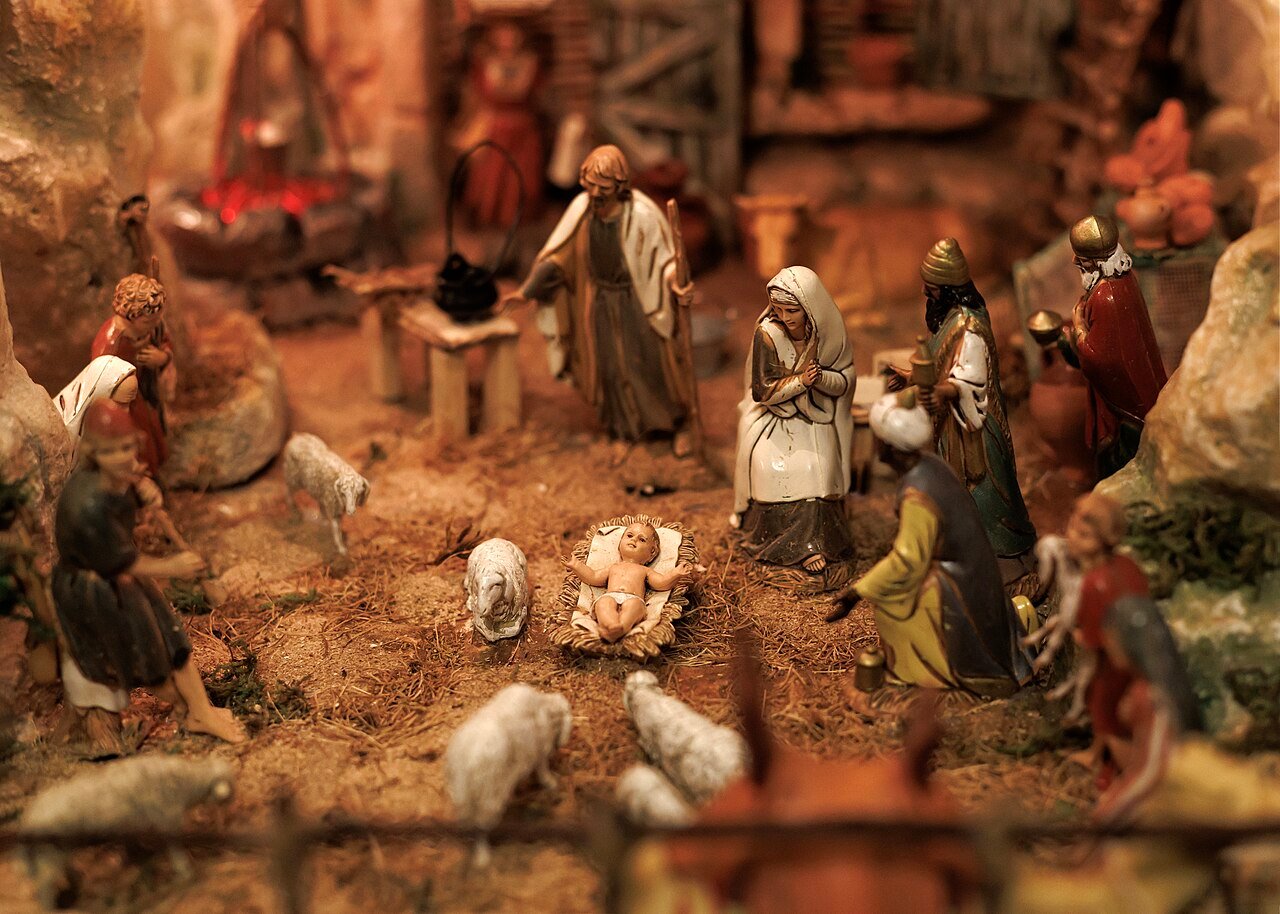
The crib, or presepju (plural presepji), is the heart of Maltese Christmas traditions. A traditional Maltese crib is not just a stable with a few figures: it is a whole landscape built from papier-mâché, stone, cork, wood and cotton wool, with hills, streams, windmills and village houses that often look more like rural Malta than Bethlehem. The small clay figures are called pasturi, and alongside the Holy Family, shepherds, angels and the Three Kings you will usually find local characters. One favourite is l-għaġeb tal-presepju, the shepherd staring up in amazement at the newborn Jesus.
Cribs appear everywhere: in living rooms, parish churches, school halls, office lobbies and shop windows. Many parishes and local groups put on crib exhibitions through December, often in a church hall or a band club, and families make a point of visiting several in the weeks before Christmas. Some are mechanised, with moving figures, running water and lighting that shifts from day to night.
For a newcomer, a crib visit is one of the easiest ways in. Exhibitions are usually free or ask for a small donation, the volunteers who built them love explaining the details, and parishes post opening times on their social media pages and noticeboards. Ask a colleague or neighbour which crib in their town is worth seeing; it is a question people enjoy answering.

Bethlehem f’Għajnsielem in Gozo
The best-known crib on the islands is a living one. Bethlehem f’Għajnsielem turns the Ta’ Passi fields in Għajnsielem, near the Mġarr ferry terminal in Gozo, into a re-created village with houses, workshops, animals and costumed volunteers, many of them local residents. It runs on selected dates from mid-December into early January.
When this guide was last checked in November 2026, the 2026–27 dates had not been announced; check the official Visit Gozo event page or the Għajnsielem Local Council before you plan the trip. It makes a good day out with new friends: a ferry crossing, a walk through the village and lunch in Gozo. If you are thinking about the island more seriously, our guide to living in Gozo as an expat covers what daily life there is like.

Ġulbiena and the Baby Jesus in the window
Walk through any old village in December and you will see a statue of the infant Jesus, il-Bambin, displayed in a window or on a balcony, surrounded by lights, candles and pots of pale, almost white shoots. Those shoots are ġulbiena: seeds (traditionally vetch, though wheat, lentils and chickpeas are also used) sown on damp cotton wool a few weeks before Christmas and kept in the dark so they grow long and pale instead of green.
Growing your own ġulbiena is a lovely first tradition to adopt. Start in late November or the first days of December, keep the cotton damp, leave the pots in a dark cupboard and bring them out for Christmas Eve. If you have Maltese neighbours, ask how their family does it; you may well end up with seeds and instructions.
Midnight Mass and the child’s sermon
Midnight Mass on Christmas Eve is still the religious high point of the season, and parish churches fill up. Before or during the celebration, a child of around seven to ten gives a short sermon, the Priedka tat-Tifel, retelling the Christmas story from memory in front of the whole congregation. The tradition dates back to the late nineteenth century, and for many Maltese families having their child chosen is a proud moment.
You do not need to be Catholic, or religious at all, to attend. Dress neatly, arrive early if you want a seat, and stay respectful during the liturgy. In many parishes, people linger outside afterwards and some churches hand out small treats or warm drinks on the church square. It is an easy way to see your own village at its most together. Exact times vary by parish, so check the noticeboard or the parish page in December.
Baby Jesus processions and carols
In many towns, children walk through the streets carrying a statue of the Baby Jesus, with lanterns and carols, usually around Christmas Eve. According to the Archdiocese, the public procession began in Ħamrun in 1921 on the initiative of St George Preca, the founder of the Society of Christian Doctrine (MUSEUM), and spread from there to other parishes.
The carols are often in Maltese. The best known is Ninni la Tibkix Iżjed (“Sleep, Don’t Cry Any More”), a lullaby to the infant Jesus that most Maltese adults can sing from memory. Hearing a few hundred people sing it in a village square is one of those moments when Malta feels very different from anywhere else.
Maltese Christmas food
Food is where tradition and modern life meet. Many families have a roast turkey and Christmas pudding, a legacy of the British era, sitting right next to dishes that are entirely Maltese.
| Dish | What it is | When you see it |
|---|---|---|
| Qagħaq tal-għasel | Ring-shaped pastries filled with a dark, spiced treacle mixture, despite the name (“honey rings”) | All year in bakeries, but especially at Christmas |
| Imbuljuta tal-qastan | A hot, thick drink of chestnuts, cocoa, sugar and spices such as cloves and orange peel | Christmas Eve and the cold nights around New Year |
| Mqaret | Deep-fried pastries filled with dates | Street stalls and festive gatherings |
| Roast turkey and Christmas pudding | The British-era Christmas lunch many families still serve | Christmas Day |
| Christmas log | A rolled chocolate dessert shaped like a log | Confectioners and home kitchens in December |
If you want to make one thing, make imbuljuta. It is a good reason to invite people round on a cold December evening, and Maltese friends will have strong opinions about whether yours is right.

Christmas Day and family visits
Christmas Day is a family day. Lunch starts late, has several courses and goes on for hours; preparing far more food than anyone could eat is part of the point. Afterwards, people visit relatives they did not have lunch with, carrying small gifts or a bottle of wine. Streets, cafés and beaches are quiet in the afternoon, and plenty of businesses close.
That can be the hardest moment of the year if you are new and alone. Plan for it in advance: agree a lunch or a long walk with other newcomers, or say yes if a colleague invites you to their family’s table. The guide to meeting Maltese people beyond the expat bubble explains why these invitations are worth accepting even when they feel formal.
L-Istrina on 26 December
L-Istrina is a yearly charity telethon broadcast across the main Maltese TV stations on 26 December, St Stephen’s Day. It raises money for the Malta Community Chest Fund Foundation, which supports patients, families and charities across the islands, and the fundraising runs through the month with school collections, sports matches and corporate events leading up to the broadcast. Watching the total climb on screen is a national ritual, and donating, even a small amount, is a quiet way of taking part in something the whole country does together.
Greetings and etiquette when you are invited
Two phrases cover the season: Il-Milied it-Tajjeb (Merry Christmas) and Is-Sena t-Tajba (Happy New Year). Say them to your bus driver, your neighbours and the person at the pastizzeria, and expect a smile back. Our guide to learning Maltese as a newcomer covers the language more broadly.
If you are invited to a Maltese home over the holidays:
- Bring something. A bottle of wine, a box of sweets or something you baked. Flowers are fine too.
- Arrive hungry and pace yourself. Several courses are normal, and second helpings will be offered more than once.
- Admire the crib. Many families build theirs with great care; asking about it is the easiest compliment.
- Expect children, grandparents and noise. Christmas is multi-generational and loud.
- Offer to help. Clearing plates is appreciated even if you are told to sit down.
- Follow up. A thank-you message the next day, and an Is-Sena t-Tajba a week later, keeps the door open.
Maltese Christmas traditions newcomers can join
Most Maltese Christmas traditions are public and free, which means you do not have to wait for an invitation. A realistic December plan for a newcomer looks like this:
- A crib visit with someone. Pick a parish crib exhibition and ask a coworker, coursemate or neighbour to come along; it is an easy, low-pressure first plan.
- Midnight Mass in your own parish. Go with a friend, then walk home through the procession and the carols.
- A Gozo day for Bethlehem f’Għajnsielem. Once the dates are out, it works well for a small group, with lunch afterwards.
- An imbuljuta evening. Invite three or four people to your place, make a pot and share stories about Christmas at home.
- A shared Christmas lunch. If you will not be with family, organise a potluck or a restaurant lunch with other newcomers, and say upfront whether everyone pays their own, splits the bill or brings a dish.
- Volunteering. Food banks, parish charities and fundraising for L-Istrina all need extra hands in December.
When you meet people you do not know well, keep it public: a church square, a crib exhibition, a café or a busy promenade. Tell a friend where you are going, plan your own way home, especially on Christmas Eve when buses can be busy, and leave if anything feels wrong. For the bigger picture of building a social life here, our 30-day plan for making friends in Malta is a good next read.
A December checklist for newcomers
| When | Do this |
|---|---|
| Late November | Sow ġulbiena on damp cotton wool and keep it in the dark |
| First week of December | Ask a local which crib exhibition in their town is worth visiting |
| 8–13 December | Use the public holidays for a crib visit or a Gozo trip with friends |
| Mid-December | Agree your Christmas Day plan: a family invitation, a shared lunch or a long walk with others |
| 24 December | Midnight Mass, the child’s sermon and the procession in your parish |
| 26 December | Watch or donate to L-Istrina |
| 31 December | Send Is-Sena t-Tajba messages to everyone who made December better |
For the rest of the year, our overview of everyday expat life in Malta covers routines, seasons and how social life changes after the holidays.
Want to turn this into an actual plan? MeetNow is a free app for meeting people in person: a host posts a plan at a public place, says who pays (host pays, split, pay your own or free) and picks who joins. It is live on the web, starting in Malta, so it works in your browser: open MeetNow and see the plans posted in Malta.
Frequently asked questions (FAQ)
What are the main Maltese Christmas traditions?
Nativity cribs (presepji), ġulbiena sprouts around a statue of the Baby Jesus, Midnight Mass with a child’s sermon, Baby Jesus processions with carols, a long family lunch on Christmas Day and the L-Istrina charity telethon on 26 December.
Is 26 December a public holiday in Malta?
No. Christmas Day, 25 December, is a public holiday, as are 8 December (Immaculate Conception) and 13 December (Republic Day), but St Stephen’s Day on 26 December is a normal working day for most people.
What is ġulbiena?
Seeds, traditionally vetch, grown on damp cotton wool in the dark for a few weeks so the shoots come out long and pale. They are placed around the crib or a statue of the infant Jesus as decoration.
Can non-Catholics attend Midnight Mass in Malta?
Yes. Churches are open to everyone. Dress neatly, arrive early if you want a seat and be respectful during the service.
What do Maltese people eat at Christmas?
Many families serve roast turkey and Christmas pudding, alongside Maltese favourites such as qagħaq tal-għasel (treacle rings), imbuljuta tal-qastan (a hot chestnut and cocoa drink) and date-filled mqaret.
How do you say Merry Christmas in Maltese?
Il-Milied it-Tajjeb. For Happy New Year, say Is-Sena t-Tajba.
Featured photo: A Maltese Christmas crib (presepju), by Godwin Borg, CC BY-SA 4.0, via Wikimedia Commons.