How to apply to University of Malta, in short: pick up to two courses, fill in UM’s online application form, upload certified documents and an English test result, and pay the non-refundable processing fee (€100 for overseas qualifications before the first deadline). Non-EU applicants who need a visa must finish by 1 July.
That is the whole process on one line, but the details are where applications stall: a username that cannot be changed, a second preference that disappears the moment you get an offer, an English result that arrives a week too late. I have helped a few friends and neighbours through UM’s system, and this guide is the version I wish they had read first. All dates and fees below were last checked in October 2026 on official University of Malta pages.
Before you apply: what to decide first
The University of Malta (UM) is Malta’s main public university, with its largest campus at Msida. If you are still deciding whether Malta is right for you at all, our pillar guide to studying in Malta compares the university with English schools and vocational colleges, and our overview for University of Malta international students covers tuition, campus life and the monthly budget. This article covers one thing only: the admissions procedure.
Three decisions shape everything else, so make them before you open the form:
- Which level? Undergraduate, postgraduate (master’s) or doctoral. Deadlines and English scores differ.
- Which intake? Most courses start in October. Some postgraduate courses also take a February intake, but UM says non-EU applicants living outside the EU cannot apply for February because there is not enough time for the visa.
- Which two courses? UM lets you list two preferences. A third is only allowed if both your first and second choices are limited-number courses, and it goes in the “Additional Notes” field. A limited-number course cannot be your third preference.
Two traps to know about early. First, if UM issues a letter of acceptance for your first preference, your second preference is automatically withdrawn, so do not list a first choice you are not sure about. Second, exchange students coming for a semester or a year are nominated by their home university and follow a different route; if that is you, read our Erasmus in Malta guide instead.

How to apply to University of Malta: step by step
UM only accepts applications online, through its online application form linked from the admissions and advice pages. Applications for the next October intake normally open around mid-November of the year before. Here is how the process works, based on UM’s admissions FAQs.
Step 1: Create your account
If you sat Maltese MATSEC exams and your MATSEC password starts with “M”, you choose “Log In”. Everyone else chooses “New User”. Pick your username carefully: UM says it must be unique and never used before, and you will need it for every later step, including checking your offer.
Step 2: Fill in the form (and save as you go)
UM estimates the form takes about ten minutes, not counting the time to find your documents. You can start, save and finish later with the “Continue Application” button. Check each page before you move on, because UM warns that changes cannot be made retroactively.
Step 3: Choose “Overseas Qualifications” if you studied abroad
If your school-leaving qualification is not considered local, select the “Overseas Qualifications” option. UM treats the International Baccalaureate and the European Baccalaureate as local qualifications, so IB and EB holders follow the local route even if they studied abroad.
Step 4: Upload your documents
Overseas applicants upload certified copies of their qualifications (with certified English translations where needed), an English test result or a declaration that you will sit one, a detailed CV, and anything your specific course asks for. Each document must be a separate attachment in JPEG, GIF or PDF format. If uploading fails, UM asks you to email the documents within ten days of submitting.
Step 5: Pay the processing fee
An application only counts as submitted once it is complete and the fee is paid. According to UM’s fees page, the processing fee is €100 for applicants with overseas qualifications up to the first deadline and €200 for late applications; applicants with local qualifications pay €35 (€75 late). The fee is non-refundable, except where a course does not run because too few qualified people applied.
Step 6: Check both confirmation emails
You should get a payment confirmation and a receipt that lists your courses. If both have not arrived within 24 hours, contact UM’s Admissions and Records Office with your ID number. Do not assume silence means it worked.
Step 7: Wait, then accept
UM says it is impossible to give exact timeframes for reviewing applications, so plan for weeks rather than days. If you are accepted, you will receive a letter of acceptance and instructions for registration and fees. Some courses also ask for a police conduct certificate issued within the previous six months, submitted at the start of the academic year.
| Applicant | Before the first deadline | Late application |
|---|---|---|
| Overseas qualifications | €100 | €200 |
| Local qualifications | €35 | €75 |
Source: UM fees and funding and UM admissions FAQs. Tuition is separate and set per course.
Entry requirements for overseas qualifications
UM’s general rule for international applicants is that each application is treated on its own merits. Qualifications that give access to recognised universities in your home country are accepted if they are of a comparable standard to UM’s requirements and the course has no special entry requirements. Many courses do have special requirements, such as particular subjects at A-level standard, a portfolio or an interview, so read the “Entry Requirements” section of the course page line by line.
For undergraduate courses, Maltese applicants are assessed on MATSEC results. Overseas qualifications are compared against them: UM publishes comparison pages for GCE Advanced levels, the European Baccalaureate and the International Baccalaureate, and a country-specific qualifications page for others, such as the Italian Diploma di Esame di Stato or the Dutch VWO diploma. There is also a guidance booklet for overseas applicants on the international applicants page.
What about recognition statements? MQRIC, Malta’s qualifications recognition centre, can issue a statement comparing your qualification with the Maltese framework. UM says it takes the MQRIC statement into consideration but evaluates qualifications itself, so an MQRIC statement is not binding on admission.
If your school qualifications are not quite enough for direct entry, UM runs Foundation Studies, a preparatory route into degree courses. Check its own entry rules and dates.
English language requirements
Teaching at UM is in English, and anyone who completed secondary education overseas must present a Secure English Language Test (SELT) result. The minimums depend on the level:
| Test | Undergraduate | Postgraduate / doctoral |
|---|---|---|
| Academic IELTS | 6.0 overall; writing 6.0, reading, listening and speaking 5.5 | 6.5 overall; 6.0 in every component |
| TOEFL iBT (pre-January 2026 scale) | 80 overall, 20 writing | 95 overall, 24 writing |
| TOEFL iBT (January 2026 onwards scale) | 4 overall, 4.5 writing | 5 overall, 5 writing |
| Pearson PTE Academic | 65 (59 in each element) | 71 (65 in each element) |
| Cambridge | Advanced Certificate, grade C or better | Advanced Certificate, grade C or better |
| Trinity ISE | ISE II Distinction in all skills, or ISE III Pass in all skills | ISE III, Merit in all skills |
Source: UM English language requirements.
The fine print matters. IELTS, TOEFL and ISET results only count if issued within two years of your course start. For the October intake, your result must reach UM by 1 July if you are a non-EU applicant who needs a visa, and by 30 September for everyone else; for the February intake the dates are 30 October and 31 January. UM states plainly that if the result is not in by those dates you will not be admitted, even if you meet every other requirement. Book the test early and leave room for a resit.
Deadlines for 2027 intakes
UM publishes deadlines per intake on its dates and deadlines page. Here is what was published when I last checked:
| What | Deadline | Note |
|---|---|---|
| Postgraduate, February 2027 intake | 29 January 2027, 14:00 | Not open to non-EU applicants living outside the EU |
| Postgraduate, October 2027 intake | 21 July 2027, 14:00 | General deadline |
| Non-EU applicants needing a visa, October 2027 | 1 July 2027, 14:00 | Later applications move to the next intake |
| MD Surgery with overseas qualifications | 15 January 2027, 14:00 | Medicine has its own, earlier dates |
| Master’s by research | Rolling | Most have multiple entry points; research proposal required |
| For comparison: all courses, October 2026 intake | 22 July 2026, 14:00 | Late applications with a late fee until 15 September 2026 (not for MD or limited-number courses) |
Undergraduate dates for October 2027 follow the same pattern but are published with the undergraduate prospectus, so confirm them there. My rule of thumb for non-EU applicants: aim to submit by the end of March, not the end of June. Visa appointments, translations and certified copies always take longer than you think.
Documents checklist
- Passport (photo page), scanned clearly
- Certified copies of school-leaving certificates and, for postgraduate study, degree certificates and full transcripts
- Certified English translations of anything not in English
- English test result (or a declaration that you will sit one) within the validity window
- Detailed CV
- Course-specific items: personal statement, references, portfolio, research proposal (master’s by research and PhD)
- Police conduct certificate, if your course requires one (issued within the previous six months)
- Originals of everything: overseas applicants must present all original certificates to UM’s International Admissions Office for verification before enrolling
Keep one folder with scans named clearly (surname_document_year.pdf) and one physical folder of originals that travels in your hand luggage, not your checked bag.

Visa timing for non-EU applicants
EU, EEA and Swiss citizens do not need a visa to study in Malta; they register their residence with Identità after arriving. Non-EU students on courses longer than 90 days generally need a national student visa and, once in Malta, a residence permit, both of which depend on having an acceptance from UM first. That is why UM’s visa deadline is three weeks earlier than the general one.
Typical documents for the visa stage include your acceptance letter, proof of tuition payment or arrangements, proof of funds, accommodation and health insurance. The exact list and the minimum funds change, so use the current checklist from Identità and the Maltese embassy, consulate or visa centre that covers your country, not a forum post from two years ago. UM also notes that its own monthly living-cost estimates are higher than the minimum funds required for a visa or residence permit, so budget on the realistic figure, not the minimum.
A realistic non-EU timeline for October 2027
| When | What to do |
|---|---|
| November–December 2026 | Shortlist two courses, read entry requirements, book your English test |
| January–March 2027 | Get certified copies and translations, submit the application, pay the €100 fee |
| March–May 2027 | Answer any requests from the faculty; receive the offer |
| By 1 July 2027 | Everything with UM complete, including your English result |
| June–August 2027 | Visa application with your acceptance letter, funds, insurance and housing |
| Late September 2027 | Arrive, show originals to the International Admissions Office, start the residence permit process |
After acceptance: housing, orientation and freshers
Once you have your letter, the practical work starts. Accommodation is the big one. The University of Malta’s International Office estimates €550–€700 a month for a room in a shared flat and €800–€1,600 for single accommodation in a residence or apartment. Our guide to student accommodation in Malta explains the options around Msida, Gżira, San Ġwann and Swieqi, and how to avoid paying a deposit on a flat that does not exist.
The other piece is the start of the year. UM’s academic year begins in October, and the students’ council, KSU, runs a Freshers’ Week at the start of it (in 2026 it ran from 5 to 9 October). This is when societies recruit, and it is by far the easiest week of the year to meet people. If your visa or flight lands you in Malta after it, message the societies you are interested in directly; most are happy to hear from a latecomer.
First-fortnight checklist
- Show your original certificates to the International Admissions Office.
- Collect your student ID and activate your university email; check it daily.
- Book your Identità appointment (EU registration or non-EU residence permit).
- Get a local SIM and, once you have your residence documents, a personalised tallinja card (Budget 2027 announced that free travel ends for third-country nationals resident for less than five years, so non-EU students should check current fares).
- Find your faculty office, the library and the quickest walking route from your flat.
- Go to at least two freshers or society events, even if you feel tired.
Making friends in your first semester
The first semester at UM has a shape that catches international students off guard. Many Maltese classmates went to school together and live with their families, so they head home after lectures. Friendships happen, but they take a little more initiative from you than at a campus university where everyone lives in halls.
What helps:
- Sit with the same people. Repetition beats charm. By week three, the person next to you every Tuesday is an easy coffee invitation.
- Suggest small, specific plans. “Library from 10, then lunch in the canteen”, “Saturday swim at the Sliema rocks”, “ferry to Valletta and a walk”. Say up front whether everyone pays their own; with new people, that is the comfortable default.
- Join one society outside your subject. Sports, volunteering, a choir or a cultural group gives you a weekly fixed point.
- Expect a dip around November. Coursework builds, the novelty fades, and some people feel flat. That is normal; add a routine rather than retreating to your room.
- Keep first meetings in public places and let someone know where you are going.
Our guide to student life in Malta has a sample week, cheap weekend ideas and more on societies and ESN.
Want to turn this into an actual plan? MeetNow is a free app for meeting people in person: a host posts a plan at a public place, says who pays (host pays, split, pay your own or free) and picks who joins. It is live on the web, starting in Malta: open MeetNow and see the plans posted in Malta.
Frequently asked questions (FAQ)
How much is the University of Malta application fee?
For applicants with overseas qualifications, the processing fee is €100 up to the first deadline and €200 for late applications. Applicants with local qualifications pay €35, or €75 late. The fee is non-refundable unless the course does not run.
When do applications open at the University of Malta?
Online applications for courses starting in October normally open around mid-November of the previous year. For October 2027 postgraduate courses, the general deadline is 21 July 2027 and the deadline for non-EU applicants who need a visa is 1 July 2027.
How many courses can I apply for at the University of Malta?
You can list two preferences. A third is only allowed if both your first and second choices are limited-number courses, and it goes in the Additional Notes field. If you get an offer for your first preference, the second is withdrawn automatically.
Do I need IELTS to apply to the University of Malta?
If you completed secondary school outside Malta, you need a Secure English Language Test such as Academic IELTS, TOEFL iBT, PTE Academic or Cambridge Advanced. Undergraduate entry needs IELTS 6.0 overall and postgraduate entry 6.5, with component minimums.
Is the IB accepted by the University of Malta?
Yes. UM treats the International Baccalaureate and the European Baccalaureate as local qualifications, so holders follow the local applicant route and UM publishes comparison pages for both.
How long does the University of Malta take to reply?
UM says it cannot give exact timeframes because review times vary by course and faculty. Apply early, keep checking the email address you used, and contact the Admissions and Records Office if you need a decision for a visa deadline.
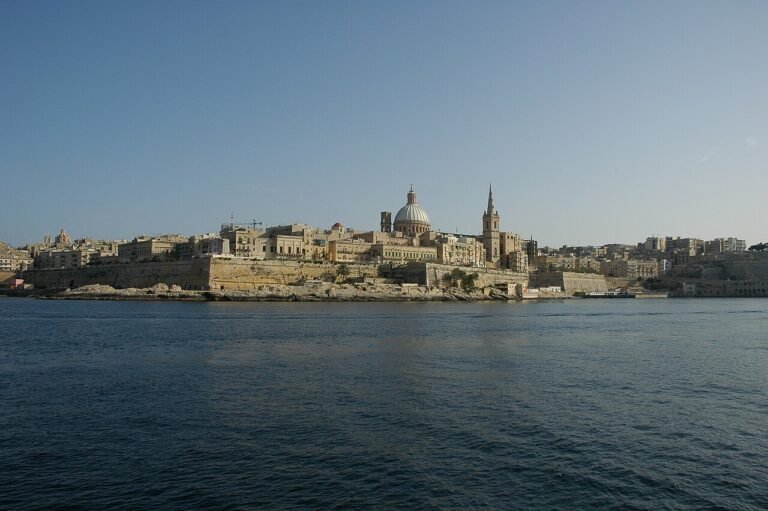
Featured photo: Entering the Grand Harbour, Valletta, by John Haslam, CC BY 2.0, via Wikimedia Commons.