Most people searching for how to meet people in Malta are not brand new. They have a flat, a job or a course, a bus route they know by heart and a phone full of numbers belonging to people who flew home in June. The first few months were busy enough. The loneliness tends to arrive later, usually on a quiet Sunday in November, when everyone you know seems to be at a family lunch or on a plane.
That feeling is common and it is fixable. Malta is small, English-speaking and sociable, but its social life runs on repetition: the same faces at the same club, the same café, the same village festa every summer. Newcomers who treat meeting people as a weekly routine rather than a lucky break tend to have a real circle within a season.
What follows is the practical version. It covers why the second phase of settling in feels harder than the first, a week-by-week plan for your next 90 days, messages you can copy, advice for different life stages, and where to turn if it starts to feel like more than loneliness.
Why meeting people in Malta feels harder than it should
If you are struggling, it is rarely about you. Four things about life here make building a lasting circle tougher than the cheerful first weeks suggest.
The expat turnover
A large part of the international community is here on contracts, courses or remote-work permits, and many people move on after a year or two. Friend groups form quickly and then thin out in waves, typically at the end of the academic year and when contracts finish. If your first circle was mostly short-term arrivals, you can find yourself starting again just as you finally felt settled. Our piece on why having no friends in Malta is so common, and what actually works goes into the pattern in more depth.
Full Maltese networks
Many Maltese adults live close to where they grew up, see family every week and keep school friends for life. Sunday lunch is a fixture, the parish and the band club are part of village identity, and weekends often belong to relatives. None of this is unfriendly; the calendar is simply full. You get in through repeated contact and genuine invitations, not through one good conversation at a party.
The summer and winter rhythm
Summer is easy: beaches, festas, long evenings outdoors and visitors everywhere. Then autumn comes, students leave, tourists thin out and social life moves indoors, into homes you are not yet invited to. Many expats fly home for Christmas, which makes December feel emptier than it really is. Knowing the pattern helps: start building in September and October, not in January.
Geography
The international crowd is concentrated in a small stretch of coast around Sliema, St Julian’s, Gżira and Msida, according to Residency Malta. If you live in a southern village or in Gozo, the expat scene can feel a long bus ride away, but you are often closer to Maltese community life, which becomes an advantage once you lean into it.
A low-commitment shortcut. Not everyone wants to join a committee to make one friend. MeetNow that works in your browser, starting in Malta (the Android app is on Google Play; the iPhone app is not in the App Store yet), is built around small, real plans rather than profiles: a host posts a coffee, a walk or a dinner at a public place with a time, the number of seats and who pays, and people ask to join with a short note.
How to meet people in Malta: the 90-day plan
The plan assumes a few free hours a week and a modest budget. It rests on one principle: show up to the same things repeatedly, then convert familiar faces into one-to-one plans. Swap any activity for one that suits you better, but keep the rhythm. If you want a longer version with more detail on the emotional side, our 12-week plan for loneliness after moving to Malta pairs well with this one.
| Week | Action | Where | Cost (EUR) |
|---|---|---|---|
| 1 | List what you genuinely enjoy, pick three anchor activities and block them in your calendar as recurring slots | Home | €0 |
| 2 | Attend a language exchange such as English Café Malta and plan to return the following week | Often around Sliema, St Julian’s, Gżira or Msida; check the group’s own page | Pay your own drink |
| 3 | Join a group hike or beach clean-up, for example with Malta Mates | Coastal routes; meeting point set by the organiser | Pay your own transport |
| 4 | Start one weekly class: Maltese, a sport or a hobby | Local council, club or private provider near you | Varies; check the provider |
| 5 | Go back to all three anchors and learn at least three names | Same places as weeks 2 to 4 | Pay your own |
| 6 | Send your first one-to-one invite using a message from the next section | A public café or seafront walk | Pay your own |
| 7 | Suggest a lunch or after-work plan with a colleague or coworker | Near your office or coworking space | Pay your own |
| 8 | Visit your locality’s band club, a parish event or a local council activity | Your own town or village | Free to attend; drinks pay your own |
| 9 | Host a small group plan for three or four people you have met | A public place with a fixed time | Split or pay your own (say which) |
| 10 | Plan a day trip together, such as Gozo or a longer coastal walk | Ferry or bus | Pay your own fares |
| 11 | Offer help: volunteer at a festa, a clean-up or a club event | Your locality or a group you have joined | €0 |
| 12 | Make a second plan with anyone you clicked with; drop one anchor that is not working | Your choice | Pay your own |
| 13 | Turn it into a standing date: a monthly walk, dinner or quiz | Same place each time | Split or pay your own |
Costs describe who pays rather than quoting fees, because organisers change their prices; check each group’s own page before you go. Table last checked May 2026.
Three rules that make the plan work
- Same time, same place. Going to one language exchange four times beats going to four different ones once. Recognition is what turns strangers into acquaintances.
- Always propose something concrete. ‘Coffee on Saturday at 11:00 in Gżira, pay your own’ gets a yes far more often than ‘we should hang out sometime’.
- Count conversations, not contacts. A good week is two real conversations and one follow-up message, not twenty new numbers you will never use.
Copy-paste opener messages
The hardest step is usually the second contact, the moment you move from ‘person I chatted to’ to ‘person I make plans with’. These messages are short, specific and easy to decline, which is exactly why people tend to accept them.
After a group meet-up
Nice chatting at the meet-up. I’m going again next week. Fancy a quick coffee beforehand? I’ll be nearby from 18:30, pay your own, no pressure.
To a colleague
I’m trying to actually leave my desk at lunch. Walking down to the seafront on Thursday at 13:00, back by 13:45. Want to come?
To a Maltese neighbour
Hi, I’m the new tenant on the second floor. I’m trying to learn how things work around here. When is the village festa, and is there anything I should know about it?
Reviving a quiet group chat
Anyone up for a coastal walk on Sunday morning? Starting at 10:00, about an hour, coffee after, everyone pays their own. Reply with a thumbs up and I’ll share the meeting point.
After a good first meet
That was fun. Same again in a couple of weeks? I’m free next Saturday afternoon or the Sunday after.
Saying yes to a Maltese invitation
Thank you for asking me, I’d love to come. Should I bring anything?
Whatever they answer, bring something small anyway: pastries or a bottle are always welcome at family gatherings, and the gesture is noticed.
Is it easy to make Maltese friends?
Honestly, it is slower than making expat friends, and usually deeper. Maltese people are warm and talkative with newcomers, but a friendly chat at the bus stop does not automatically become a dinner invitation. The turning point for most expats I know came from one specific invitation: a christening, a family barbecue, a festa evening on someone’s balcony. Say yes to those, even when you are tired, because they rarely come twice if you decline the first.
Band clubs and village life
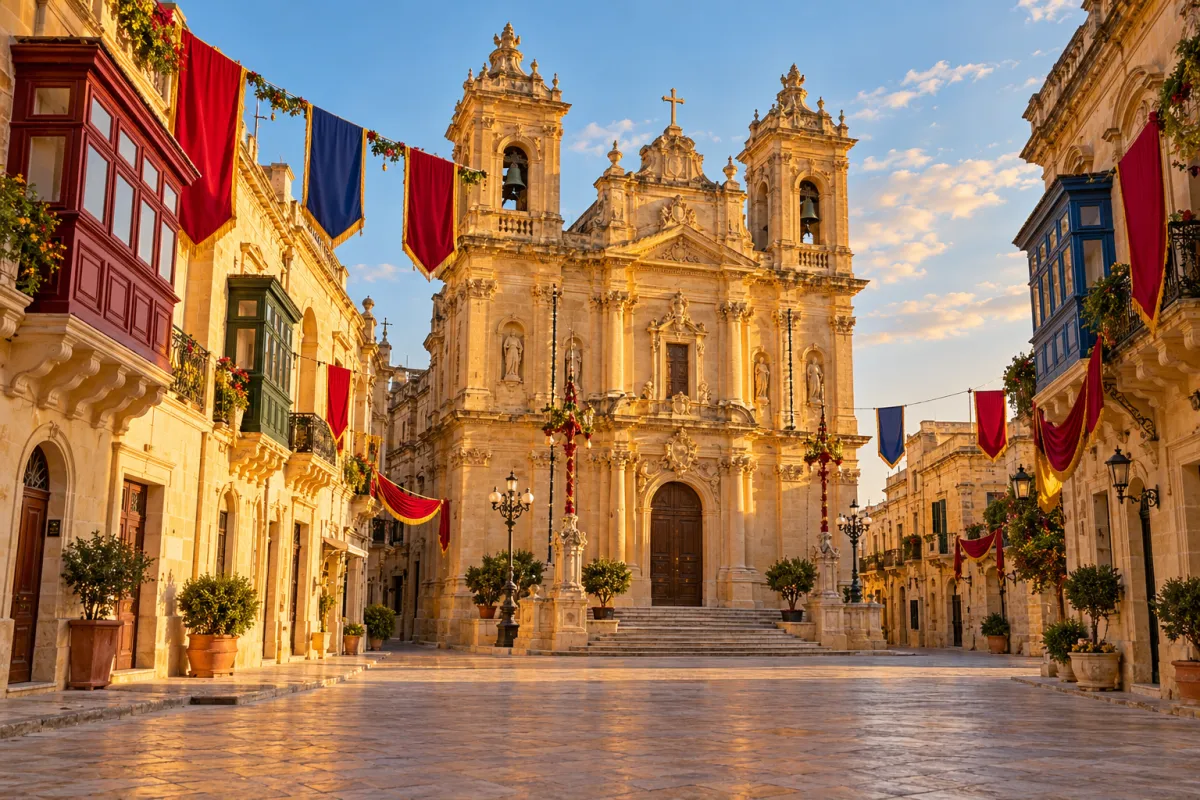
Most towns and villages have at least one band club, and some have two rival clubs linked to different saints or traditions. Clubs are busiest in the weeks before the summer festa, when volunteers decorate streets, set up statues and banners and help run events. Turning up regularly, offering a hand and buying your own drinks is a respected way in. Parish groups, local football clubs and local council activities work in the same way: low glamour, high repetition, and full of people who are not leaving in a year.
Language helps more than you expect
Everyone speaks English, so you do not need Maltese to live here. But a handful of greetings and a genuine attempt at pronunciation signal that you plan to stay, and that changes how people treat you. Our guide to learning Maltese, with courses, apps and phrases that help covers where to start, and a weekly evening class is also a ready-made anchor activity for your plan.
Keep the expat bubble, just widen it
Expat friends are not a failure. They understand what you are going through and are often available at short notice. The trick is to mix in people with long-term ties: Maltese colleagues, neighbours, long-term expats who married locally or have lived here for a decade. They are the bridge into Maltese circles. For more routes, see 12 ways to meet Maltese people beyond the expat bubble.
Friendships at work, remote work and study
In an office
Workplaces in Malta are often the single biggest source of friendships, especially in international sectors where many colleagues are also new. Join the five-a-side team, the charity run or the Friday lunch, and suggest small plans yourself rather than waiting for the social committee. Maltese colleagues may keep weekends for family but are often happy with weekday lunches and after-work coffees, which is where trust builds.
As a remote worker
If you came on the Nomad Residence Permit, which Residency Malta issues for one year and renews on application if you still meet the criteria, you may have no colleagues on the island at all. Build them back in. Book a coworking desk on the same days every week, take a daytime class or gym session at a fixed time, and set a recurring lunch with one person you meet there. Remote workers who rely only on evening events tend to meet the same short-stay crowd; daytime routines bring you into contact with people who actually live here.
As a student
The University of Malta in Msida hosts a large body of international and Erasmus students and has student associations for almost every interest, so join one linked to a hobby rather than only your nationality. English-school students usually get a social programme, which is a good start; the next step is one activity outside the school, so your friendships survive when classmates go home.
Meeting people at different life stages
In your 30s
In your 30s, the big mixer stops being fun and many peers are busy with partners, children or demanding jobs. What works is activity-based: sport, classes, volunteering and small dinners of four to six people. We go into detail in making friends in Malta in your 30s.
Over 40, over 50 and retired
Older newcomers often do best with structured groups that meet in daylight: walking groups, choirs, art classes, church communities and volunteering. These give you weekday contact that people in their 30s, juggling childcare, rarely have time for. Retirees also have a quiet advantage in Malta: time to show up to village events and parish activities consistently, which is exactly how belonging is built here.
Couples
Couples risk becoming a closed unit of two. Split up on purpose: one evening a week each doing your own activity, then introduce your new friends to each other. Hosting is your advantage, because a couple inviting two or three people for a simple dinner feels warm rather than intense.
Trailing spouse in Malta
If you moved for your partner’s job, you may have the hardest version: no colleagues, perhaps no work yet, and a partner who comes home tired with a ready-made social circle. Treat the first months as a project with a schedule: a daytime class, a volunteer slot and one weekly coffee with another partner in the same position. Ask whether your partner’s employer runs family or partner events; if not, the partners of their colleagues are often in the same boat and make a natural first contact. Above all, build some friendships that are yours, not only your partner’s.
Expat dads and parents
Dad-specific groups are thinner on the ground than mums’ groups, and we could not verify a standing expat dads group in Malta to recommend. So build it yourself: the school gate, children’s sports sessions and weekend playgrounds are where the contacts are. A message in the class chat such as ‘Some of us are taking the kids to the playground on Saturday at 10:00, coffee for the adults’ often forms the group by itself. Mums can start with our guide to expat mums in Malta, with groups and playgroups.
Weekends, Christmas and when friends leave
Weekends alone
Sunday is often the hardest day, because that is when Maltese families gather and the island goes quiet. Give yourself a default weekend routine that involves other people: a regular Saturday class, a Sunday morning walk you host, a volunteer slot once a month. A weekend with one small plan feels completely different from a weekend with none, even if the rest of it is spent alone.
Christmas in Malta on your own
Maltese Christmas is family-centred and many expats fly home, so ask early, ideally in November, who else is staying. Organise or join a shared Christmas lunch at someone’s flat with costs split. Fill the days around it with walks, the traditional Christmas cribs and the lights, and a call home at a fixed time so you have something to look forward to.
When friends leave Malta
Losing a close friend to a new job abroad is a real loss, so allow yourself to feel it and say a proper goodbye. Then look at your circle honestly: if it is all short-term arrivals, deliberately add people with roots here. Keep at least one anchor activity going even when life is good, so a departure never sends you back to zero.
Meeting new people safely
Most new connections in Malta are exactly what they seem, but a few habits keep first meetings easy and safe:
- Meet somewhere public for the first few times, such as a café, a seafront walk or a busy square.
- Tell a friend where you are going, when, and who you are meeting.
- Arrange your own way home and check the bus times back before you set off.
- Keep first meets short and leave whenever you feel uncomfortable; you owe nobody an explanation.
- Do not share your home address until you know someone well.
When it’s more than loneliness
Loneliness is painful but common. It is worth reaching out for support if low mood sticks around most days, if you stop eating or sleeping properly, if you are drinking more to cope, or if you have thoughts of harming yourself.
- In an emergency, call 112.
- Malta’s national Supportline, 179, is free and confidential.
- For GPs, counselling services and English-speaking therapists, see our guide to mental health support for expats in Malta.
This article is not medical advice; a professional can help you work out what you need.
Want to turn this into an actual plan? MeetNow is a free app for meeting people in person: a host posts a plan at a public place, says who pays (host pays, split, pay your own or free) and picks who joins. It is live on the web and works in your browser, starting in Malta. The Android app is on Google Play; the iPhone app is not in the App Store yet. Open MeetNow and see the plans posted in Malta.
Frequently asked questions
How do I meet people in Malta if I work from home?
Build colleagues back into your week. Book a coworking desk on the same days each week, join one daytime class or sport, and set a recurring lunch or walk with someone you meet there. Remote workers who rely only on evening events tend to meet the same short-stay crowd; daytime routines bring you into contact with people who live here long term.
Is it easy to make Maltese friends?
It is slower than making expat friends but usually lasts longer. Many Maltese adults have family and school networks that already fill their weekends, so friendships grow through repeated contact at work, band clubs, sport and village life. Say yes to invitations, learn a few Maltese phrases and keep showing up.
How long does it take to build a social life in Malta?
Most people need a full season of consistent effort before acquaintances turn into friends. If you repeat the same activities every week, as in the 90-day plan above, you can realistically expect familiar faces within a month and a few genuine friends by the end of the plan.
What can a trailing spouse in Malta do to meet people?
Treat the first months as a project: a daytime class, a volunteer slot and one weekly coffee with another partner in the same position. Ask whether your partner’s employer runs family or partner events, and build a circle that is yours, not only your partner’s colleagues.
Are there groups for expat dads in Malta?
Dad-specific groups are less established than mums’ groups, and we could not verify a standing one to recommend. The practical route is the school gate, children’s sports sessions and weekend playgrounds; suggest a regular Saturday morning playground meet in the class chat and the group often forms itself.
What should I do if I’m alone at Christmas in Malta?
Ask early, ideally in November, who else is staying, and organise or join a shared Christmas lunch at someone’s flat with costs split. Fill the days around it with walks, the Christmas cribs and lights, and a call home at a fixed time. If the season brings your mood very low, reach out to the support services listed above.