Malta universities are fewer than most newcomers expect: one university in the strict sense, three other publicly funded higher education institutions and a regulated group of private colleges. The short list is the University of Malta, MCAST, the Institute of Tourism Studies (ITS) and the Institute for Education, and the real decision is rarely “which university” but “which kind of qualification, taught where, for what cost”.
This guide maps every option an international student can realistically choose in 2026, shows how to check that a provider is licensed, and gives you a way to narrow the list down.
Quick answer: Malta has four publicly funded higher education institutions: the University of Malta, MCAST, ITS and the Institute for Education, according to the European Commission’s Eurydice network. Private colleges also operate, but each needs a licence from the national regulator, the MFHEA. For most international students the choice is between the University of Malta for academic degrees and MCAST for vocational and professional ones. Information last checked November 2026.
How higher education in Malta is organised
Malta is a small country with a compact system. Qualifications sit on the Malta Qualifications Framework (MQF), which Eurydice describes as covering levels 5 to 8, roughly equivalent to the diploma, bachelor’s, master’s and doctoral levels you know from elsewhere in Europe. First-cycle programmes at MQF level 5 or 6 generally ask for an MQF level 4 entry qualification, while master’s and doctoral programmes generally ask for an earlier degree.
The regulator is the Malta Further and Higher Education Authority (MFHEA). It accredits institutions and programmes, runs quality assurance and recognises qualifications. Three public institutions, the University of Malta, MCAST and ITS, have what Eurydice calls “self-accrediting status within specific limits”, while every other provider needs an MFHEA licence to operate. The practical point: the title on the door matters less than the licence and the accredited programme behind it. Source: Eurydice, Malta higher education, checked November 2026.
The four public institutions
University of Malta
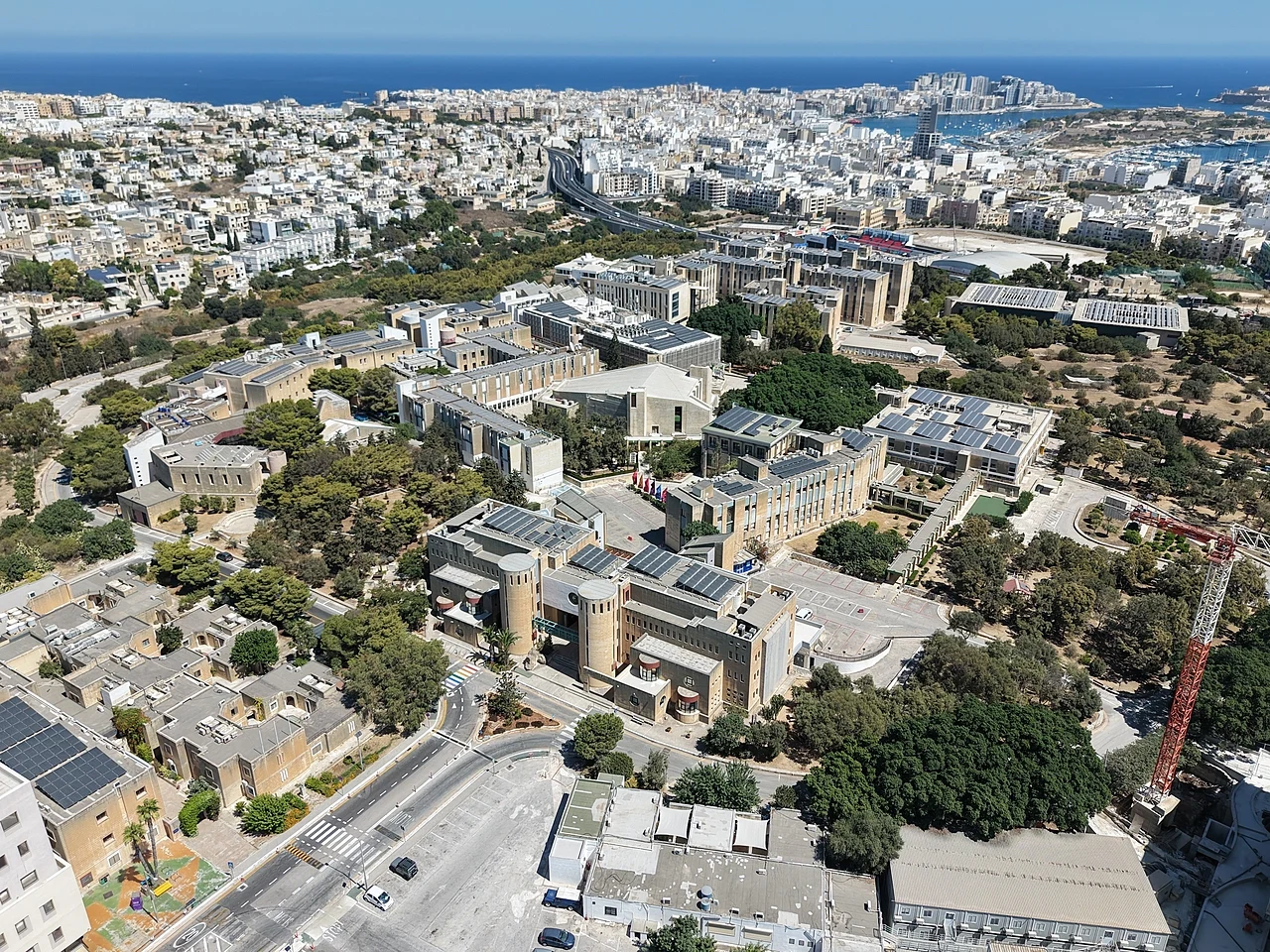
The University of Malta (UM) is the national university and the only one that most people would call a university in the traditional sense: faculties, research institutes and degrees from foundation level to doctorates. Its main campus is in Msida, a short bus ride from the harbour towns of Sliema and Gżira. Each course page states tuition fees for EU/EEA and non-EU/non-EEA applicants separately, and the university’s fees page lists an application processing fee of €100 for applicants with overseas qualifications up to the first deadline (€200 for late applications), as checked in November 2026 on UM’s fees and funding page. Our guide to the University of Malta for international students goes deeper on entry, fees and life on campus.
MCAST
MCAST, the Malta College of Arts, Science and Technology, is the vocational and professional institution, with certificates, diplomas, bachelor’s and master’s degrees and strong links to employers. Its main campus is in Paola. MCAST’s own pages state that no fees apply to Maltese and other EU nationals, while non-EU applicants pay fees from a published structure that can be paid in instalments; see MCAST’s fees page for non-EU candidates (the version linked in November 2026 was for 2024 to 2025, so ask the international office for the current figure). We cover it in detail in our MCAST international students guide.
Institute of Tourism Studies (ITS)
ITS is the national school for tourism and hospitality, and it has its own international students section and a tariff and fees page on its website. If you want a career in hotels, restaurants, events or travel, it is worth a look alongside MCAST. The ITS application and admission page lists the MQF level of each course, so you can see at a glance whether a programme is a diploma or a degree. ITS tuition is charged per academic year, and its tuition policy says international students pay an application processing fee.
Institute for Education
The Institute for Education (IfE) serves the education sector, with a focus on training and professional development for people working in or entering schools and learning support. It is the least relevant to most international applicants, but if teaching or education management is your field it is the institution to ask about.
Private colleges and overseas awards
Beyond the public four, Malta has private further and higher education colleges. Some award their own qualifications, often at MQF level 5. Others deliver degrees awarded by an overseas university, with the college providing teaching, support and a Maltese licence.
A concrete example is Saint Martin’s Institute of Higher Education in Ħamrun. On its own website it states that it is licensed by the MFHEA (licence number 196), that all its programmes are accredited by the MFHEA, that the language of tuition is English, and that it confers its own qualifications at MQF level 5 while its honours degrees at level 6 are conferred by the University of London. Treat that as the college’s own description and confirm it on the MFHEA register, but it illustrates the model well: a licensed provider, an accredited programme, and an awarding body you should name in your own notes before you pay a deposit.
Provider licences also lapse or get revoked. The MFHEA has published notices about unaccredited programmes and about providers whose licences were withdrawn, so a glossy website is never enough on its own.
Malta universities compared
| Institution | Type | Typical levels | Main campus area | What to check for non-EU fees |
|---|---|---|---|---|
| University of Malta | Public university | Foundation to doctorate | Msida | Fee shown on each course page for non-EU/non-EEA applicants |
| MCAST | Public vocational college | Certificate to master’s | Paola, with campuses in Mosta, Gozo and Qormi | MCAST’s published full-time fee structure; instalments available |
| ITS | Public tourism and hospitality institute | Diploma to master’s, per MQF level on its site | Malta | ITS tariff and fees page; per academic year |
| Institute for Education | Public education institute | Professional and postgraduate education programmes | Malta | Ask the institute directly |
| Private colleges | Licensed by the MFHEA | Mostly diploma and bachelor’s, some master’s | Varies, often central Malta | Provider’s fee page; confirm what the fee covers and who awards the degree |
Last checked November 2026. I have not listed tuition amounts because published figures differ by course, year and nationality; every institution above publishes its own, and third-party guides often contradict them.
How to check a licence and accreditation
Use this short checklist before you send money to any provider other than the four public institutions:
- Find the provider on the MFHEA register. The authority publishes a database of licensed providers and a separate list of accredited programmes. The MFHEA site sometimes blocks automated tools but opens normally in a browser.
- Check the programme, not just the school. A licensed provider can still advertise a course that is not on its licence.
- Look for the MQF level. A bachelor’s should be at MQF level 6, a master’s at level 7.
- Ask who awards the qualification. The college, the University of Malta or a named overseas university.
- Get fees, deposit and refund rules in writing, and ask whether the fee covers exams and resits.
- Be wary of agents who cannot name the licence number or who push you to pay before an offer letter.
How to choose
Choose the University of Malta if…
- You want an academic degree in a field such as law, medicine, sciences, humanities or a research route.
- You are an EU student and want to see whether your course is fee-free on the course page.
- You plan a master’s or doctorate later. Our guide to a master’s degree in Malta covers that route.
Choose MCAST if…
- You want a hands-on qualification in IT, engineering, business, care or creative trades.
- You value placements and employer contacts over a research-heavy programme.
- You are a non-EU student who can use the final-year fee exemption on three- and four-year bachelor’s degrees, which MCAST describes on its fees page.
Choose ITS if…
- You already know you want a career in tourism or hospitality.
Choose a private college if…
- Its niche programme is what you need, such as a specific computing or business route, and you have checked the licence and the awarding body.
- You are comfortable paying fees and want a different admissions style from the public institutions.
Costs, application fees and living expenses
Tuition is only part of the cost of studying in Malta. Housing is usually the largest monthly expense, and rooms near the University of Malta in Msida, Gżira and Sliema command higher rents than southern towns near MCAST in Paola. Our student accommodation guide compares residence, homestay and shared flats, and the studying in Malta guide pulls the whole budget together.
| Cost | What the sources say |
|---|---|
| University of Malta application fee | €100 for overseas qualifications up to the first deadline; €200 late (UM fees page) |
| MCAST EU students | No fees per MCAST pages |
| MCAST non-EU students | Published fee structure, paid in instalments; final-year exemption on three- and four-year bachelor’s degrees |
| Tax refund route | MCAST says all students may apply for a 70% tuition refund as a tax rebate after completing the course, if they qualify |
| Private colleges | Set by each provider; ask for the full cost in writing |
Student life outside the lecture hall
Whichever institution you pick, campus life is smaller and quieter than in a big university city. Plan a few anchor activities in your first month: a weekly sports session, a language exchange, a regular study spot. A quick tour video can help you picture the biggest campus before you commit.
Our guide to studying in Malta has weekly plans and budgets, and the main pitfalls are the same everywhere: leaving visa paperwork late, assuming fees match a friend’s and underestimating rent.
Open MeetNow (it runs in your browser, no download needed). Plans start in Malta: join one or post your own.
Frequently asked questions (FAQ)
How many universities are there in Malta?
Strictly one: the University of Malta. Malta also has three other publicly funded higher education institutions, MCAST, the Institute of Tourism Studies and the Institute for Education, plus private colleges licensed by the MFHEA. Which counts as a university in everyday speech varies, so judge by the qualification and its MQF level.
Which is the best university in Malta for international students?
There is no single best. The University of Malta has the widest range of academic degrees, MCAST suits practical and vocational careers, ITS focuses on tourism and hospitality, and private colleges offer niche programmes. Choose by course, entry requirements, cost and how you want to live.
Is a degree from a private college in Malta valid?
It can be, if the college holds an MFHEA licence and the specific programme is accredited. Check both on the MFHEA register before paying, and ask who awards the degree: the college itself or an overseas university.
Are Malta universities taught in English?
Many programmes are, and the University of Malta and MCAST both publish English-language entry requirements for overseas applicants. Always check the language of instruction on the individual course page, because some courses are taught partly or wholly in Maltese.
Do EU students pay tuition at Malta universities?
MCAST states that no fees apply to Maltese and other EU nationals. At the University of Malta, fees are shown on each course page for EU/EEA and non-EU/non-EEA applicants, so read the page for your programme.
Can I work while studying at a Malta university?
EU students can work freely. Non-EU students face limits tied to their permit, so check the current rules before relying on a part-time income.
Cover image: Christian Camenzuli, CC BY-SA 4.0, via Wikimedia Commons.