A private car sale in Malta comes down to one document: the original logbook, which must be signed by the seller, the buyer and a witness before anything moves (Transport Malta). Get that page wrong and the transfer bounces back, however good the car is. If you are buying a used car in Malta as expat, the order of operations matters more than haggling: residence document first, insurance in your own name second, signatures last.
I have watched friends learn this the hard way: signing in the wrong box on a café table, or handing over cash for a car that still had a finance agreement attached. None of it is complicated once you know the sequence. Below is the process I walk newcomers through: what Transport Malta actually asks for, what to check on the car, how to meet a private seller sensibly, and what parking looks like once the car is yours.
One honest caveat before you start: rules, fees and forms change, and this is a practical guide, not legal advice. Where something depends on your personal situation, I point you to the official source rather than guessing.
Do you actually need a car in Malta?
Plenty of newcomers buy a car in their first fortnight and regret it by the second month. Traffic along the Sliema, St Julian’s and Msida stretch crawls at peak times, parking in dense towns is a daily puzzle, and the bus network reaches most localities. Before you commit, spend a few weeks on public transport and note which journeys are genuinely painful and which are just slower than you are used to.
Your very first trip is a good test. The Malta airport to Valletta bus gives you a feel for how routes, stops and timings work in practice, and our guide to Malta bus routes and the Tallinja app covers the key lines from there. Once you are resident, the Tallinja card and free travel for residents can change the maths completely, so check current fares and rules on Malta Public Transport before you decide a car is essential.
In my experience, a car tends to make sense if you:
- Commute to an industrial estate or a village where buses are infrequent.
- Work shifts that start or finish when buses are sparse.
- Regularly carry sports gear, tools, a dog or children.
- Want easy access to quieter beaches in the north and west.
- Live somewhere with a garage or a reliable off-street space.
If two or more of those apply, keep reading. If none do, a mix of buses, the odd taxi and a bike may serve you better for your first year.
Documents you need before you start
Transport Malta is strict about who can become the registered owner of a vehicle. A transfer can only go to someone holding a legally valid Maltese identification or residence document, an acknowledgment from the Expatriate Office, or a copy of a notary contract showing the acquisition of property in Malta or Gozo (Transport Malta). For most people renting on a work or study route, that means waiting until the residence document is physically in hand.
Here is the paperwork pile for a typical private sale:
- The original logbook (officially the Vehicle Registration Certificate), held by the seller.
- Copies of ID cards or residence documents for the seller, the buyer and the witness.
- An insurance policy in your own name, effective from the date of transfer.
- A hire-purchase cancellation document, if the car was bought on finance.
- Confirmation that road licence fees, contraventions and penalties are settled on the vehicle.
If you have not yet set up your digital access to government services, our guide to getting and activating your Malta e-ID explains the appointment process. It is not strictly part of the car purchase, but it makes later admin, from checking records to renewals, far smoother.
Your driving licence
Owning a car and being allowed to drive it are two separate questions. Whether you can use your foreign licence, and for how long, depends on where it was issued and on your residence status. Our guide to Malta driving licence conversion, parking and costs walks through the general picture. For your exact case, confirm with Transport Malta before you insure the car, because the insurer will ask which licence you hold and that answer affects your cover.
Buying a used car in Malta as expat: step by step
These steps follow the order that avoids the most common hold-ups. Skipping ahead, especially paying before steps 1, 6 and 7 are done, is where most problems start.
1. Confirm you qualify as a registered owner
Before you view a single car, check that your document is on the accepted list above. If your residence application is still pending, ask Transport Malta or the Expatriate Office what they will accept rather than relying on a seller’s assurance that “it will be fine”. Sellers want a sale; they will not be the ones standing at the broker’s desk when the transfer is refused.
2. Set a realistic budget
The asking price is only part of the cost. Add insurance, the road licence, an independent mechanic’s inspection, the transfer fee, tyres if the current set is worn, and a buffer for the first service. Insurance is usually the swing factor for newcomers, because a short local driving history can push quotes up. Get two or three quotes on a sample make and model before you shortlist, so the number does not ambush you later.
3. Choose between a dealer and a private seller
Dealers generally charge more but often handle the transfer paperwork and may offer a limited warranty; ask exactly what is included and get it in writing. Private sales are cheaper and more common for older cars, but every check in this guide becomes your job. Either way, the same Transport Malta requirements apply to you as the new owner.
4. Shortlist cars that suit Maltese roads
Small hatchbacks dominate for good reasons: narrow village cores, tight garage ramps and scarce kerbside spaces. Automatics are popular because stop-start traffic and steep streets are hard on clutches. Air conditioning is not a luxury in summer. Also think about where the car will live: on-street in a seaside town means salt air, strong sun and the occasional scrape from a neighbour’s bumper.
5. Inspect and test-drive
Arrange the viewing in daylight, ask the seller not to warm the engine beforehand, and drive on a mix of flat road and a proper hill. Then book an independent mechanic before you agree a final price. The full checklist is further down.
6. Ask the seller to clear the car’s history
Any active hire-purchase restriction must be cancelled with an official document, and any outstanding road licence fees, contraventions or system penalties tied to the vehicle must be settled before the transfer can go through (Transport Malta). Make this the seller’s responsibility in writing, and do not pay in full until it is done.
7. Arrange insurance in your own name
Transport Malta requires a valid insurance policy issued in the new owner’s name, effective as of the date of the transfer (Transport Malta). A friend’s policy or the seller’s existing cover does not count. Give the insurer the exact date you will take ownership, and keep the policy document both on your phone and on paper in the glovebox.
8. Sign the logbook carefully, with a witness
The seller, the buyer and the witness each sign the original logbook, and each supplies a copy of their ID or residence document. Agree in advance who will act as witness so nobody is scrambling on the day. Read every box before you sign: if the logbook is filled out or signed incorrectly, Transport Malta rejects it, and a signed declaration to null the transaction is needed on Form VEH 50 (Transport Malta). No crossing out, no correction fluid, no “we’ll fix it later”.
9. Complete the transfer and collect the new logbook
You do not necessarily need to queue at a Land Transport office in Paola or Hal Lija. Standard transfers can typically be processed directly through a licensed insurance agency or broker, which updates the policy and registers the change of ownership at the same time (Transport Malta). Transport Malta charges a standard administrative fee of typically €10 for processing the change of ownership and issuing the new logbook (Transport Malta). Pay the seller at the point of transfer, ideally by bank transfer so there is a clear record; if your banking is not set up yet, see our guide to opening a bank account in Malta.
10. Sort the first-week admin
Check that the new logbook shows your name and the correct vehicle details, note the road licence renewal date in your calendar, save your insurer’s breakdown number, and learn the parking rules for your street before you leave the car there overnight. Keep copies of every document from the sale in one folder; you will want them when you eventually sell.
What it costs: transfer and running costs table
Only one item below is a fixed government fee. Everything else depends on the car, your profile and your negotiation, so treat the right-hand column as a list of things to get quotes for, not a price list.
| Item | What it covers | Cost |
|---|---|---|
| Change of ownership and new logbook | Transport Malta administrative fee | Typically €10 (Transport Malta) |
| Motor insurance | Mandatory policy in your name from the transfer date | Quote-based; depends on your age, licence history and the car |
| Road licence | Must be valid and up to date on the vehicle | Varies by vehicle; check with Transport Malta |
| Hire-purchase cancellation | Only if the car was bought on finance | Seller arranges before the sale |
| Outstanding fines and penalties | Must be settled before transfer | Seller should clear before the sale |
| Form VEH 50 declaration | Only if the logbook is signed incorrectly | Avoidable with care |
| Independent mechanic inspection | Optional but strongly advised | Agree a price before booking |
When you collect insurance quotes, ask whether the agency also processes the transfer and whether it adds any handling charge of its own, so you know the full amount before you arrive at the desk.
The pre-purchase checklist
Malta is small, cars do short hops, and many look tidy on the outside. What you are really checking for is the effect of salt air, heat, hills and tight parking, plus clean paperwork.
Paperwork checks
- The name on the logbook matches the seller’s ID. If it does not, stop and ask why.
- The chassis number on the logbook matches the one on the car, usually visible at the base of the windscreen or inside a door frame.
- The seller can show the latest roadworthiness (VRT) certificate and any service records.
- The seller confirms in writing that there is no hire-purchase restriction, or provides the cancellation document.
- The seller confirms that road licence fees and any fines are settled.
Mechanical checks
- Rust: look along the sills, inside the wheel arches and under the boot carpet. Seafront parking is hard on metal.
- Clutch and gearbox: on a manual, a high biting point or slipping on a hill suggests a clutch nearing the end. On an automatic, watch for jerky or delayed shifts.
- Air conditioning: it should blow properly cold quickly. Regassing is cheap; a failed compressor is not.
- Cooling system: check the temperature gauge stays steady in slow traffic, not just on an open road.
- Tyres and brakes: uneven tyre wear can point to alignment issues from kerbs and potholes.
- Warning lights: every dashboard light should come on at ignition and go out once the engine is running.
- Damp: a musty smell or water marks under the mats can mean flood exposure from heavy autumn rain in low-lying streets.
A good independent mechanic will put the car on a lift and tell you what needs attention soon versus later. Use the report to negotiate, or to walk away without regret.
Meeting a private seller safely
Viewing a car usually means meeting a stranger, often alone if you have only just arrived. The same rules I would give for any first meeting apply here:
- Meet in a public place, such as a busy car park or outside the seller’s building in daylight, not a quiet lay-by.
- Tell a friend where you are going, the seller’s number and the car’s details.
- Have your own way home. Know your bus route or have a taxi option ready, so you never feel obliged to accept a lift or a deal.
- Leave if you feel uncomfortable, whether that is pressure to pay a deposit on the spot or a story about the car that does not add up.
- Do not carry the full price in cash. Complete payment at the broker with the paperwork in front of you.
If you can, bring a friend who drives. A second opinion on the test drive is worth a lot, and someone else noticing the rattle you missed can save you a costly repair.
Malta parking rules to know before you buy
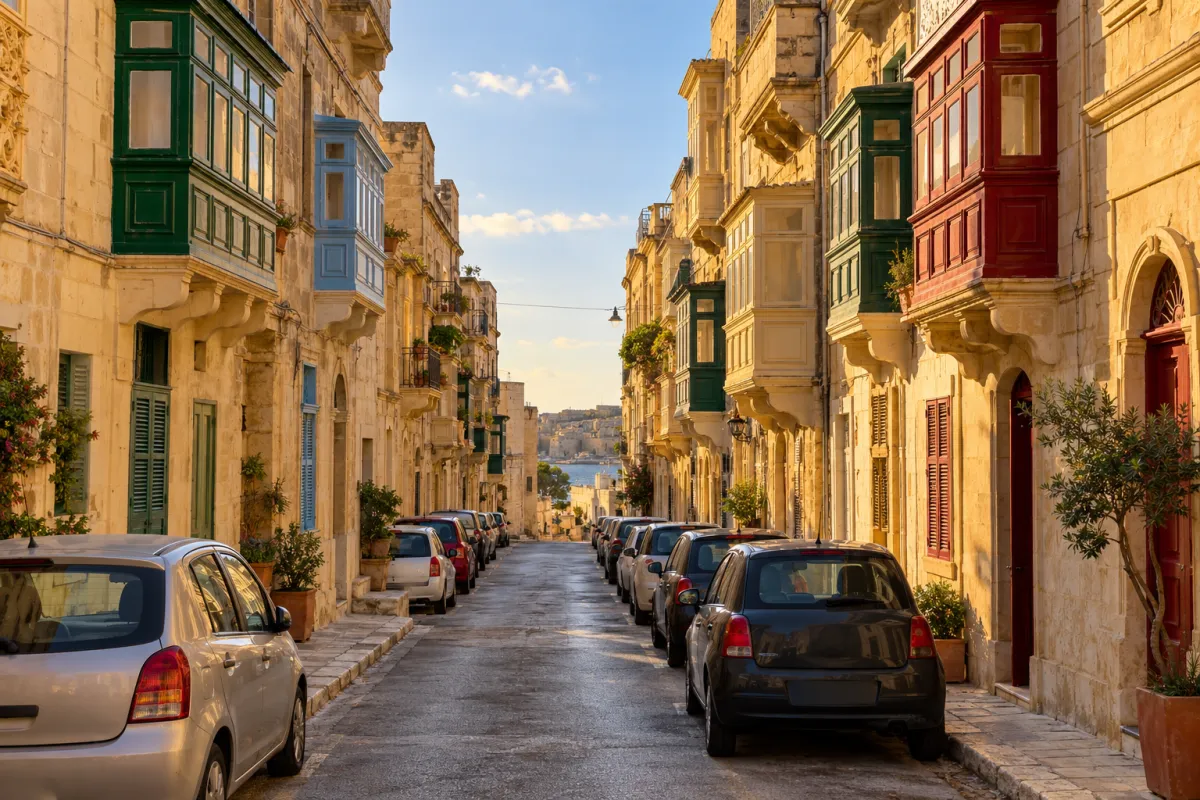
Parking shapes car ownership here more than fuel or insurance does. Before you buy, walk your street at different times of day and count the realistic spaces. A few practical points:
- A yellow line along the kerb means you should not park there, and enforcement is active in busy areas.
- Some localities run residents’ parking schemes in parts of town, with bays reserved for permit holders at certain times. Read every sign on the street, not just the nearest one, and ask your local council how the scheme works.
- Blocking a garage entrance, even briefly, is one of the quickest ways to collect a fine or a tow.
- Corners, pavements and bus stops are off limits, however tempting they look late in the evening.
If you are still deciding where to rent, parking pressure belongs in the decision alongside rent and bus links; our guide on where to live in Malta compares areas honestly. For the fuller picture on Malta parking rules, fines and licence conversion, the driving in Malta guide goes deeper.
Common mistakes expats make
Avoid these
- Paying a deposit before confirming eligibility. If your residence document is not accepted, the transfer cannot happen.
- Signing in the wrong box or correcting an entry. The logbook is rejected and you are into Form VEH 50 territory.
- Assuming the seller’s insurance covers the drive home. Your own policy must be live from the transfer date.
- Not asking about finance. A car with an active hire-purchase restriction cannot be transferred until it is cancelled.
- Skipping the independent mechanic. A clean exterior hides rust, tired clutches and weak air conditioning.
- Forgetting the witness. No witness and no copy of their ID means no transfer on the day.
- Buying before checking parking at home. A car you cannot park near your flat becomes a daily stress.
Handled in the right order, buying a used car in Malta as expat is a one-afternoon job at the broker’s desk rather than a saga. Do the checks, keep the paperwork tidy, and the car becomes a way to see more of the islands rather than another admin headache.
Once you have wheels, a drive up to the quieter northern bays is more fun with company.
Want to turn this into an actual plan? MeetNow is a free app for meeting people in person: a host posts a plan at a public place, says who pays (host pays, split, pay your own or free) and picks who joins. It is live on the web and works in your browser, starting in Malta. The Android app is on Google Play; the iPhone app is not in the App Store yet. Open MeetNow and see the plans posted in Malta.
Frequently asked questions
Can I buy a used car in Malta before my residence card arrives?
Transport Malta only transfers a vehicle to someone holding a legally valid Maltese identification or residence document, an acknowledgment from the Expatriate Office, or a notary contract showing property acquisition in Malta or Gozo. If your application is still pending, confirm with Transport Malta what you can use before paying a deposit.
Do I need to visit a Transport Malta office to transfer ownership?
Usually not. Standard transfers can typically be processed through a licensed insurance agency or broker, which issues your policy and registers the change of ownership at the same time. Unusual cases may still need a visit to a Land Transport office.
How much is the change of ownership fee?
Transport Malta charges a standard administrative fee of typically €10 for processing the change of ownership and issuing the new logbook (Transport Malta). Insurance, road licence and any inspection costs are separate.
What happens if the logbook is signed in the wrong place?
Transport Malta rejects a logbook that is filled out or signed incorrectly, and a signed declaration on Form VEH 50 is needed to null the transaction. Read every box before anyone signs, and never cross out or correct an entry.
Can I drive my new car on my foreign licence?
It depends on where your licence was issued and on your residence status. Check the official Transport Malta guidance for your situation and tell your insurer exactly which licence you hold, because it affects your cover.
Who pays outstanding fines or road licence fees on a used car?
Outstanding road licence fees, contraventions and system penalties tied to the vehicle must be settled before the transfer can go through. In a private sale, agree in writing that the seller clears them before you pay.