Most people who move here for work never fill in a Malta social security number application themselves. If you are a non-Maltese national starting your first job, the Jobsplus engagement form your employer submits normally sets the process in motion, and the number is issued without you touching a form. The people who end up applying by hand are usually those whose details do not line up with government records, or whose situation the automatic route does not cover.
That distinction matters because the most common newcomer mistake is doing the paperwork twice: booking a visit, queuing, and then finding out HR had already triggered the number weeks earlier. The second most common mistake is the opposite: assuming it is all automatic, then discovering the first payslip has no number on it because a surname was spelled one way on the passport and another way on the residence card.
What follows is the practical version, from someone who has watched plenty of friends go through it: who needs a separate number, how the automatic route works, how to apply manually through the eForm or a Servizz.gov hub, and what to sort out once the number arrives. Rules on eligibility can change, so treat the Department of Social Security website as the final word. This guide is a map, not legal advice.
If you are a non-Maltese national taking up your first job in Malta, you usually do not apply yourself: the Jobsplus engagement form submitted by your employer (or by you, if self-employed) triggers the social security number automatically, provided your details match the records held by Identità. If you need to register manually, use the Department of Social Security eForm on gov.mt or get help at a Servizz.gov hub. Holders of a permanent Maltese Identity Card use their ID card number as their social security number.
Who actually needs a Malta social security number application
Your social security number (SSN) is the reference the state uses to record your contributions while you work. Whether you need to apply, and whether you need a separate number at all, depends on three things: the card you hold, whether you are starting employment, and whether your personal details match what the authorities already have on file. Work through the three cases below before you open any form.
Starting your first job: the Jobsplus engagement form does the work
According to the Department of Social Security, non-Maltese nationals taking up employment for the first time typically do not need to apply manually: when the employer, or the worker if self-employed, submits a Jobsplus Engagement Form, the details are transmitted automatically to the department so that an SSN can be issued. The condition attached is the part people overlook. Your details have to match the official records held by Identità, the agency that handles identity and residence documents.
In practice, your job is not to apply but to check. Ask HR, ideally by email so you have it in writing, whether the engagement form has been submitted. If you are self-employed, the engagement form is yours to submit, so put it near the top of your admin list rather than leaving it until your first invoice. Either way, compare the name, date of birth and nationality on the form with your passport and residence card. A missing middle name or a reversed surname is enough to stop the automatic match.
Permanent Maltese ID card holders: your ID number is your SSN
If you hold a permanent Maltese Identity Card from the M, L, G or H series, you do not receive a separate number: since October 2016 the Identity Card number itself serves directly as the social security number (socialsecurity.gov.mt). This applies to citizens holding a permanent card. If that describes you, there is nothing to apply for; give your employer your ID card number and move on to the next errand.
Residence card ending in A: you need a separate number
Look at the number printed on your residence card. If it ends in the letter A, which is typical for third-country nationals and EU citizens taking up employment, you need a distinct social security number. The same goes for anyone without a permanent Maltese Identity Card. For most people reading this site, this is the category you fall into, and the question is simply whether the number arrives automatically or whether you need to register manually.
If your residence card is still being processed, or you have it but have not set up online access yet, our guide to getting, activating and using your Malta e-ID explains the appointment side of things. Having your residence card in hand makes every step below easier, because it is the document your details will be checked against.

Which route applies to you
The table below summarises the routes as the Department of Social Security describes them. Instead of fees, the last column shows the effort involved, because the official information we checked does not list a fee for issuing the number. If cost matters to your situation, confirm on the official page before you apply.
| Your situation | Separate SSN needed? | How it is issued | Effort on your side |
|---|---|---|---|
| Non-Maltese national, first job with an employer | Yes | Automatically, after the employer submits the Jobsplus Engagement Form | A check with HR and a careful look at your details |
| Self-employed, first time | Yes | Automatically, after you submit the Jobsplus Engagement Form | Submitting the form yourself, with details that match your documents |
| Residence card ending in A | Yes, a distinct number | Via the engagement form when starting work, or by manual registration | Low if the automatic route works; one online form if not |
| Permanent Maltese Identity Card (M, L, G or H series) | No | The ID card number serves as the SSN | None |
| Automatic route did not produce a number, or manual registration required | Yes | eForm on gov.mt, or assisted at a Servizz.gov hub | One online application or one in-person visit |
If you cannot tell which row describes you, the quickest answer usually comes from your employer’s HR or payroll team, who deal with this for every new starter, rather than from an expat forum thread written several years ago.
Malta social security number application: step by step
These steps assume you hold, or are about to receive, a residence card ending in A. If you are a permanent ID card holder, stop at step one.
- Check whether you already have a number. Look at your card type first. Then look at any payslip you have received: if a social security number appears on it, the automatic route has already worked and you do not need a Malta social security number application of any kind. Ask HR before assuming otherwise.
- Confirm the Jobsplus engagement form has been submitted. If you are employed, ask HR to confirm the engagement form has gone in and ask which details were entered. If you are self-employed, submit it yourself. This is the step that triggers the number for most first-time workers.
- Make your details identical everywhere. Your name order, spelling, date of birth and nationality should match across your passport, your residence card and the engagement form. Transliterated names, double surnames and dropped middle names cause most mismatches. If something on your residence record is wrong or has changed, sort it out with Identità before anything else, because the automatic match is made against their records.
- Give it a reasonable period, then follow up. There is no point applying manually the week after HR submits the form. If your first payslip arrives without a number, or HR tells you the number has not come through, that is your signal to move to the manual route.
- Apply through the eForm if manual registration is needed. The Department of Social Security offers an online eForm, Application for a Social Security Number, on gov.mt. Have your passport, residence card details, Maltese address and a phone number and email you actually check to hand. Some gov.mt forms ask you to log in with your e-ID, so set that up first if yours has not been activated.
- Use a Servizz.gov hub if you prefer help in person. Applications can be processed or assisted at local Servizz.gov hubs. This suits anyone whose case is unusual, whose e-ID is not working, or who simply wants someone to look over the details with them. Bring originals, not just photos on your phone.
- Record the number and pass it on. Once issued, give the number to your employer if they do not already have it, store a copy somewhere secure, and check that it appears correctly on your next payslip.
That is genuinely the whole process for most people. The paperwork itself is light; delays almost always come from mismatched details or from not knowing which route you are on.
Online eForm or Servizz.gov hub: which to use
The eForm is the faster option if your situation is straightforward: you know your details are correct, your e-ID works, and you simply need to register because the automatic route did not happen. You can complete it from your flat, keep a record of what you submitted, and avoid planning a trip around bus times.
A Servizz.gov hub makes more sense when something is not straightforward. Typical examples are a name that appears differently across documents, a residence card that has just been renewed, or an e-ID login that keeps failing. Sitting with someone who can see the record often resolves in one visit what would otherwise become several rounds of email.
Getting to a hub without losing half a day
Hubs are spread across Malta, so start with the one nearest to where you live or work. If you are relying on public transport, plan the trip with our overview of key Malta bus routes and the tallinja app, and leave yourself a buffer, because buses can bunch up or run late in traffic.
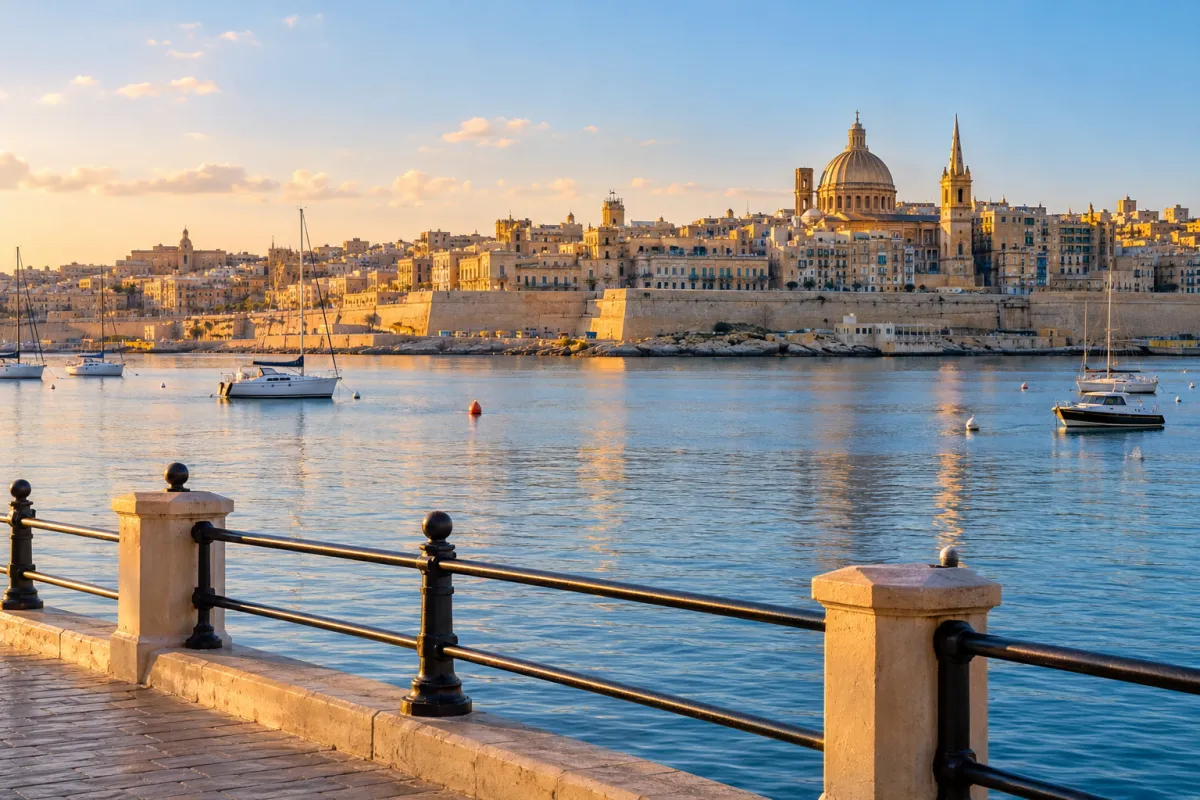
If your errands take you into the capital and you are coming from the Sliema side of the harbour, the ferry across Marsamxett is often a calmer option than the bus. Check the current Valletta to Sliema ferry times on the operator’s official timetable before you rely on it, since sailings can change through the year, and allow for a short walk from the landing up into the city.
One small thing that helps more than it should: put a Maltese mobile number on any form you submit. Officials and HR teams are far more likely to call a local number back, and if you have not picked a network yet, our comparison of the best SIM cards in Malta from GO, Epic and Melita will help you choose one.
After you have the number: payroll, banking and health
Once the number exists, it mostly works in the background. Your employer uses it for your contributions, and you will be asked for it again when dealing with other parts of the state system. Keep it with your residence card details rather than in a screenshot you will never find again.
Banking and Revolut
Plenty of newcomers arrive with a Revolut account and use it for daily spending while a local bank account is being opened, which can take a while. If you are searching for Revolut Malta advice, the key point is that your social security number has nothing to do with which bank account your salary lands in. Whether your employer can pay into a particular account is a question for HR and payroll, while opening a local account is a separate process that is covered in our guide to opening a bank account in Malta, including the documents banks tend to ask for.
Healthcare and the European Health Insurance Card
EU citizens often arrive with a European Health Insurance Card issued by their home country, and searches for European Health Insurance Card Malta information usually come from people wondering whether it replaces local registration. It does not do the same job. The EHIC is designed for temporary stays, whereas your social security number is the reference for your contributions as someone living and working here. Questions about your healthcare entitlement as a resident belong with the official health and social security offices. For the practical side, such as registering with a GP, how Mater Dei works and when private insurance is worth having, see our guide to healthcare in Malta for expats.
Benefits and anything legal
Entitlement to benefits, contribution rules and anything linked to your residence status depend on your circumstances and can change. Do not rely on what a colleague received in a different year. Read the relevant page on the Department of Social Security website or ask the department directly, and treat everything here as a starting point.
Common mistakes that slow things down
Avoid these
- Applying manually before checking with HR. If the Jobsplus engagement form has already been submitted, a separate Malta social security number application can create confusion rather than speed things up.
- Small differences in your name. A missing middle name, a different transliteration or swapped surnames can stop the automatic match with Identità records. Make every document read the same way.
- Mixing up your card types. A permanent Maltese Identity Card number doubles as the social security number; a residence card ending in A does not. Check which card you actually hold.
- Using a foreign number or an inbox you never check. If someone needs to clarify your details, a missed call or an unread email can stall the process for weeks.
- Visiting a Servizz.gov hub with photos instead of originals. Bring your passport and residence card. Copies on your phone are a useful backup, not a substitute.
- Not checking your first payslip. It is the simplest way to confirm your number exists and has been recorded correctly.
- Treating old forum posts as the rules. Procedures change. The official department page is the source to trust.
None of these are dramatic, and none of them will get you into trouble. They simply turn a light piece of admin into a drawn-out one, at exactly the moment you would rather be settling into a new job and a new flat.
The first few weeks of admin can feel solitary when you arrive alone: forms, queues, bus timetables and not many people to grab a coffee with afterwards. Once the paperwork is done, it helps to have a few faces around.
Want to turn this into an actual plan? MeetNow is a free app for meeting people in person: a host posts a plan at a public place, says who pays (host pays, split, pay your own or free) and picks who joins. It is live on the web and works in your browser, starting in Malta. The Android app is on Google Play; the iPhone app is not in the App Store yet. Open MeetNow and see the plans posted in Malta.
Whenever you meet someone new, keep it simple and safe: choose a public place, tell a friend where you are going, sort out your own way home, and leave if anything feels uncomfortable.
Frequently asked questions
Do I need to apply for a social security number if I have a job in Malta?
Usually not. If you are a non-Maltese national taking up employment for the first time, the Jobsplus Engagement Form submitted by your employer passes your details to the Department of Social Security, which issues the number automatically, as long as your details match the records held by Identità. Ask HR to confirm the form has been submitted.
How do I apply for a Malta social security number online?
If you need to register manually, use the eForm called Application for a Social Security Number on gov.mt, run by the Department of Social Security. Enter your details exactly as they appear on your passport and residence card, and keep a copy of whatever confirmation you receive.
Can I get help with the application in person?
Yes. Applications can be processed or assisted at local Servizz.gov hubs around Malta. Bring your original passport and residence card, plus your Maltese address and a local phone number you actually answer.
I have a Maltese ID card. Do I need a separate social security number?
Not if it is a permanent Maltese Identity Card from the M, L, G or H series. For those cards, the ID card number itself serves as your social security number, so you simply give that number to your employer.
My residence card number ends in A. What does that mean?
A residence card ending in A, which is typical for third-country nationals and EU citizens taking up employment, means you need a separate social security number. For a first job this is normally issued via the Jobsplus Engagement Form; if that does not happen, use the eForm or a Servizz.gov hub.
Is a social security number the same as a European Health Insurance Card?
No. The social security number is the reference for your contributions in Malta, while the European Health Insurance Card is a separate EU card meant for temporary stays. Questions about your healthcare entitlement as a resident belong with the official health and social security offices.