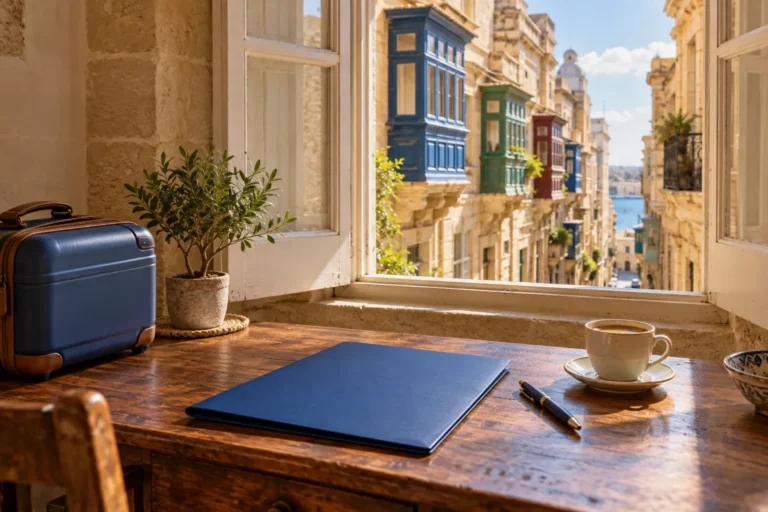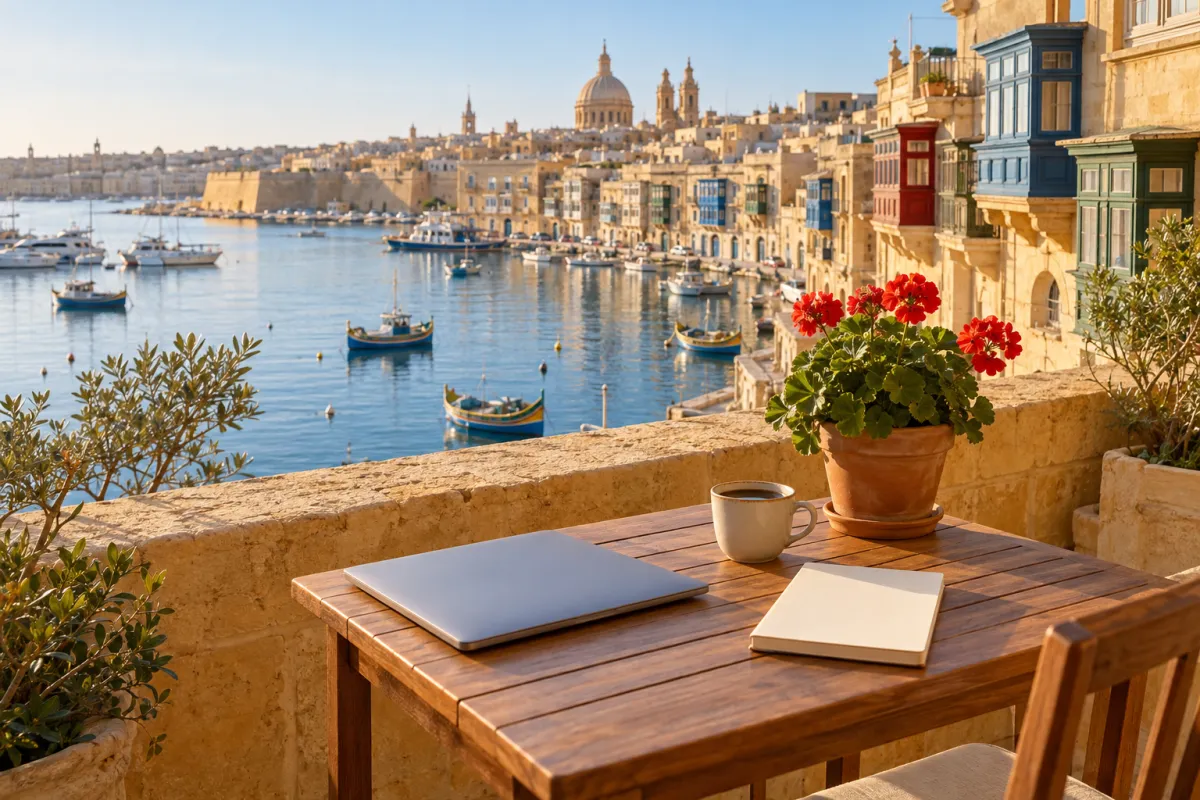
The Malta nomad residence permit income requirement is a gross yearly income of at least €42,000 from qualifying remote work, according to the Residency Malta Agency. Most people search for that number first. It is also the one that trips people up, because the word “qualifying” carries a lot of weight in that sentence.
I have watched plenty of remote workers arrive in Malta with the threshold memorised and the details fuzzy. They are unsure whose clients count, whether one contract with a Maltese company spoils the application, and what happens at renewal. This guide sticks to what the official pages say and gives you a dated facts table. Then it covers the part no form asks about: building a weekday life, so a year of working from a rented flat does not become a year of talking only to your laptop.
One honest caveat first. This is a plain-English summary for newcomers, not legal or tax advice. Rules change, and the official site always wins over any blog, including this one.
The Malta nomad residence permit income requirement in 2026
The current Malta nomad residence permit income requirement is €42,000 gross per year, and it applies to every application submitted from 1 April 2024 onwards (Residency Malta Agency). Applications submitted before that date were assessed against the previous threshold of €32,400 (Residency Malta Agency). That is why you will still find older blog posts and forum threads quoting a lower bar. If someone in an expat group mentions that figure, they are remembering the old rules.
Three things are worth understanding about the threshold:
- It is gross, not net. The threshold refers to income before tax and deductions, not to what lands in your bank account. Employees should look at the gross figure on their contract. Freelancers and business owners should be able to show clearly how they arrive at their gross yearly figure.
- It is yearly. Spread evenly over twelve months, the €42,000 threshold set by the Residency Malta Agency comes to €3,500 gross a month. If your income arrives unevenly, be ready to present the full-year picture clearly rather than one strong month.
- It is a minimum, not a living budget. Meeting the bar does not mean life in Malta will feel comfortable on it. Rents in the popular seaside towns can take a big bite. Before deciding, read our breakdown of areas, rents and bus links across Malta.
Permit facts at a glance
| Fact | What the official page says | Source | Last checked |
|---|---|---|---|
| Income threshold | €42,000 gross per year from qualifying remote work | Residency Malta Agency | May 2026 |
| Older applications | €32,400 for applications submitted before 1 April 2024 | Residency Malta Agency | May 2026 |
| Who qualifies | Third-country nationals working remotely for a foreign employer, their own foreign-registered company, or mainly foreign clients | Residency Malta Agency | May 2026 |
| Excluded work | Services to a Maltese entity, including a foreign company’s Maltese subsidiary | Residency Malta Agency | May 2026 |
| Administrative fee | €300 per applicant, non-refundable | Residency Malta Agency | May 2026 |
| Validity | One year, renewable up to a maximum of four years at the agency’s discretion | Residency Malta Agency | May 2026 |
For the application process step by step, see our guide to Malta Nomad Residence Permit requirements, fees and steps. It goes through the documents and stages in order.
Which income counts towards the threshold
The permit is for third-country nationals, meaning people without EU, EEA or Swiss citizenship. They must work remotely using telecommunications in one of three setups (Residency Malta Agency). Hitting the number only matters if your income comes from one of these setups. The Malta nomad residence permit income requirement is about the source of the money as much as its size.
Employed by a foreign company
You work for an employer registered outside Malta and you have a contract of work. Your contract is the backbone of the application, so make sure it reflects your actual role and pay. It also helps a lot if your employer is comfortable, in writing, with you working from Malta. HR teams sometimes have their own rules about working abroad, quite apart from Malta’s.
Running your own foreign-registered business
You carry out business activity for a company registered abroad, and you are a partner or shareholder in it. Expect to show both sides: that the company exists and operates abroad, and what you personally earn from it. A company with plenty of turnover but very little paid to you can be harder to present than a smaller, cleaner set-up.
Freelancing or consulting
You offer freelance or consulting services mostly to clients whose permanent establishments are in a foreign country, and you have contracts with them. Note the word “mostly” and the word “contracts”. Freelancers who work on handshake deals or loose email agreements often have the hardest time proving their income. Signed contracts, matching invoices and bank statements that tell the same story make the application far easier to assess.
The Maltese subsidiary trap
This is the rule that catches people out. The official page states that individuals contracted by a foreign employer or business to provide services to the company’s Maltese subsidiary are not eligible (Residency Malta Agency). In practice, suppose a company based elsewhere in Europe hires you but your daily work is really for its Malta office. That is not nomad work, however the payslip is routed. If your job is genuinely tied to a Maltese employer, the Single Permit section below is the one to read.
The part the form does not ask about. Meeting the threshold gets you a permit. It does not get you lunch company on a Wednesday. MeetNow is a free app that works in your browser, starting in Malta (the Android app is on Google Play; the iPhone app is not in the App Store yet), built for exactly that gap. Someone posts a plan at a public place with a time, a number of seats and who pays, and people ask to join with a short note. It is about plans, not profiles. The weekly routine further down shows how plans like that fit around remote work.
Fees, validity and renewal
The Residency Malta Agency charges a non-refundable administrative fee of €300 per applicant (Residency Malta Agency). “Per applicant” matters if you are moving with a partner or family. Budget for the fee more than once, and read the official page on family members before you apply. It sets out how they are included and whether they change the income you need to show. Because the fee is non-refundable, it pays to be confident you qualify before you submit, rather than applying to see what happens.
The permit is issued for one year and may be renewed up to a maximum of four years, at the discretion of the agency (Residency Malta Agency). Two practical points follow from that:
- Treat each renewal as a fresh check. Assume the agency will look again at whether you still meet the Malta nomad residence permit income requirement and the other conditions. Keep a folder of contracts, invoices and statements throughout the year, not just in the month before renewal.
- Think before changing your work set-up mid-year. Picking up a big Maltese client, switching employers or restructuring your company can all affect whether your income still qualifies. Check the official rules before you sign, not after.
- Set a reminder well ahead of expiry. Bureaucracy in Malta moves at its own pace. Leaving renewal to the last few weeks is a reliable way to spend them stressed.
Tax is a separate question from eligibility. The tax treatment of permit holders is set by Malta’s tax authority, the Commissioner for Revenue, and it depends on your own circumstances and those of your home country. We summarise what the rules say in our article on Nomad Residence Permit tax rules in Malta. For your own situation, speak to a qualified adviser.
Malta nomad permit vs Single Permit
Newcomers often confuse these two routes, especially people who arrive on one plan and then get a local job offer. The short version: the Nomad Residence Permit is for work that stays outside Malta’s economy, while the Single Permit is the combined work and residence route for third-country nationals employed by a company in Malta.
| Question | Nomad Residence Permit | Single Permit |
|---|---|---|
| Who you work for | A foreign employer, your own foreign-registered company, or mainly foreign clients | An employer based in Malta |
| Work for Maltese entities | Does not qualify, including a foreign company’s Maltese subsidiary | That is the purpose of the route |
| Who handles it | Residency Malta Agency | Identità, Malta’s agency for residence documents |
| Income test | A set gross yearly threshold for the scheme | Depends on the job and the category; check the official guidance |
| Typical person | A remote employee or freelancer bringing work with them | Someone hired locally, for example by a Malta-based company |
The most common mix-up I see: someone arrives on the nomad route, gets on well with a Malta-based company, and is offered a contract. That is good news, but it is a change of route, not an extra on top of the nomad permit. Check how the switch works on the official channels before you accept a start date. Likewise, if your plan from the beginning is to work for a local company, the nomad permit is the wrong tool, even if you could meet its income threshold.
Malta vs Cyprus digital nomad visa: how to compare fairly
Many remote workers shortlist Malta and Cyprus together: two sunny, English-friendly EU islands, each with its own scheme for remote workers. Comparisons online tend to go out of date fast, and some still quote Malta’s pre-2024 threshold. So instead of a ready-made verdict, here is how to compare the two honestly.
- Income bar and how it is assessed. Look past the headline figure. Is it gross or net? Does it rise for family members? What evidence is accepted? For Malta, the Malta nomad residence permit income requirement and its conditions are on the Residency Malta Agency site. For Cyprus, go to the Cypriot government’s own official pages rather than a reseller’s summary.
- Duration and renewal. How long is the first permit, how many renewals are allowed, and what happens at the end? Your plan for year three matters as much as your plan for month one.
- Family. If a partner or children are coming, compare the family rules side by side, including fees per person.
- Tax. The two countries treat nomad income differently, and your home country has a say too. Get proper advice; do not decide on the basis of a forum thread.
- Daily life. Malta is small and dense. The main towns are linked by buses, which are cheap but not always punctual, and a coworking space, the sea and a friend’s flat are often a short ride apart. Cyprus is a much larger island where many residents find a car more useful. Neither is better in the abstract; it depends on how you like to live.
- Social life. Ask yourself where you would actually meet people on a Tuesday. In Malta, the strip from Sliema through Gżira and St Julian’s packs a lot of coworking, seafront and cafés into a walkable area, which makes regular meet-ups easier to sustain.
Short-term rentals in Malta for digital nomads
Most remote workers I know started with a short let for their first few weeks. They viewed long-term flats in person and then signed a proper lease. That order works well, because photos in Malta can be generous. A “sea view” may be a slice of blue between two buildings, and a “quiet street” may have a construction site starting next month.
Before you book, check the official document checklist for what accommodation evidence your application needs. A short holiday let may not be what the agency expects to see, so confirm this before you commit to any arrangement.
What to check in a short let when you work from it
- A real desk and chair. A sofa and a breakfast bar are fine for a week of holiday, not for a month of calls.
- Internet you have tested. Ask the host for a recent speed test, then run your own on your first day. Keep a mobile data plan as a backup for important calls.
- Noise and building works. Construction is a fact of life in Malta. Walk the street at different times if you can, or ask the host directly.
- Winter comfort. Many Maltese flats are built for summer heat, so damp and cold indoor air in winter surprise newcomers. Ask about heating, not only air conditioning.
- Bus stop distance. If you are not driving, a flat ten minutes from a frequent bus route beats a cheaper one that leaves you stranded.
Choosing an area for the social side
Sliema, Gżira and St Julian’s suit people who want to walk to coworking spaces, the seafront and other remote workers. Msida is close to the university and generally a little calmer. Valletta is beautiful and central, though some streets are quiet in the evening. Gozo is slower and greener, which some people love; plan your week around the ferry if you go there. If coworking is a priority, our guide to coworking in Sliema, with day passes and community is a good place to start comparing.
A sample weekly social routine for remote workers
The biggest risk of the nomad lifestyle in Malta is not the paperwork. It is isolation. You can go days speaking only to people on video calls, and the island’s busy summer can make a quiet weekday feel lonelier, not less. The fix is structure: the same few anchors each week, at the same places, so seeing people becomes a habit rather than an effort.
| Day | Work set-up | Social anchor | Who pays |
|---|---|---|---|
| Monday | Home | Plan the week; message one person to fix a lunch or a walk | Free |
| Tuesday | Coworking day pass | Lunch with whoever is in the shared kitchen or nearby | Pay your own |
| Wednesday | Home | After-work swim in the warmer months, or a seafront walk in winter | Free |
| Thursday | Coworking or a café | A weekly class or activity: climbing, a language course, volunteering | Pay your own |
| Friday | Home, shorter day | Weekday lunch with a small group at a public place | Split |
| Saturday | Off | Coastal walk or a trip across the island with people from the week | Pay your own |
| Sunday | Off | Slow brunch, or host a simple plan yourself | Host pays or split |
A few principles make this work:
- Repeat, do not reinvent. Going to the same coworking space on the same days means you start recognising faces within a few weeks. Novelty is fun; repetition builds friendships.
- Host instead of waiting. Most people are glad to be invited and few take the initiative. A simple “lunch near the coworking, pay your own” plan is easy to say yes to.
- Say who pays up front. It removes the awkward moment at the end and makes newcomers more comfortable joining.
- Mix nomads and locals. Other remote workers understand your days, but many leave after a year. Local friends and long-term residents give your life in Malta roots.
For more ideas that suit weekday evenings, see our guide to hobbies and activities in Malta for newcomers. For the groups and spaces where remote workers tend to cross paths, read our guide to the digital nomad community in Malta.
Meeting someone new? Keep it simple and safe. Meet at a public place, tell a friend where you are going and who with, arrange your own way home, and leave whenever you feel uncomfortable. No plan is worth ignoring your instincts.
Before you apply: a short checklist
- Confirm your nationality makes you a third-country national for the scheme.
- Check that your income clearly meets the Malta nomad residence permit income requirement on a gross, yearly basis.
- Confirm the income comes from a foreign employer, your foreign-registered company, or mainly foreign clients, and that none of it depends on serving a Maltese entity.
- Gather contracts, invoices and statements that tell one consistent story.
- Budget the non-refundable fee for each applicant, and read the family member rules if anyone is joining you.
- Check what accommodation evidence the official checklist asks for before booking a rental.
- Get tax advice on your own situation; this guide and others like it are no substitute.
- Put the permit expiry in your calendar with a reminder well in advance.
- Plan your first month’s social anchors: a coworking day, a weekday lunch and one regular activity.
Want to turn this into an actual plan? MeetNow is a free app for meeting people in person: a host posts a plan at a public place, says who pays (host pays, split, pay your own or free) and picks who joins. It is live on the web and works in your browser, starting in Malta. The Android app is on Google Play; the iPhone app is not in the App Store yet. Open MeetNow and see the plans posted in Malta.
FAQ
What is the Malta nomad residence permit income requirement in 2026?
Applicants need a gross yearly income of at least €42,000 from qualifying remote work, a threshold that applies to applications submitted from 1 April 2024 onwards (Residency Malta Agency). Applications made before that date were assessed under the older, lower threshold.
Does income from Maltese clients count towards the threshold?
No. Services provided to a Maltese entity do not qualify, and this includes working for a foreign company’s Maltese subsidiary. Freelancers and consultants must work mostly for clients whose permanent establishments are outside Malta, under contracts.
How much does it cost to apply for the Nomad Residence Permit?
The Residency Malta Agency charges a non-refundable administrative fee of €300 per applicant (Residency Malta Agency). If family members apply with you, budget for the fee for each person, and remember that your living and housing costs are separate.
How long is the Malta Nomad Residence Permit valid?
The permit is issued for one year and may be renewed up to a maximum of four years, at the discretion of the agency (Residency Malta Agency). Treat each renewal as a fresh check that you still meet the conditions.
Should I choose the nomad permit or the Single Permit?
It depends on who you work for. If your employer, your company or most of your clients are abroad, the Nomad Residence Permit is designed for you. If you are being hired by a company in Malta, the Single Permit is the relevant route, and you should check the official guidance before switching from one to the other.
Is Malta or Cyprus better for digital nomads?
There is no universal answer. Compare the income bar and how it is assessed, duration and renewal, family rules, tax treatment and daily life, using each government’s official pages rather than older comparison posts. Malta suits people who want a compact, walkable base with lots of coworking and social options close together.