Short answer: electricity bills Malta residents pay depend mostly on one thing many newcomers miss: whether anyone is registered on the account. Enemalta’s residential tariff, which applies when at least one person is registered at a primary residence, starts at €0.1047 per kWh; the domestic tariff for dwellings with nobody registered starts at €0.1365. Both rise in bands as cumulative consumption grows, plus an annual service charge of €65 (single phase). Low-consumption residential homes also get an eco-reduction of up to 25%. Air conditioning in July and August is what drives big bills. All rates include 5% VAT and were last checked in October 2026.
The worst utility bill I ever saw here belonged to a friend who rented a lovely flat in Gżira and never asked to be registered on the account. For a year he paid domestic rates, ran the air conditioning all summer and then got a bill that wiped out his holiday budget. A ten-minute request would have saved him a good part of it. Here is how the system works.
Who bills you: Enemalta, WSC and ARMS
- Enemalta supplies electricity and publishes the tariffs.
- Water Services Corporation supplies water.
- ARMS Ltd runs the customer accounts and sends the combined utility bills for electricity and water, and handles registrations, meter questions and account changes.
When you rent, the account is usually in the landlord’s name. What matters for your bill is who is registered on that account as living there.
Electricity tariffs in 2026: residential vs domestic
| Band | Cumulative consumption (kWh) | Residential rate (€/kWh) | Domestic rate (€/kWh) |
|---|---|---|---|
| 1 | 0 to 2,000 | 0.1047 | 0.1365 |
| 2 | 2,001 to 6,000 | 0.1298 | 0.1673 |
| 3 | 6,001 to 10,000 | 0.1607 | 0.2023 |
| 4 | 10,001 to 20,000 | 0.3420 | 0.4180 |
| 5 | 20,001 and over | 0.6076 | 0.6860 |
Source: Enemalta, residential property services and domestic property services tariff pages, all rates including 5% VAT. Annual service charge €65 (single phase) or €195 (three phase) for both. Last checked October 2026.
What “residential” and “domestic” mean
The residential tariff applies to the primary residence of an individual registered on the service. The domestic tariff applies to private dwellings used regularly as homes but with nobody registered, which is common in rentals and second homes. Enemalta notes that a consumer can ask ARMS customer care to register individuals resident in Malta on a domestic service; if accepted, the service is treated as residential while at least one person is registered. Each person can only be registered on one service at a time.
The eco-reduction
Residential primary residences with low consumption get a discount, calculated pro rata through the year, according to Enemalta:
- Single-person households: 25% off all consumption if less than 2,000 units are used in a year.
- Two or more people: as long as consumption does not exceed 1,750 units per person per year, 25% off the first 1,000 units and 15% off the next 750 units (or part of them).
The eco-reduction does not apply once you exceed the thresholds, which is easy to do with heavy summer air conditioning.

Worked examples: what a year of electricity costs
These are my calculations from the published tariffs, for annual consumption only (water is billed separately on the same account). Real bills are issued per billing period with the bands applied pro rata.
| Household | Annual use | Residential (registered) | Domestic (nobody registered) |
|---|---|---|---|
| Single person, careful use | 1,800 kWh | 1,800 × €0.1047 = €188.46, less 25% eco-reduction = €141.35, plus €65 service charge = about €206 | 1,800 × €0.1365 = €245.70 plus €65 = about €311 |
| Couple with summer air conditioning | 4,000 kWh | 2,000 × €0.1047 + 2,000 × €0.1298 = €469 plus €65 = about €534 (no eco-reduction: above 3,500 units) | 2,000 × €0.1365 + 2,000 × €0.1673 = €607.60 plus €65 = about €673 |
| Three flatmates, heavy use | 7,000 kWh | €209.40 + €519.20 + 1,000 × €0.1607 = €889.30 plus €65 = about €954 | €273.00 + €669.20 + 1,000 × €0.2023 = €1,144.50 plus €65 = about €1,210 |
My calculations from Enemalta’s October 2026 tariffs, single-phase service, rounded. The eco-reduction is applied only where thresholds are met. Your bill depends on your actual readings and billing periods.
The gap between columns is the cost of not being registered: roughly a quarter more in these examples. For a shared flat, that is worth a conversation with the landlord in week one.
Setting up or changing an ARMS account as a renter
- Ask the landlord whose name the account is in and whether anyone is registered at the address.
- Ask to be registered on the service as a resident. ARMS handles the request; you will usually need ID and your lease, and the landlord may need to consent.
- Check that nobody else is still registered from a previous tenancy; each person can only be registered on one service.
- Take a meter photo on the day you move in and the day you move out.
- Agree in writing how bills are split and paid if the account stays in the landlord’s name.
- Deregister when you leave, so you can register at your next home.
Our guide to a shared apartment in Malta covers leases, deposits and how flatmates usually share bills.
Common electricity bill mistakes
- Living for months on the domestic rate because nobody asked to be registered.
- Running the air conditioning at a very low temperature all day in August.
- Not reading the meter at move-in, then paying for the previous tenant’s usage.
- Agreeing to a vague “bills split” without seeing actual ARMS bills.
- Forgetting to deregister when moving out, then being unable to register at the new flat.
Summer, air conditioning and winter heating
Malta’s electricity use peaks in July and August, when air conditioning runs for hours, and again on cold, damp winter evenings when people heat stone flats. Because bands are cumulative over the year, a hot summer can push a household into more expensive bands for the rest of the year. Practical ways to keep bills down:
- Set air conditioning to a moderate temperature and close doors to the rooms you are cooling.
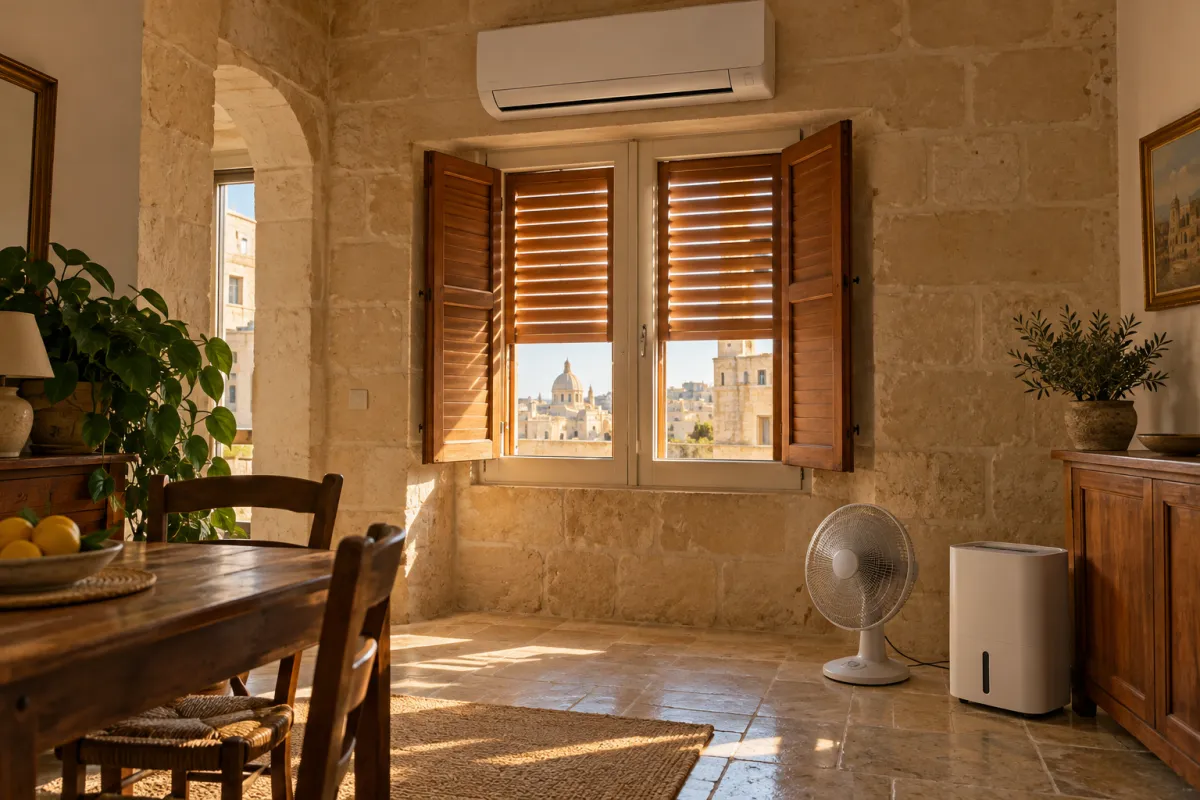
- Use shutters in the afternoon and open windows in the evening breeze.
- Use fans where they are enough; they use far less power than air conditioning.
- Heat with reverse-cycle air conditioners in winter rather than old electric heaters, and run a dehumidifier to make rooms feel warmer.
- Check the water heater: an electric boiler left on all day is a quiet bill-raiser; use a timer.
- Look at your consumption: Enemalta offers an online consumption service, so you can see how you are tracking before the bill arrives.

Questions to ask a landlord before you sign
- Whose name is the utility account in, and can I be registered on it as a resident?
- Is the supply single phase or three phase? (It changes the service charge.)
- Can I see the last summer bill and the last winter bill?
- How are bills shared between flatmates: by reading, equally, or by room?
- Is there an electric water heater, and is it on a timer?
- Do the air conditioners also heat, and when were they last serviced?
- Is there a separate meter for common areas, a pool or a garage?
A landlord who answers these clearly is usually one who will handle the deposit fairly too. Vague answers about bills are one of the warning signs we list in our shared-flat guide.
What about water?
Water is supplied by the Water Services Corporation and appears on the same ARMS bill as electricity, with its own tariffs and service charge. For most households it is a much smaller part of the total than electricity. Many residents drink bottled or filtered water because of the taste, which is a grocery cost rather than a utility one. If your bill shows unusually high water use, check for running toilets and leaking taps, and ask the landlord about the roof tank and pump, which some older buildings still use.
A simple monthly routine
The households I know that never get bill shocks do three small things. They photograph the meter on the first day of every month and note the number in a shared flat chat. They agree an air-conditioning rule for summer, such as cooling bedrooms only at night and keeping the living room on fans during the day. And they compare each bill with the same period last year, so a sudden jump gets noticed and explained, whether it is a faulty water heater, a new flatmate who works from home or simply a hotter August. Ten minutes a month saves arguments, and money, when the big summer bill arrives.
Reading your bill
- Account and service number: quote these whenever you contact ARMS.
- Tariff type: check whether it says residential or domestic.
- Readings: actual or estimated; compare with your own meter photo.
- Consumption by band: shows how many units fell into each price band.
- Eco-reduction: appears as a discount line if you qualify.
- Service charge: the annual charge, applied pro rata.
- Water: listed separately on the same bill.
Budgeting for bills when you move
For planning, the University of Malta budgets about €50 a month per person for electricity and water in a shared flat, which matches the worked examples above for moderate use, with summer months higher and spring and autumn lower. Our cost of living in Malta guide puts utilities next to rent, food and transport, and the step-by-step moving to Malta guide covers the first-month admin, including banking and residence registration. If you are still choosing a flat, ask the landlord for the last summer and winter bills; it is the most honest preview of what you will pay.
Registering on the utility account usually needs your ID or residence card, so it fits naturally after your residence registration; our Malta e-ID guide explains the residence card and online government login.
Electricity bills Malta: FAQ
How much is electricity per kWh in Malta?
On Enemalta’s residential tariff, the first 2,000 kWh of cumulative consumption cost €0.1047 per kWh, rising to €0.1298, €0.1607, €0.3420 and €0.6076 in higher bands (all including 5% VAT). The domestic tariff starts at €0.1365 per kWh. There is also an annual service charge of €65 for single phase or €195 for three phase.
What is the difference between residential and domestic rates in Malta?
Residential rates apply to a primary residence where at least one person is registered on the electricity service, and they are cheaper. Domestic rates apply to private dwellings with nobody registered, such as many rentals before tenants register. Asking ARMS to register you on the account can move a rental from domestic to residential rates.
What is the eco-reduction in Malta?
A discount for residential primary residences with low consumption. Single-person households get 25% off all consumption if they use less than 2,000 units a year. Households of two or more get 25% off the first 1,000 units and 15% off the next 750 per person, if consumption does not exceed 1,750 units per person per year.
Who sends electricity bills in Malta?
ARMS Ltd handles billing and customer accounts for electricity and water. Electricity tariffs are published by Enemalta; water is billed alongside on the same utility account.
Why is my electricity bill so high in summer in Malta?
Air conditioning in July and August pushes consumption up, and because bands are cumulative over the year, extra units can fall into more expensive bands. Being on the residential rate, setting the air conditioner to a moderate temperature and using fans and shutters all help.
Is electricity included in rent in Malta?
Usually not; most leases make tenants pay utilities on top of rent, either directly on the account or reimbursed to the landlord based on bills. Some short lets and rooms include a fixed allowance. Check the lease wording and how meter readings are shared.
Want to turn this into an actual plan? MeetNow is a free app for meeting people in person: a host posts a plan at a public place, says who pays (host pays, split, pay your own or free) and picks who joins. It works in your browser and on Android through Google Play, starting in Malta; the iPhone app is not in the App Store yet. Open MeetNow and see the plans in Valletta, Sliema and St Julian’s.
Tariffs from Enemalta’s published pages; the legislation (S.L. 545.41) prevails in case of discrepancies. Budget 2027 is due to be presented on 26 October 2026; if it announces changes to utility tariffs, the eco-reduction or household support, Enemalta and ARMS will publish the details on their own pages, so check those before relying on the figures in this guide. We may mention products we are connected with; see the affiliate and product disclosure page linked in the site footer.