Working remotely in Malta and feeling isolated is one of the most common things newcomers admit after their first few months. The sea is beautiful, the flat is fine, the Wi-Fi mostly works, and yet whole days pass where your only conversation is with a supermarket cashier or a delivery rider. That is not a personal failing. It is what happens when you remove the office, the commute and the colleague who asks about your weekend, and place yourself on a small island where most social life runs through family, school friends and the village.
I have worked from Maltese flats for years, through the packed summers when everyone seems to be at the beach and the quiet, damp Januaries when even the expat group chats go silent. What fixed it for me, and for most remote workers I know here, was not one big gesture. It was a dull, repeatable structure: the same café on the same mornings, one recurring group, a couple of neighbours who know my name, and a habit of making small, specific plans instead of vague “we should meet up” messages.
This guide is that structure, written down. You will find why remote work isolates you more in Malta than you might expect, a 12-week plan built around a working week, how to get to know neighbours, where book clubs and other repeat groups fit in, what changes for couples, opener messages you can copy, and where to turn when it is more than loneliness.
If you are working remotely in Malta and feeling isolated, put people into your working week on purpose: one or two days at a coworking space or café, one recurring group (a book club, a class, a band club, a sports session) and one small plan with a specific place and time each week. Greet the same neighbours and shopkeepers repeatedly, because familiarity in Malta builds slowly and then quickly. If low mood lasts for weeks or you feel unsafe, contact your GP or Supportline 179, and call 112 in an emergency.
Why working remotely in Malta and feeling isolated go together
An office gives you dozens of tiny, unplanned contacts a week: the coffee machine, the lift, the lunch queue, the colleague who drags you to after-work drinks. Remote work strips all of that out, and nothing replaces it automatically. In a big city you might still bump into people through sheer density. In Malta you often won’t, because the social fabric is built on relationships that started long before you arrived.
The rules for Malta’s Nomad Residence Permit make the point clearly: applicants must work for an employer registered outside Malta, be a partner or shareholder in a company registered abroad, or freelance for clients based outside Malta, and earn at least €3,500 gross a month (Residency Malta Agency). In other words, the system is designed so that your colleagues are somewhere else. EU citizens working remotely here do not need that permit, but the effect on your week is the same: your work ties live in another time zone. If you are still sorting out the paperwork and workspace side, our guide to digital nomad life in Malta, coworking and costs covers the basics.
Three Malta-specific reasons it feels harder
- Expat turnover. Many of the people you meet are on one- or two-year contracts, language courses or short stays. You can build a good friendship and then watch it leave on a Ryanair flight. That is painful, but it also means new people are always arriving and looking for the same thing you are.
- Established Maltese networks. Maltese social life tends to orbit around extended family, school and university friends, the parish and the village. People are generally warm and helpful, but their weekends are often already full. Getting in usually happens through repetition and shared activity rather than a single invitation.
- The summer and winter rhythm. In July and August life moves outdoors and late, and the heat keeps many remote workers indoors with the air conditioning all day. From November to February the island quietens, flats get cold and damp, and it becomes easy to stay home for a week without noticing.
You are also far from alone in this. The University of Malta’s Faculty for Social Wellbeing has researched loneliness among residents using the De Jong Gierveld Loneliness Scale, which measures both social and emotional loneliness, and the work treats isolation as a challenge across age groups rather than a newcomer problem (University of Malta). Plenty of locals feel it too, which is worth remembering when you are deciding whether to say hello first.
A small-plan option: MeetNow is a free app that works in your browser and on Android through Google Play, starting in Malta (the iPhone app is not in the App Store yet), where a host posts a real plan at a public place (a coffee, a quiz, a coastal walk), says who pays and picks who joins. It suits remote workers who want one real conversation a week without signing up to a club.
A 12-week plan built around your working week
The aim is not to become a social butterfly in three months. It is to end week 12 with a routine that produces contact on its own: two anchor days out of the flat, one group you attend regularly, a few familiar faces in your street and at least one person you can message with a plan. Each week takes an hour or two at most, so it fits around a full-time remote job.
| Week | Action | Where | Cost (EUR) |
|---|---|---|---|
| 1 | Choose two fixed “anchor” mornings a week to work outside your flat | A café with tables and plugs near you, or a coworking day pass | Price of a coffee or a day pass; check the venue |
| 2 | Learn three neighbours’ or shopkeepers’ names and greet them every time | Your building, the corner shop, the bakery, the pharmacy | Free |
| 3 | Try one recurring group: book club, language exchange, run or walking group | Library branch, local council page or noticeboard, organiser listings | Usually free or low; check the organiser |
| 4 | Make one specific plan with someone you have met at least twice | A café or a seafront walk | Pay your own |
| 5 | Go back to the same group a second time, even if the first visit was awkward | Same as week 3 | Same as week 3 |
| 6 | Book a weekly class with a fixed slot (Maltese, yoga, climbing, pottery, dance) | Local council courses, private studios, language schools | Varies; check the provider |
| 7 | Attend one village event: a festa, a local council activity, a parish event | Your own locality | Usually free |
| 8 | Invite two people from different parts of your life to the same small plan | Café, beach in season, coastal path | Split or pay your own |
| 9 | Give some time: a volunteer slot, a clean-up, a skill swap | Local NGOs, animal shelters, community groups | Free |
| 10 | Review: who do you want to see more of? Send each of them a plan with a day and place | Your phone | Free |
| 11 | Host something small: coffee, a board game afternoon, a potluck | A public café, or your flat once you know people well | Your choice |
| 12 | Lock in the routine: anchor days, one group, one plan a week, in your calendar | Your calendar | Free |
Costs are described rather than quoted because they change by venue and season; check with the venue or organiser before you go. Last checked May 2026.
If your isolation is less about work and more about the move itself, our broader 12-week plan for loneliness after moving to Malta goes deeper on the first months. The version above is deliberately built around a laptop and a working day.
Put people into your working week
The single biggest change most remote workers can make is to stop treating social life as something that happens after work. In Malta, with no office to leave, “after work” can quietly become “never”. Build contact into the working day instead.
Anchor days
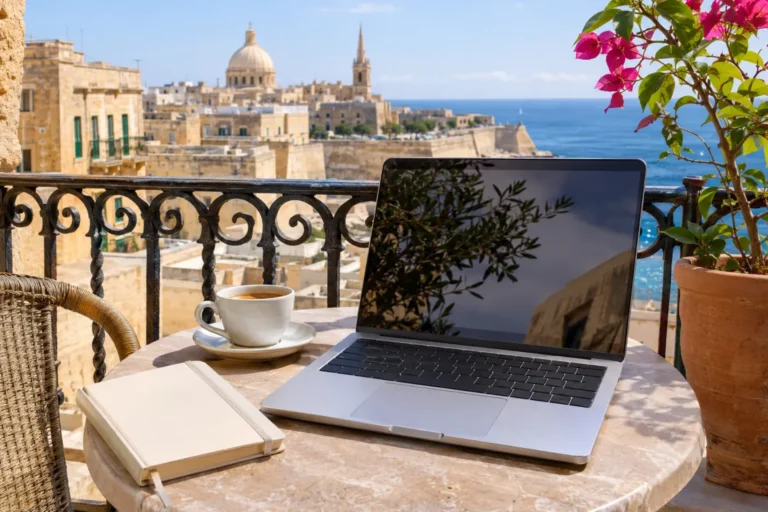
Pick two days and make them non-negotiable: Tuesday and Thursday, for example. Work from the same café or coworking space on both, arrive at roughly the same time and sit in roughly the same spot. Within a few weeks the staff will recognise you, and so will the other regulars. That recognition is the raw material of friendship on a small island. A coworking membership matters less than the shared kitchen: the place where you make coffee is where conversations start.
Use your time zone
If your team is in the Americas, your mornings are often free; use them for a class, a swim or a coffee with someone. If you work with Asia, your afternoons and early evenings open up. Many remote workers in Malta waste their best social hours sitting alone waiting for meetings that start later.
Take a real lunch break
A twenty-minute walk along the same route every day, past the same kiosk and the same benches, is not wasted time. People who walk the Sliema or Msida promenades, or around the village core where they live, start nodding at each other surprisingly fast. Say good morning. Most people will say it back.
Put one social hour in your calendar
Block one hour a week as a meeting called “plan something”. Use it to message someone, look for an event or confirm a weekend plan. It sounds mechanical, but remote workers already live by the calendar; this simply makes people part of it. Plan your weekend by Thursday, because Saturday mornings are when isolation tends to hit hardest.
Meeting neighbours in Malta
Meeting neighbours in Malta works best through small, repeated gestures rather than big introductions. Older Maltese neighbours in particular often notice who comes and goes, and a newcomer who greets them consistently is remembered. A simple bonġu in the morning and bonswa in the evening goes a long way, even if the rest of the conversation happens in English.
- The corner shop and bakery. The local ħanut is a social hub in many villages. Buy your bread there rather than at the big supermarket a few times a week and you will start hearing the local news.
- Offer practical help. Taking in a parcel, carrying shopping up the stairs or watering plants during someone’s trip turns a stranger into a neighbour quickly.
- Village festas. Each parish celebrates its festa, mostly in the summer months. Turning up, watching the band march and standing in the square is the easiest way to see your locality as a community rather than a set of buildings.
- Band clubs. The każin tal-banda is the heart of festa preparations in many villages, and some welcome extra hands for decorations or events. Ask politely, accept that it may take time, and do not expect it to be an expat social club.
- Local council activities. Councils organise events, courses and clean-ups that bring together residents of all ages.
Where you live shapes this a great deal. In high-turnover areas such as Sliema, Gżira and St Julian’s, your neighbours may change every few months; in smaller villages they may have lived on the same street for decades. Our guide on where to live in Malta, with areas, rents and bus links explains the trade-offs, and how to meet Maltese people beyond the expat bubble has more ideas for building local friendships.
Book clubs in Malta and other repeat groups
The groups that work best against isolation are the ones that meet on the same day, at the same place, with mostly the same people. One-off events are fun but rarely turn into friendships; the third or fourth time you see someone is usually when a real conversation starts. That is why book clubs in Malta, along with classes and sports groups, are so useful for remote workers: they give you a reason to return.
Finding a book club
Book clubs here are often run by individuals, bookshops or community groups, and they come and go as organisers move on. Ask at your local library branch and at independent bookshops, check your local council’s page, and ask in any groups you are already part of. When you find one, commit to three sessions before deciding whether it suits you.
Starting your own
If you cannot find one that fits, starting a small book club is one of the easiest ways to create the group you need. A few rules that keep it going:
- Keep it small: four to eight people is plenty.
- Fix the slot, such as the first Sunday of each month, and do not keep moving it.
- Meet in a public café with a quiet corner, not your flat, at least at first.
- Choose short books, and let people come even if they have not finished.
- Rotate who picks the next book so it does not depend on you alone.
Other groups that repeat
Running and walking groups along the coastal paths, choirs, language exchanges, five-a-side or padel sessions, volunteering rotas and Maltese language classes all share the same advantage. They also give you something to talk about other than “so what do you do?”, which is the question remote workers often find the least interesting to answer. If you are in your thirties and finding that age changes how people socialise, our piece on making friends in Malta in your 30s looks at what tends to work.
Expat couples: Malta social life when one of you works from home
Couples are often surprised to find they feel just as isolated as single people, sometimes more. It is easy to fall into a two-person bubble where each of you is the other’s only company. When one partner works in a Maltese office and the other works remotely, the gap can widen: one comes home tired of people, the other has spoken to nobody all day.
A few habits that help with expat couples’ Malta social life:
- Each keep one solo activity. A class, a sport or a group that belongs to just one of you widens your shared circle, because you each bring people back.
- Use the office partner’s network. Colleagues of the partner with a local job are often the quickest route to Maltese friends. Suggest a weekend lunch with a colleague and their partner.
- Talk about the imbalance. If the remote partner is the one who moved for the other’s job, say so openly. A trailing partner with no colleagues and no local network needs more than a weekend plan; they need their own routine.
- Meet other couples deliberately. Double plans feel awkward to suggest, but many couples here are looking for exactly that. A long lunch or a walk is lower pressure than dinner at home.
For parents, the school gate and playgroups can become a social lifeline, though the parent working from home may need to make an extra effort to show up at pick-up times and weekend birthday parties.
Copy-paste opener messages
The hardest part is usually the first message. These are deliberately specific: a day, a place and a low-pressure tone. Adjust them to your own voice and send them.
- After a group or class: “It was good chatting at book club on Thursday. I’m getting a coffee near the Sliema ferries on Saturday morning, around ten. Fancy joining?”
- To a coworking regular: “I’m usually in here on Tuesdays and Thursdays. A couple of us grab lunch around one; you’re welcome to come along.”
- To a neighbour: “Hi, I’ve just moved in on the second floor. If you ever need a parcel taken in while you’re away, just knock.”
- To another remote worker you’ve met once: “Nice to meet another remote worker here. Would you be up for working from the same café one morning next week? Coffee’s on me the first time.”
- Starting a book club: “I’m starting a small monthly book club, six people maximum, on the first Sunday of the month in a café in Gżira. The first book is short. Interested?”
- For couples: “My partner and I are still fairly new here and would love to meet up with you two for a long Sunday lunch. Any weekend that suits you works for us.”
If someone says no or does not reply, do not read too much into it. Weekends in Malta fill up with family commitments quickly. Try one more time with a different date, and then put your energy into someone else.
Meeting someone new safely
Most first meetings are completely ordinary, but a few habits keep them that way:
- Meet in a public place, such as a busy café, a seafront promenade or a village square.
- Tell a friend, or someone back home, where you are going and who you are meeting.
- Arrange your own way home, whether that is the bus, a ride-hailing app or your own car.
- Leave if you feel uncomfortable at any point; you do not owe anyone an explanation.
- Keep your home address to yourself until you know someone well.
When it’s more than loneliness
Loneliness is common, but sometimes it is a sign of something that needs more support. If you notice weeks of low mood, losing interest in things you used to enjoy, sleeping or eating very differently, avoiding leaving the flat altogether, or thoughts of harming yourself, please reach out rather than waiting for a social plan to fix it.
- Emergency: call 112 if you or someone else is in immediate danger.
- Supportline 179: Malta’s national helpline for support and referral to social services.
- Your GP or local health centre: a good first step for talking through how you have been feeling and getting referred to the right service.
Our guide to mental health support for expats in Malta lists further services and helplines, with links to their official pages. This article is not medical advice; if you are worried about your health, speak to a professional.
Want to turn this into an actual plan? MeetNow is a free app for meeting people in person: a host posts a plan at a public place, says who pays (host pays, split, pay your own or free) and picks who joins. It is live on the web and works in your browser, starting in Malta. The Android app is on Google Play; the iPhone app is not in the App Store yet. Open MeetNow and see the plans posted in Malta.
FAQ
Is it normal to feel isolated working remotely in Malta?
Yes. Remote work removes the casual daily contact an office provides, and Malta’s social life is largely built around family, school friends and the village, so newcomers often find their weekdays very quiet. Research from the University of Malta shows loneliness affects many residents, not just expats, so you are far from unusual.
How long does it take to make friends in Malta as a remote worker?
It varies, but most people notice a difference after two or three months of a consistent routine: fixed days out of the flat, one recurring group and one small plan a week. Familiarity builds slowly at first and then quickly, especially once you start seeing the same faces regularly.
Are there book clubs in Malta for English speakers?
Yes, though they are often run by individuals, bookshops or community groups and change as organisers move on. Ask at your local library branch, independent bookshops and your local council, or start your own small monthly club in a public café with four to eight people.
How do I start meeting neighbours in Malta?
Greet the same people consistently, use your local corner shop and bakery, offer small practical help such as taking in parcels, and turn up to your village festa and local council events. A simple bonġu in the morning and bonswa in the evening is noticed and appreciated.
Should I work from a coworking space or a café?
Either can work; consistency matters more than the venue. A coworking space with a shared kitchen makes conversations easier to start, while a café you visit on the same mornings each week builds familiarity with staff and regulars. Many remote workers mix both.
Where can I get help if loneliness is affecting my mental health?
Speak to your GP or local health centre, or contact Supportline 179, Malta’s national helpline. In an emergency, call 112. Our mental health support guide lists further services with links to their official pages.