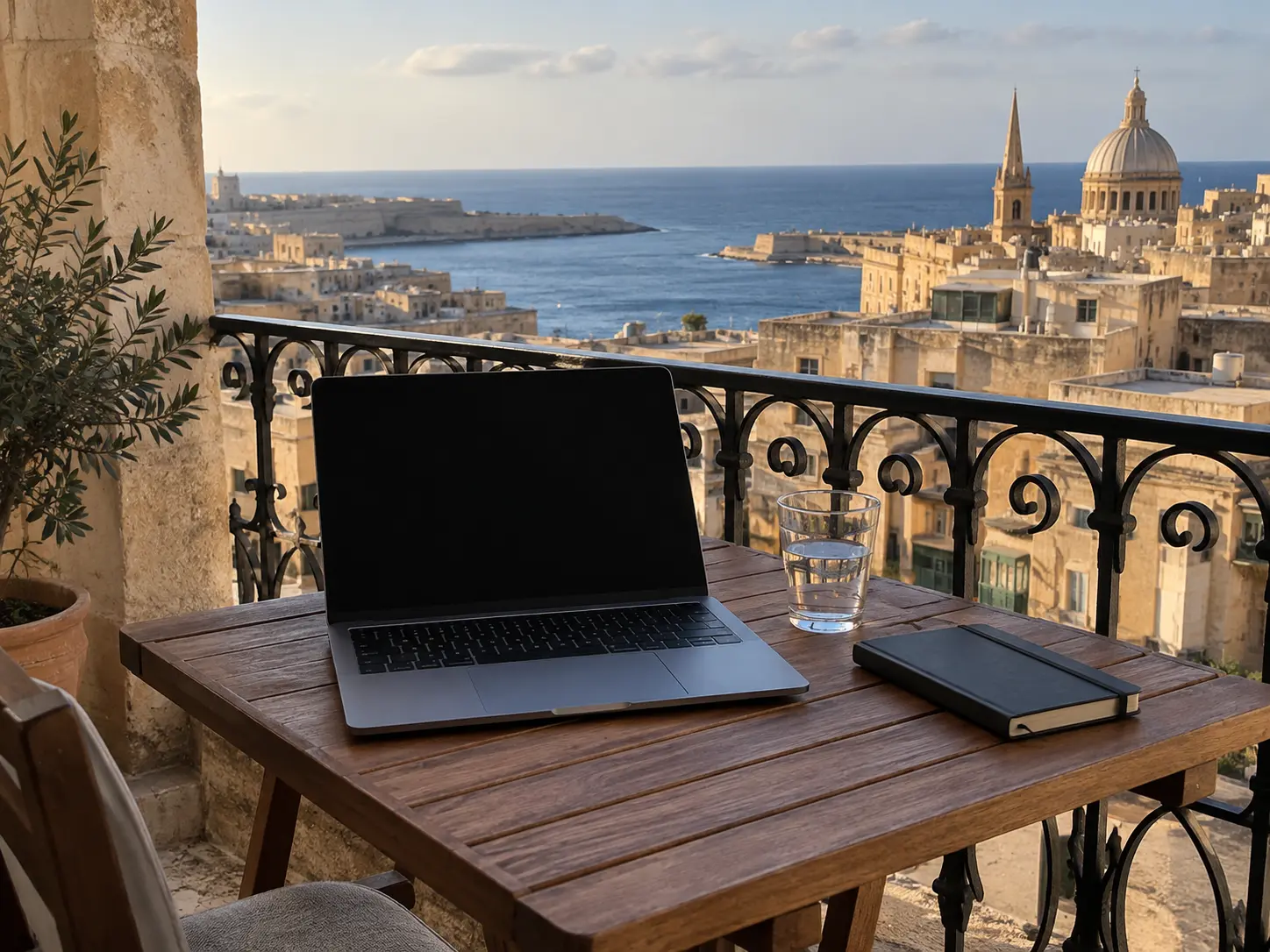
Short answer: Malta works well for remote workers: English everywhere, a European time zone, fast connections in the harbour towns and a sea you can swim in after work. Non-EU remote workers usually come on the Nomad Residence Permit from the Residency Malta Agency, which requires a minimum gross income of €42,000 a year, health insurance, a rental or purchase agreement and a police conduct certificate, with a €300 non-refundable application fee per person and a €100 residence card fee. The permit is issued for one year and can be renewed at the agency’s discretion. EU citizens do not need it. Coworking day passes at the big international operators started at about €29 a day when I checked. The real risk is not the paperwork but isolation, so build a routine with people in it from week one.
I know plenty of people who came to Malta “for a winter” with a laptop and stayed for years. The ones who thrived treated remote work like a job with a commute: a desk somewhere with other people two or three days a week, a fixed weekly activity, and a habit of saying yes to small plans. The ones who left early were usually lonely, not bored.
Nomad Residence Permit basics (non-EU)
This site does not give immigration or tax advice. The details below are summarised from the official Residency Malta Agency nomad pages, checked in October 2026; always read the current criteria and checklist before applying.
Who it is for
The permit is for third-country nationals (non-EU, non-EEA and non-Swiss) who can work remotely, independent of location, using telecommunications technology. According to the agency, you must fall into one of three categories:
- Employed by an employer registered in a foreign country, with a contract of work;
- Self-employed, conducting business for a company registered in a foreign country of which you are a partner or shareholder;
- Freelance, offering freelance or consulting services to clients whose permanent establishments are in a foreign country, with whom you have contracts.
The agency states that people contracted by a foreign company to provide services to that company’s Maltese subsidiary are not eligible.
Key requirements and fees
| Requirement | What the agency says |
|---|---|
| Minimum income | €42,000 gross a year (applications submitted before 1 April 2024 keep the earlier €32,400 threshold) |
| Travel document | Valid passport or travel document |
| Health insurance | Cover for risks in the EU (including Malta) and the UK; a fully comprehensive policy for one full year covering you and any dependants; travel insurance is not accepted |
| Accommodation | A valid property rental or purchase agreement covering the permit period |
| Checks | Police conduct certificate and a background verification check |
| Proof of income | Official bank statements for the last three months showing the income credited to your account |
| Application fee | €300 per person, non-refundable, paid by bank transfer from the main applicant’s account |
| Residence card | €100 per person, issued through Identità, paid by card in person |
| Validity | Issued for one year; renewable on application at the agency’s discretion while you still meet the criteria |
Source: Residency Malta Agency eligibility, checklist and FAQ pages, last checked October 2026. Criteria can change; the agency’s current pages always take precedence.
EU, EEA and Swiss citizens
You do not need the Nomad Residence Permit. If you stay longer than three months, you apply for a residence document through Identità on the relevant basis, such as self-sufficiency or self-employment. Tax residence is a separate question; speak to the Commissioner for Revenue or a qualified adviser before you assume anything about where you pay tax.

How to apply, step by step
- Check you fit a category. Employed, self-employed or freelance for foreign clients, with enough income.
- Collect your documents. Passport, contracts, three months of official bank statements, a police conduct certificate and, after approval in principle, a rental agreement and full health insurance. Documents not in English need translations.
- Submit the application through the Residency Malta Agency process described on its website.
- Pay the €300 fee per applicant by bank transfer from the main applicant’s account when instructed.
- Get approval in principle, then provide proof of accommodation and health insurance.
- Collect your residence card (€100 per person) and keep the documents you will need for renewal.
The agency also notes that it is your responsibility to apply before your allowed stay period runs out and to keep your immigration status regular while you wait. If you are unsure, ask the agency before you travel.
Coworking in Malta
Coworking is concentrated in the harbour business areas. I could only verify prices for the two big international operators, whose websites showed these day-pass prices in October 2026. Independent spaces exist across Sliema, St Julian’s, Gżira and Valletta; ask for a trial day before you commit.
| Operator | Product | Price shown (October 2026) |
|---|---|---|
| Spaces (Malta) | Cowork day pass | €29 per person per day |
| Regus (several Malta centres) | Day coworking | from €29 per day |
| Spaces and Regus | Monthly memberships and reserved desks | vary by centre and contract; ask for a quote |
Prices as listed on the operators’ Malta pages when checked in October 2026. They vary by centre and contract length; confirm before booking. Listing here is not an endorsement.
What to ask a coworking space
- Is there a trial day or a short-term pass?
- What is the internet speed and is there a backup connection?
- Are phone booths or meeting rooms included, or charged extra?
- Is the air conditioning (and in winter, heating) reliable?
- Do members actually talk to each other? Are there community events?
Cafés with wifi and remote work days
Cafés in Sliema, Gżira, St Julian’s and Valletta are used to laptops, especially mid-morning on weekdays. Be a good customer: order regularly, avoid long video calls at shared tables and leave at lunch rush if the place is small. In summer, a café with strong air conditioning is worth more than one with a view. A coworking day pass once or twice a week, plus a couple of café mornings, is the balance many remote workers settle on.
Cost of living for remote workers
The main cost is rent. Housing Authority data for new leases in the first half of 2025 put the median two-bedroom rent at €1,500 a month in St Julian’s and €850 in St Paul’s Bay. Day-to-day costs are moderate, and buses are free once you hold a personalised tallinja card. Our cost of living in Malta guide has full monthly budgets, and our guide to moving to Malta step by step covers renting safely.
| Monthly line | Planning figure | Basis |
|---|---|---|
| Room in a shared flat | €550 to €700 | University of Malta shared-accommodation estimate |
| Two-bedroom flat, St Paul’s Bay / St Julian’s | €850 / €1,500 | Housing Authority medians, H1 2025 |
| Food and drink (one person) | about €450 | University of Malta estimate |
| Coworking, 8 day passes | about €232 | 8 × €29 day pass, operator pricing October 2026 |
| Transport | €0 with a personalised tallinja card | Malta Public Transport |
Worked planning figures, last checked October 2026. Your own costs will differ.

Practicalities: time zone, phone, banking and health
- Time zone. Malta uses Central European Time, one hour ahead of the UK and Ireland, which makes calls with most of Europe easy and with the US East Coast workable in the afternoon.
- Phone and internet. The three mobile networks are GO, Epic and Melita, and home broadband is widely available in the harbour towns. Ask a landlord which provider the flat already uses and test the speed at a viewing.
- Banking. The permit asks for official bank statements showing your income. Many remote workers keep their home account and add a Maltese account later; requirements vary by bank.
- Health. Nomad permit holders need private health insurance covering Malta. Know where your nearest private clinic and health centre are, and save 112 for emergencies.
- Getting around. Apply for a personalised tallinja card once you have your residence documents; buses on day and night routes are then free.
A remote-work week that keeps you sane
| Day | Work | People |
|---|---|---|
| Monday | Home, deep work | Evening walk on the promenade |
| Tuesday | Coworking day | Lunch with someone from the space |
| Wednesday | Café morning, home afternoon | A class, club or language exchange |
| Thursday | Coworking day | After-work drink or Meetup social |
| Friday | Short day | Early swim or coffee with a friend |
| Weekend | Off | A hike, a Gozo trip or a long lunch |
If you are switching from remote work to a local job later, our guide to working in Malta covers sectors, contracts and the minimum wage.
Where remote workers live
- Sliema and Gżira: walkable, cafés everywhere, the ferry to Valletta, lots of other newcomers. Expensive.
- St Julian’s and Swieqi: close to coworking and nightlife; Swieqi is quieter.
- Valletta: beautiful and calm in the evenings, but flats can be small and involve stairs.
- St Paul’s Bay and the north: more space for the money and the sea on your doorstep; longer trips to see people in the harbour area.
- Gozo: peaceful and rural; check your internet options before you sign anything.
The trade-off is simple: cheaper areas give you more space, and expensive ones give you more people within walking distance. For a remote worker, the second often matters more than it seems from abroad.
The real challenge: isolation
Working from a rented flat on an island where you know nobody is a recipe for loneliness, however good the weather. I have seen it many times. What helps:
- Book people into your week. Two coworking days, one class or club, one social plan. Put them in the calendar like meetings.
- Separate work and home. Even a café morning changes the feel of a week.
- Use your flexibility. Remote workers can swim at 8, work from 9 and walk the promenade at 6. Invite someone along.
- Join groups early. Our guide to the expat community in Malta lists Meetup groups, InterNations and other places to start.
- Make small, specific plans. Our 30-day plan for making friends in Malta shows how.
If you would like a simpler way to find people for a weekday swim or a coffee break, open MeetNow: it is our free app for small plans with people nearby, live on the web in Malta now.
Safety when meeting new people
- Meet in public places first: a café, a coworking space, a busy promenade.
- Tell a friend where you are going and who with.
- Know how you will get home: bus, night route or ride-hailing app.
- Leave whenever you feel uncomfortable.

Common mistakes for remote workers in Malta
- Arriving on a short visitor stay and leaving the permit application too late.
- Buying travel insurance instead of the full health insurance the permit requires.
- Assuming the tax position without advice.
- Renting somewhere cheap but isolated, then seeing nobody for weeks.
- Working through the best months of the year without taking a single weekday swim.
Frequently asked questions
What is the income requirement for Malta’s digital nomad permit?
The Residency Malta Agency requires a minimum gross income of €42,000 a year for the Nomad Residence Permit. Applications submitted before 1 April 2024 keep the earlier €32,400 threshold.
How much does the Malta Nomad Residence Permit cost?
The agency lists a €300 non-refundable application fee per person and a €100 residence card fee per person. Health insurance, translations and any professional help are extra.
How long is the Nomad Residence Permit valid?
It is issued for one year and can be renewed on application at the agency’s discretion, as long as you still meet the eligibility criteria.
Do EU citizens need a digital nomad visa for Malta?
No. EU, EEA and Swiss citizens can live in Malta under free movement rules. If you stay longer than three months, apply for a residence document through Identità on the appropriate basis.
How much does coworking cost in Malta?
When checked in October 2026, Spaces listed a day pass at €29 per person and Regus listed day coworking from €29. Monthly memberships vary by centre and contract, so ask for a quote. Independent spaces vary, so ask for a trial day.
Is Malta good for digital nomads?
For many people, yes: English is spoken everywhere, the time zone suits Europe, and the climate is mild. The downsides are high rent in the harbour towns, traffic and the risk of isolation if you work alone from home.
Want to turn this into an actual plan? MeetNow is a free app for meeting people in person: a host posts a plan at a public place, says who pays (host pays, split, pay your own or free) and picks who joins. It works in your browser and on Android through Google Play, starting in Malta; the iPhone app is not in the App Store yet. Open MeetNow and see the plans in Valletta, Sliema and St Julian’s.
We may mention products we are connected with; see our affiliate and product disclosure.