Most people booking an English course in Malta choose their room in the same checkout as their lessons, and that click decides more than where you sleep. Your English school Malta accommodation sets which documents Identità asks for, whether a landlord owes you anything legally, and how much of your monthly budget is locked in before you land.
I’ve watched classmates and flatmates handle this the easy way and the hard way. The easy way is knowing the three real options (school residence, licensed host family, private shared flat) and the paperwork that comes with each before you pay a deposit. The hard way is finding out at your Identità appointment that the flat you found online has no registered lease, or that the friendly family you were introduced to has no tourism licence.
A quick honesty note: rents and school package prices move with the season and differ from school to school, so this guide doesn’t print a price list that would be out of date by the time you read it. You’ll get the legal facts that don’t change, a comparison table, a checklist and a budget planner to fill in with the quotes you actually receive.
The three types of English school Malta accommodation
Schools in Malta usually sell housing alongside their courses, and outside of that you can rent privately like any other newcomer. If you haven’t chosen a school yet, start with the ELT Council licence, which is the baseline for any school worth booking; our comparison of licensed English schools in Malta explains what that licence covers and what it doesn’t. Once the school is settled, the accommodation question splits into three paths.
School residence or school-managed apartments
This is the default option for most first-time students. You book through the school, pay the school, and the school deals with the property. Rooms are often shared, sometimes with a classmate from a different country, and the building is usually within walking distance of the school or on a direct bus route. House rules are set by the school: guest policies, quiet hours, cleaning arrangements and what happens to your key when you leave.
The big advantage is administrative. If you’re a non-EU student, the school can confirm your address in writing for your visa or residence application, so you don’t need a private lease. The downsides are less privacy, less choice of flatmates and, depending on the school, rules that feel a little like boarding school if you’re older or used to living alone.
Host family
A homestay puts you in a Maltese household, usually with a private bedroom and some meals included. It suits younger students, shorter stays and anyone who wants daily English practice outside class. Host families arranged through a school are normally vetted by that school, but the legal requirement that matters most is a valid licence from the Malta Tourism Authority, which comes up again in the paperwork section below.
Private shared flat
Longer-stay students, and especially those over 25 who are tired of dorm rules, often move into a shared flat after the first few weeks or book one from the start. You get your own door key, your own rules and usually more space for the money, but you also take on a private lease, deposits, utility bills and the job of checking the landlord is doing things properly. Location matters a lot here, because a cheaper flat with a long commute can wipe out the saving; our guide to areas, rents and bus links in Malta helps you judge which neighbourhoods actually work for a school timetable.
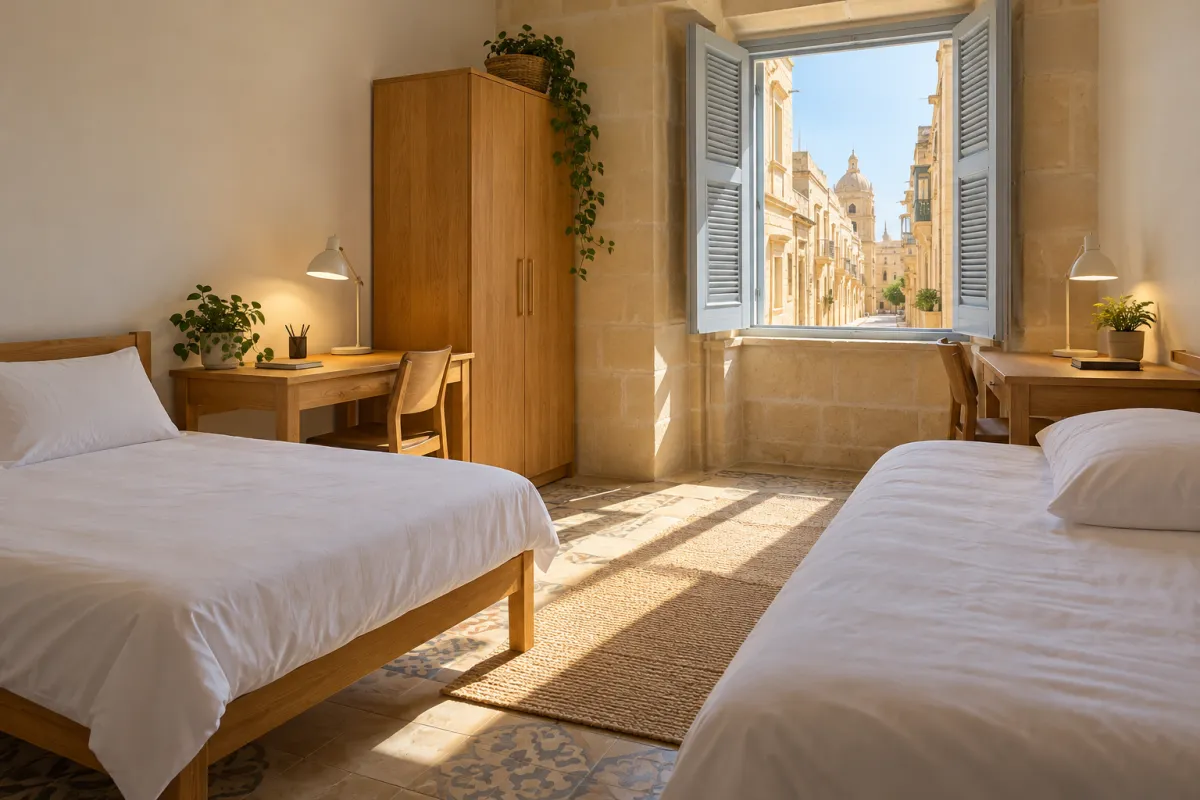
Residence, host family or flat: side by side
This table compares the three options on the things that tend to cause problems later, not on price, because prices depend on your school, your dates and the season.
| Factor | School residence | Licensed host family | Private shared flat |
|---|---|---|---|
| Who you contract with | The school | The school or the family | A private landlord or agent |
| Proof of address for non-EU students | Confirmation letter from the school | Copy of the MTA licence plus signed declaration form | Housing Authority approval letter, signed lease and inventory |
| Meals | Self-catering, shared kitchen | Often some meals included; confirm which | Self-catering |
| Privacy | Low to medium, often shared rooms | Medium, private room in a family home | Medium to high, depending on flatmates |
| Bills | Usually included in the package | Usually included | Often extra; check the lease |
| Flexibility to extend | Subject to school availability | Subject to the family | Depends on lease terms |
| Social life | Easiest; classmates on every floor | Quieter; good for language practice | Depends entirely on flatmates |
| Best for | First stay, non-EU visa applicants, solo arrivals | Younger or shorter-stay students | Longer stays, older students, couples |
For more detail on what each type looks like on the ground, including typical room layouts and the areas schools tend to use, see our full student accommodation guide for Malta.
Proof of address: what Identità asks for
If you’re a third-country national applying for a student visa or a residence card, proof of accommodation is one of the documents that most often holds an application up. The rules differ by accommodation type, which is why your choice matters before you book flights.
- Official school accommodation: you don’t need to present a separate private lease; instead the language school issues a formal letter with your name, surname, passport number, accommodation address and the exact duration of your stay (Identità).
- Host family: you need a copy of the family’s valid licence issued by the Malta Tourism Authority, together with a fully completed and signed rental declaration form (Identità).
- Private flat: when you submit private accommodation as proof for an e-residence card or a permit extension, you provide the registration approval letter issued by the Housing Authority, the signed lease agreement and the property inventory.
One practical trap: some flats are advertised as short lets or holiday rentals. If the landlord won’t give you a lease that is registered with the Housing Authority, you may not be able to produce the approval letter Identità wants. Ask this question before paying anything, not after.
Shared flats: lease registration in plain English
Private residential renting is governed by the Private Residential Leases Act, Chapter 604 of the Laws of Malta, and every private residential lease must be registered with the Housing Authority through its online portal (rentregistration.mt).
The landlord is the person legally responsible for registration and must complete it within 30 days from the date the lease starts (rentregistration.mt).
The cost is small: the standard online registration fee is €10, and €5 for renewals (rentregistration.mt). If the landlord fails or refuses to register, you as the tenant have the right to register the lease yourself and deduct the registration cost from the rent.
The stakes for landlords are high: a mandatory private residential lease that isn’t registered is considered legally null and void, and landlords face fines ranging from €2,500 to €10,000 for failing to register a primary residential lease (rentregistration.mt). In other words, a landlord who says registration is optional or “not needed for students” is either misinformed or hoping you won’t ask.
What this means for you as a student
- Ask the landlord or agent to confirm, in writing, that the lease will be registered and when.
- Keep a copy of the signed lease and the property inventory; Identità asks for both.
- Request the Housing Authority approval letter once registration is done, and store it with your passport documents.
- Pay rent and deposits by bank transfer or with a written receipt, never as untraceable cash.
- Photograph every room on move-in day so the inventory matches reality when you leave.
- If a flatmate is subletting a room to you, find out whose name is on the registered lease and whether you’re included in it.
Host families: licence, meals and house rules
A good homestay can be the best part of a course: home-cooked food, a family who explains why everything shuts on a feast day, and English conversation over dinner rather than only in a classroom. A poor match can feel like living in someone else’s spare room with a curfew. The licence protects you legally; the questions below protect your sanity.
First, confirm the family holds a valid Malta Tourism Authority licence and that you’ll receive a copy plus the signed declaration form if you need them for Identità. If the school arranges the family, ask the school to send both documents. If you found the family privately through a friend, ask directly and politely; a licensed host will not be offended.
Then ask about daily life:
- Which meals are included, and on which days?
- Can you use the kitchen to cook your own food?
- Is there a house rule about coming home late or having visitors?
- How is laundry handled, and is there a charge?
- Do you get your own key?
- Is Wi-Fi included and reliable enough for online homework?
- How far is the nearest bus stop for your school?
- Are there pets, smokers or young children in the house?
None of these is a deal-breaker on its own, but knowing the answers before arrival stops small frustrations from building up over a long stay.
English school Malta accommodation budget planner
I don’t publish an average monthly figure because any number without a dated, official source would be a guess, and guesses are how students end up short in their final month. Use the planner below with the written quotes from your school or landlord. Fill in the right-hand column in EUR and add it up before you commit.
| Cost item | School residence | Host family | Shared flat | Your monthly figure (EUR) |
|---|---|---|---|---|
| Rent or accommodation package | School’s weekly price, converted to monthly | School or family’s weekly price, converted | Monthly rent from the lease | |
| Booking or placement fee | Check school invoice | Check school invoice | Agency fee, if any | |
| Deposit (refundable, but cash you won’t have) | Ask the school | Ask the school or family | Stated in the lease | |
| Electricity, water, internet | Usually included; confirm | Usually included; confirm | Often extra; ask for past bills | |
| Food | Self-catering groceries | Meals not covered by the package | Self-catering groceries | |
| Transport | Low if near school | Depends on distance | Depends on area | |
| Phone and data | Local SIM plan | Local SIM plan | Local SIM plan | |
| Health insurance | Your policy, monthly share | Your policy, monthly share | Your policy, monthly share | |
| Social life and trips | Your choice | Your choice | Your choice | |
| Emergency buffer | Set aside before arrival | Set aside before arrival | Set aside before arrival |
Course fees sit on top of all this. Our breakdown of Malta English course costs covers weekly tuition, registration fees and the extras that schools list in small print.
Turning a weekly quote into a monthly number
Schools usually quote accommodation per week, landlords per month. To compare them fairly, multiply the weekly price by the number of weeks you’re booked, add every one-off fee, then divide by the number of months you’re staying. Do the same for the flat, adding deposits, agency fees and estimated bills. The cheaper-looking option is not always cheaper once the fees and the commute are in.
Seasonal reality
Summer is peak season for language schools and for tourism, so residences fill up and private rooms get more competitive. If your dates are flexible, ask the school how its accommodation prices change across the year before you fix your start date.
Health insurance, bus fares and scholarships
Health insurance for students in Malta
Health insurance for students in Malta is a separate decision from accommodation, but it belongs in the same budget. If you’re applying for a visa or residence card, check Identità’s current document list for the insurance requirement that applies to your situation. EU students should bring their European Health Insurance Card and understand what it does and doesn’t cover. Our guide to healthcare in Malta for expats explains how GPs, Mater Dei Hospital and private insurance fit together, which helps you judge whether a cheap travel policy is really enough for a long course.
Malta student bus fares
Your accommodation choice decides how often you’ll ride the bus, so check Malta student bus fares before choosing a cheaper room further from school. Fare rules and who qualifies for reduced or free travel with a personalised card have changed in recent years, so confirm current terms with Malta Public Transport rather than relying on a forum post. Our round-up of student bus fares and travel discounts in Malta covers transport alongside culture, food and gym offers.
Scholarships for international students in Malta
Searches for scholarships for international students in Malta mostly lead to university-level funding and home-country programmes rather than support for English courses. For a language course, ask your school directly whether it offers any long-stay pricing or bursaries, and ask your home country’s education or youth agency about mobility funding. If you’re continuing to a degree afterwards, the university’s international office is the right place to ask. Never pay a deposit on the assumption that funding will arrive later.
Checklist before you pay any deposit
Run through this list for whichever English school Malta accommodation option you’re leaning towards. If you can’t tick an item, ask until you can.
- The school holds a valid ELT Council licence.
- You know exactly which type of accommodation you’re booking: residence, host family or private flat.
- Non-EU students: you know which proof-of-address document you’ll receive and when.
- School accommodation: the confirmation letter will include your name, surname, passport number, address and stay dates.
- Host family: you’ll get a copy of the MTA licence and a signed declaration form.
- Private flat: the landlord has confirmed in writing that the lease will be registered with the Housing Authority.
- You have the full address and have checked the route to school on a map.
- You know what’s included: bills, Wi-Fi, meals, cleaning, linen.
- You know the deposit amount, how it’s paid and the conditions for getting it back.
- You know the cancellation and extension terms.
- Your budget planner is filled in with written quotes, not estimates from social media.
- You have an emergency buffer that isn’t part of the rent money.
Settling in and meeting people
The first weeks in any new country are when loneliness hits hardest, and accommodation shapes how easy it is to meet people. Residences make it almost automatic: someone in the kitchen is always planning a beach afternoon or a walk around Valletta. Host families give you local company but fewer people your own age. Shared flats can go either way; some flatmates become close friends, others are polite strangers who share a fridge.
Whichever you choose, the school timetable is your best starting point. Join the excursions, stay for the coffee after class, and say yes to the first few invitations even if you’re tired. If you’re arriving alone and a bit older than most classmates, that’s common in Malta’s language schools and nothing to worry about.
When you meet someone new outside school, keep the basics in mind:
- Meet in a public place, such as a café, a seafront promenade or a busy square.
- Tell a friend or flatmate where you’re going and who you’re meeting.
- Arrange your own way home, and check the bus timetable before you set off.
- Leave if anything feels uncomfortable; you don’t owe anyone an explanation.
Want to turn this into an actual plan? MeetNow is a free app for meeting people in person: a host posts a plan at a public place, says who pays (host pays, split, pay your own or free) and picks who joins. It is live on the web and works in your browser, starting in Malta. The Android app is on Google Play; the iPhone app is not in the App Store yet. Open MeetNow and see the plans posted in Malta.
FAQ
Do I need a private lease if I stay in school accommodation?
Not if you’re a non-EU student staying in official school accommodation. Instead, the language school issues a formal letter with your name, surname, passport number, accommodation address and the exact duration of your stay, which you use as proof of address with Identità.
Can I stay with any host family I find?
The family must hold a valid licence from the Malta Tourism Authority. If you need proof of address for Identità, you provide a copy of that licence together with a fully completed and signed rental declaration form, so confirm both are available before you agree to move in.
What can I do if my landlord won’t register the lease?
Registration is the landlord’s legal duty, but if they fail or refuse, you have the right to register the lease yourself through the Housing Authority portal and deduct the registration cost from your rent. An unregistered mandatory lease is considered legally null and void, so don’t leave it unresolved.
Is a shared flat cheaper than school accommodation?
Sometimes, but not automatically. Compare the full monthly cost, including deposits, agency fees, utility bills and transport, against the school package, which often includes bills. A cheaper flat far from school can end up costing more in time and travel.
Can I move from a school residence to a private flat during my course?
Yes, many students do once they know the island better. If your residence permit relies on proof of address, make sure the new lease is registered with the Housing Authority and keep the approval letter, the signed lease and the inventory, because Identità asks for all three for private accommodation.
Do scholarships cover English school accommodation in Malta?
Don’t assume they do. Ask your school about any long-stay pricing or bursaries, check with your home country’s education or youth agency about mobility funding, and if you plan to continue to a degree, contact the university’s international office. Only budget for funding you have confirmed in writing.