Short answer: Malta is an easy place to raise children in many ways: English is an official language, distances are short, the sea is everywhere and Maltese culture is very child-friendly. For expat families the first months are mostly about four things: choosing an area that works for school and commuting, picking between state, church and fee-paying schools, sorting childcare and healthcare, and building a new social circle for the whole family. This guide covers each one with official links, a 30-day family checklist and the ways expat parents actually make friends here. School and childcare rules are summarised from official pages checked in October 2026; always confirm with the school or agency.
Families I know who settled well did one thing early: they treated the first term as a social project as much as a practical one. They said yes to every birthday party, stood at the same school gate every morning and turned weekend outings into small plans with other parents. Children usually adapt faster than adults. It is the parents, and especially the parent who does not have a job here yet, who most often feel isolated.
Is Malta good for expat families?
For most families, yes, with some honest caveats.
- The good: English everywhere, a mild climate, beaches and open spaces, a culture where children are welcome in restaurants and at festas, and a small country where most journeys are short on paper.
- The harder parts: high rents in the harbour towns, traffic at school-run times, construction noise, limited green space in the densest areas, and summer heat that changes daily routines.
- The social reality: Maltese families often have large networks nearby. Expat families start from zero, so the school community matters even more.
Choosing an area as a family
The right area for a family is usually not the one that suits single newcomers. Think about the school run first, then everything else. Many families pick their school before signing a lease, because a short school run saves hours of traffic every week.
- Close to the school. Traffic at drop-off and pick-up times can turn a short distance into a long drive.
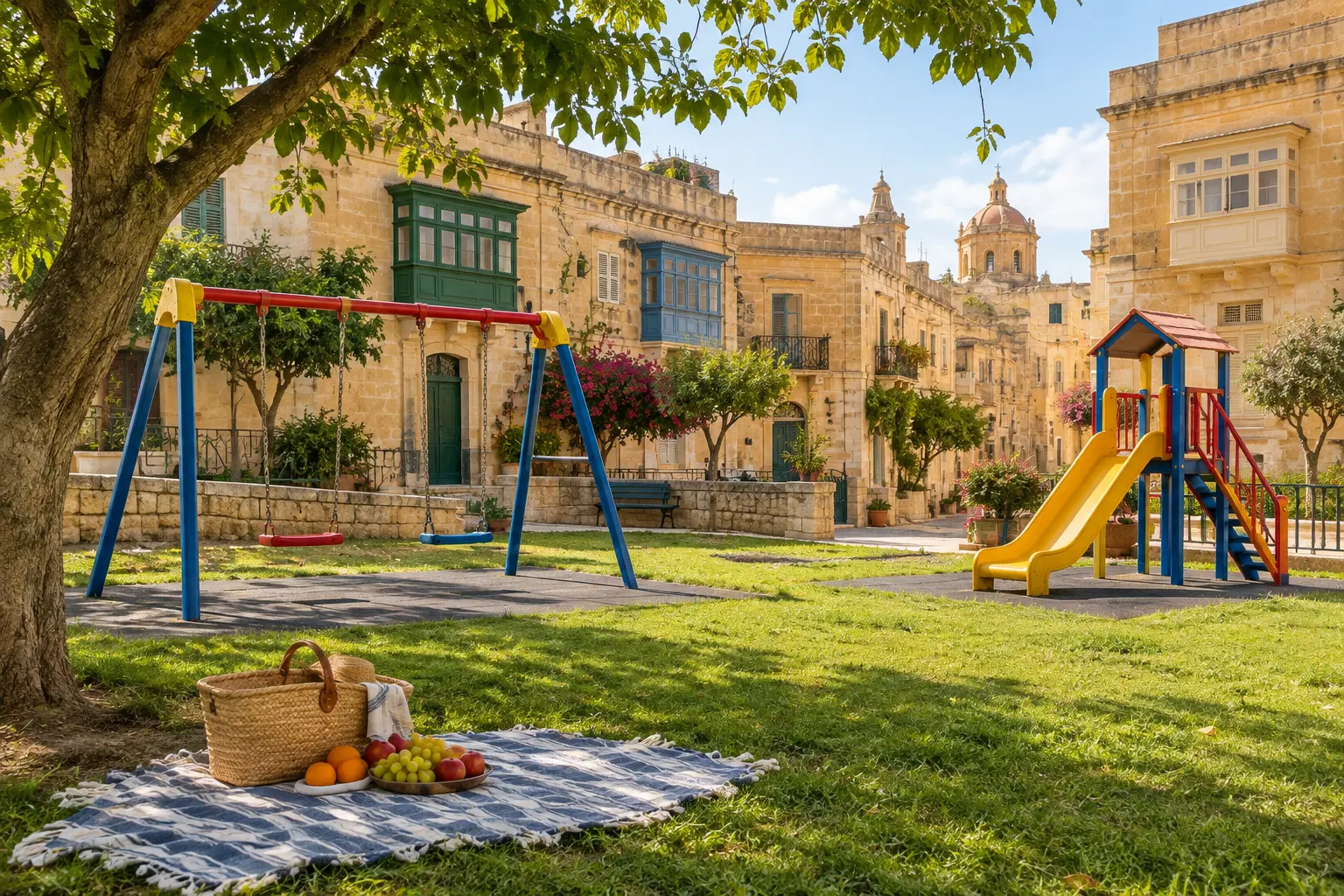
- Parks and playgrounds within walking distance. Dense areas like parts of Sliema and Gżira are lively but have less green space.
- Quieter residential towns in the centre and north of the island often give more space for the money and a stronger neighbourhood feel.
- Bus links if one parent will not drive.
Our guide to where to live in Malta compares areas with rent ranges and bus links.
Schools in Malta for expat children
Malta has three main types of school. Compulsory education runs from age 5 to 16, and most children start kindergarten earlier. The right choice depends on how long you plan to stay, your child’s age and languages, and your budget.
| Type | Cost | Language | Good to know |
|---|---|---|---|
| State schools | Free | Maltese and English; the balance depends on subject and level | Allocated mainly by where you live. Induction support exists for children new to Maltese and English. |
| Church schools | No tuition fees; families are usually asked for an annual donation | Maltese and English | Places are limited and allocated through an admissions process, so apply early and ask about mid-year entry. |
| Independent and international schools | Fee-paying; fees vary widely by school and year group | Mostly English | International schools such as Verdala International School and QSI International School of Malta follow international curricula. Ask each school for current fees. |
Summary of school types, last checked October 2026. Admission rules and fees change; confirm with the school or the education ministry before you decide.
How families tend to choose
- Staying one to three years? Many expat families choose an English-medium international or independent school so children can move on easily.
- Staying longer, with young children? State and church schools give children Maltese, local friends and a strong neighbourhood connection.
- Teenagers? Curriculum continuity matters most. Check how the school’s exams fit the system your child will move to later.
The school gate is your social life
Whatever school you choose, the parent community will be your main route into a social circle for the first year. Ask whether there is a parents’ association, a class chat group or a welcome coffee for new families, and join it in week one.

Childcare: the Free Childcare Scheme
Malta’s Free Childcare Scheme covers children from three months until they are eligible for Kinder 1 (around age three), in registered childcare centres, for parents who are working or in education. In outline, when checked in October 2026:
- Who qualifies: parents who are employed or self-employed and paying social security contributions, or in recognised education. Single working parents are included.
- How hours work: free hours are linked to the parents’ working or study hours.
- How to apply: through your chosen registered childcare centre, with the documents the scheme asks for (such as recent payslips and an employer declaration).
- Exceptions: some residence statuses are excluded; check the official page for your situation.
Childcare centres fill up, especially in popular areas. Visit two or three, ask about waiting lists and start the paperwork as soon as you have a job contract.
Healthcare for children
How your family accesses public healthcare depends on your residence and employment status. In general, people entitled to public healthcare can use local health centres and Mater Dei Hospital, and many expat families also take private health insurance or use private paediatricians. Register early, find your nearest health centre and keep 112 saved for emergencies. Our guide to healthcare in Malta for expats explains entitlement and how to register.
Weekends with kids in Malta
Weekends are where families settle in, and where you meet other families without trying. A few reliable options (check opening times and prices on each venue’s own website):
- Beaches with shallow water: sandy beaches in the north, such as Għadira in Mellieħa, are popular with families from late spring to autumn.
- Esplora in Kalkara: an interactive science centre with a planetarium, good for rainy days and curious children.
- Malta National Aquarium in Qawra: tanks themed on Maltese marine habitats, an easy half-day.
- Playmobil FunPark in Ħal Far: indoor and outdoor play areas for younger children.
- Popeye Village at Anchor Bay: the old film set, with family activities in season.
- Gardens and countryside: Buskett Gardens and the walks around them, the Upper Barrakka Gardens in Valletta, and village squares during festas.
- Village festas: mostly in summer, with brass bands, fireworks and street food. Children love them and so do neighbours.

Summer and winter routines
Summer in Malta is hot, so family life shifts to early mornings and evenings: a swim before the heat, a late-afternoon beach, dinner outside. In winter the island is quieter and indoor options matter more. Many expat families are surprised by how damp and cool homes can feel in January, so plan indoor activities and playdates for those months.
Making friends as an expat family
Families have a different route into Maltese social life from single newcomers. Most of it runs through children, and most of it rewards repetition.
For the children
- After-school activities: football, swimming, gymnastics, music, scouts and dance all meet weekly and mix Maltese and expat children.
- Birthday parties: say yes to every invitation in the first term, and invite the class back.
- Playdates: suggest a specific time and place. “Saturday 10:00 at the playground, then an ice cream” works better than “we should get the kids together”.
For the parents
- Be a regular at the school gate. Same time, same place, every day. Faces become names within weeks.
- Join the parents’ association or class group and volunteer once for something small.
- Turn a drop-off chat into a plan: a coffee after drop-off, a Sunday beach morning with two families, a split picnic.
- Keep one thing that is yours. A class, a run, a sport or a weekly adult social stops your whole life revolving around the school run.
Our 30-day plan for making friends in Malta covers adult routes in more detail, and if the first months feel heavier than expected, our guide to loneliness after moving to Malta has a 12-week reset plan and helpline numbers.
The trailing parent
If one parent moved for the other’s job, that parent often carries the most change and the least structure: no colleagues, no routine, a new home to set up. Plan for it. Give that parent at least two fixed weekly slots outside the home in the first month, and make sure weekends include plans with other adults, not only family time.
Small, specific plans are the habit that works best for parents too, and it is what MeetNow is being built around: a host posts a plan at a public place, such as a Saturday playground coffee or a family beach morning, with a time, the seats and who pays, and other people ask to join.

What expat parents wish they had known
When I ask parents who have been here a few years what they would tell their newly arrived selves, the same answers come up:
- Visit schools before you sign a lease. The school run shapes your whole week, and traffic at 07:30 is very different from traffic at 11:00 on a viewing.
- Start paperwork early. School enrolment, childcare applications and health registration all ask for documents. Keep scans of passports, birth certificates, vaccination records and your lease in one folder.
- Expect a summer gap. The school summer holiday is long. Summer schools and sports camps fill up, so book in spring.
- Buy for the heat and the damp. Air conditioning or good fans for summer, a dehumidifier and warm layers for winter evenings at home.
- Look beyond expat groups. Online parent groups are useful for questions, but the friendships come from the people you see every week. Our guide to the expat community in Malta lists groups worth joining for both.
- Give it a full school year. The first term is the hardest. By the second, children have friends, you know the routines and invitations start to arrive.
A 30-day checklist for expat families
| When | Practical | Social |
|---|---|---|
| Week 1 | Confirm school places and start dates; find your nearest health centre and pharmacy | Walk the neighbourhood at school-run time; find the nearest playground |
| Week 2 | Childcare applications; health registration; school uniforms and books | Join the class chat or parents’ association; say hello to the same parents daily |
| Week 3 | Set up after-school activities for each child | Suggest one playdate or coffee with a specific time and place |
| Week 4 | Plan for the season: summer routines or winter indoor options | Book one adult-only plan for each parent; repeat the playdate |
Safety when meeting new families and adults
- Meet in public places first: playgrounds, cafés, beaches and school events.
- Tell your partner or a friend where you are going and who you are meeting.
- Have your own way home, whether a car, a bus or a ride-hailing app.
- Trust your instincts and leave if anything feels wrong. Never send money to someone you have just met.
Frequently asked questions
Is Malta a good place for expat families?
For many families, yes: English is widely spoken, the climate is mild, children are welcome almost everywhere and the sea is close. The main challenges are rent in popular areas, school-run traffic and building a new social circle without family nearby.
Are schools free in Malta for expat children?
State schools are free, and church schools charge no tuition but usually ask for an annual donation. Independent and international schools charge fees that vary by school and year group. Confirm admission rules and current fees with each school.
What language do children learn in at Maltese schools?
State and church schools teach in Maltese and English, with the balance depending on the subject and level. International and most independent schools teach mainly in English. Induction support exists for children new to both languages.
Can expat parents use Malta’s Free Childcare Scheme?
Parents who are working or in recognised education, and who meet the scheme’s conditions, can use it for children from three months until they are eligible for Kinder 1. Some residence statuses are excluded, so check the official Jobsplus page for your situation.
How do expat parents make friends in Malta?
Mostly through the school gate, children’s activities and birthday parties, then by turning those contacts into small specific plans such as a coffee after drop-off or a beach morning with another family. Keeping one adult activity of your own helps too.
What can families do at weekends in Malta?
Beaches with shallow water in the north, Esplora science centre in Kalkara, the National Aquarium in Qawra, Playmobil FunPark in Ħal Far, Popeye Village, Buskett Gardens and village festas in summer. Check opening times and prices before you go.
Want to turn this into an actual plan? MeetNow is a free app for meeting people in person: a host posts a plan at a public place, says who pays (host pays, split, pay your own or free) and picks who joins. It works in your browser and on Android through Google Play, starting in Malta; the iPhone app is not in the App Store yet. Open MeetNow and see the plans in Valletta, Sliema and St Julian’s.
We may mention products we are connected with; see our product disclosure.