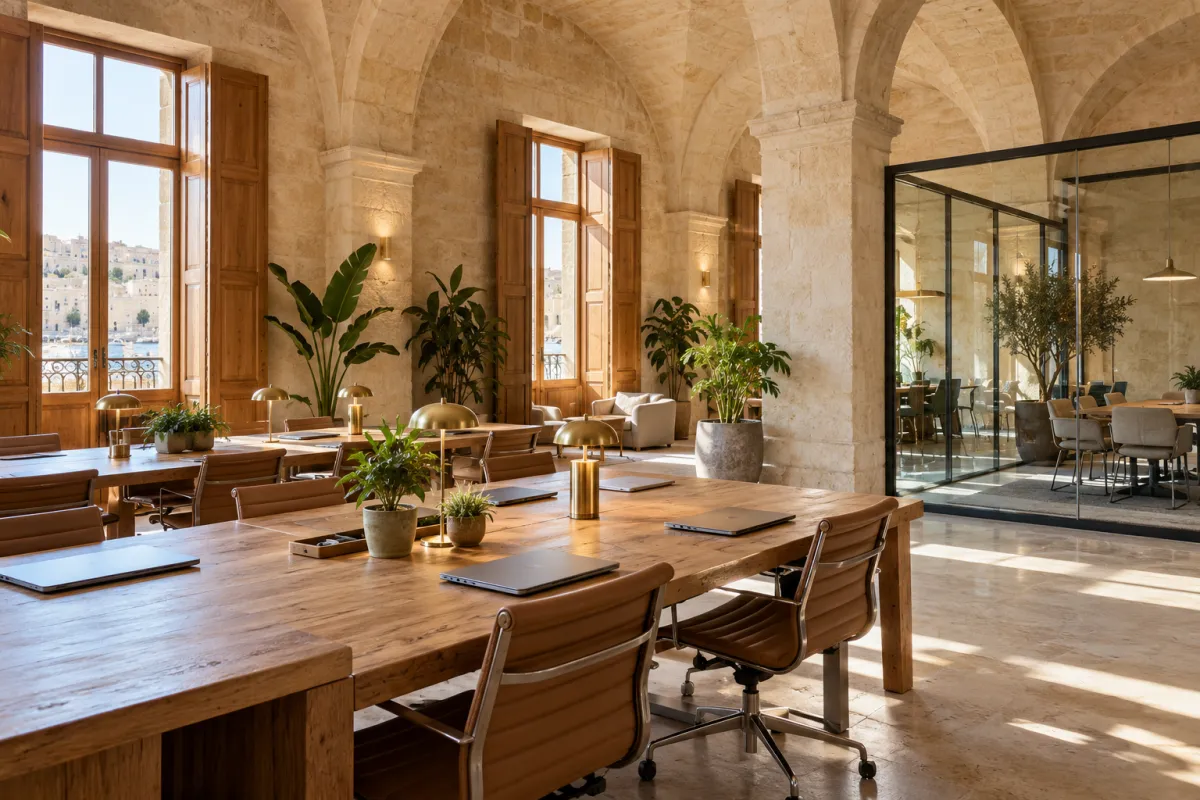
Short answer: choosing a coworking space Malta remote workers actually enjoy comes down to three things: location, price and people. Most spaces are in Valletta, Sliema, Gżira and St Julian’s. When I checked the operators’ own pages in October 2026, the international chains Regus and Spaces listed day passes from about €29 and Regus hot-desk memberships from €119 a month, while Valletta’s independent Grand Central charged €35 plus VAT for a day and €325 to €450 plus VAT a month for a dedicated desk. Pick a space near where you live, try a day pass first, and choose the one where people actually talk to each other.
I have worked remotely from Malta for long stretches, in flats, cafés and coworking spaces, and I have watched friends burn out working alone from a bedroom in a shared flat. A coworking desk is not a luxury here: it is often the difference between a lonely winter and a good one. This guide is the island-wide overview; separate guides go deeper into coworking in Sliema and Valletta.
Coworking options in Malta at a glance
| Operator | Areas | Day pass | Monthly | Community feel | Last checked |
|---|---|---|---|---|---|
| Grand Central (independent) | Valletta: Strait Street and Archbishop Street | €35 + VAT (1-hour pass €6 + VAT; €20 one-off sign-up) | 60-hour pass €175 + VAT; dedicated desk €325 to €450 + VAT | Two buildings with lounges, kitchens and roof terraces | Oct 2026 |
| Spaces (international chain) | Gżira, Sliema and other harbour locations | From about €29 | Coworking memberships and dedicated desks; prices on enquiry or online | Business-club style; events vary by centre | Oct 2026 |
| Regus (international chain) | St Julian’s (Junction and Dragonara business centres), Gżira, Sliema, Swatar and others | From about €29 | Hot-desk memberships from €119 a month | Quieter, more corporate | Oct 2026 |
Sources: Grand Central drop-in and coworking membership pages; Spaces and Regus Malta pages. Chain prices vary by centre, contract and promotion: €29 is the lowest day rate Regus advertised for Malta, while its St Julian’s centre page listed day coworking at €55, so confirm the price for your centre on the day. Last checked October 2026.
Independent spaces open and close more often than the chains, and some only offer private offices. If you find a smaller space you like, ask how long it has been open and whether it has a community manager or regular member events.
Coworking space Malta prices explained
Coworking pricing here follows the same pattern as elsewhere in Europe:
- Hourly passes for a quick call or a few hours of focus (Grand Central lists €6 plus VAT an hour).
- Day passes, typically around €29 to €35 before any VAT, depending on the operator.
- Bundles or part-time memberships: a set number of days or hours per month, such as Regus hot-desk plans for 5, 10 or unlimited days, or Grand Central’s 60-hour monthly pass at €175 plus VAT.
- Dedicated desks: your own desk with 24/7 access. At Grand Central, €450 plus VAT a month rolling, €395 on a three-month plan, or €1,950 paid upfront for six months (€325 a month).
- Private offices for teams, priced per desk or per office.
Check whether prices include VAT. In Malta the standard VAT rate is 18%, so a “€35 + VAT” day pass is roughly €41 at the till. Most international operators show prices inclusive of local taxes, but read the small print.

Which area suits you?
| Area | Why people choose it | Trade-offs |
|---|---|---|
| Valletta | Historic setting, ferries to Sliema and the Three Cities, central bus terminus | Quiet in the evenings; steep streets; limited parking |
| Sliema and Gżira | Walkable, seafront, close to where many expats rent | Busy, pricier rents, construction noise in places |
| St Julian’s | Business centres, gaming and tech companies, evening social life nearby | Traffic around Paceville; can feel corporate |
| Central business areas (e.g. Swatar, Mrieħel) | Near offices and main roads | Less to do after work; car or bus needed |
| Gozo and the north | Quiet and space | Few coworking options; more travel for plans |
Seasons matter too. In July and August, a space with strong air conditioning is worth a lot when your flat turns into an oven by midday. In January and February, the opposite applies: many Maltese homes are cold and damp, and a warm, dry desk with good light can make the difference between a productive winter and a gloomy one. Ask about both when you visit, and look at where the desks sit relative to windows and air vents.
The rule I give friends: choose a space within a 15-minute walk or a single bus ride of home. A beautiful space you need two buses to reach becomes the space you stop going to in February.
What to look for when you try a day pass
- Internet: run a speed test and make a short video call from the hot-desk area, not just the meeting room.
- Noise and phone booths: can you take a call without leaving the building?
- Air conditioning and heating: summer heat and damp winters both matter in stone buildings.
- Kitchen and lunch area: lunch is where coworking friendships start.
- Community manager and events: ask what happened last month, not what is “planned”.
- Who the members are: a space filled by one company’s team is less social for an outsider.
- Access hours: drop-in hours are often office hours only (Grand Central’s drop-in is Monday to Friday, 8:45 to 18:00), while dedicated desks may include 24/7 access.
- Contract terms: notice period, deposits and whether you can pause in summer.
Common coworking mistakes
- Signing a six-month plan before trying the space for a few days.
- Choosing on price alone, then never speaking to anyone there.
- Forgetting VAT when comparing prices.
- Picking a space across the island from where you live.
- Using coworking only for deep work and never for lunch or events, which is where the people are.
Coworking vs cafés vs working from home
| Coworking | Cafés | Home | |
|---|---|---|---|
| Cost | About €29 to €41 a day, less on memberships | Price of your coffees and lunch | Free, but electricity in summer |
| Internet | Usually reliable | Variable | Depends on your flat |
| Calls | Phone booths and meeting rooms | Noisy | Fine if you live alone |
| Meeting people | Best, if the space is social | Occasional | None |
| Best for | Two to four anchor days a week | A change of scene for a few hours | Focus days and early or late calls |
Most remote workers I know mix all three: coworking on fixed days, home for early calls, and a café when they need a change of scene. If you are setting up from scratch, a good phone plan helps on café days; our guide to the best SIM card in Malta compares data packs.

Three monthly coworking budgets
Here is how the published prices translate into a month, for three common working patterns. These are my worked examples using the October 2026 prices above, not quotes.
| Pattern | What you buy | Approximate monthly cost |
|---|---|---|
| Light: one day a week | Four day passes at about €29 to €35 (+ VAT where applicable) | €116 to €165 |
| Regular: two or three days a week | A part-time hot-desk plan (Regus from €119) or a 60-hour pass at Grand Central (€175 + VAT, about €207) | €119 to €210 |
| Full-time: your own desk | Dedicated desk at Grand Central (€325 to €450 + VAT) | About €384 to €531 |
VAT calculated at Malta’s standard 18% where prices are shown excluding VAT. Chain prices may differ by centre and contract.
Compare that with what you would spend anyway: a café habit of two coffees and a snack on four days a week can easily cost €60 to €100 a month, without phone booths or meeting rooms. For many people a part-time plan plus a home setup is the sweet spot.
Coworking in Gozo and the north
Outside the harbour area, options are thinner. On Gozo and in the northern towns, remote workers more often rely on home offices, hotel lounges and cafés, plus occasional days on Malta. If you plan to live there, check internet options for your flat before signing a lease, and plan one or two regular days in a harbour-area space so your work week includes people as well as views.
Receipts, tax and the paperwork side
If you are self-employed or a freelancer, coworking costs may be a business expense. Keep VAT invoices in your name or your company’s name, not just card receipts. Rules depend on where you are tax resident and on your business structure, so check with a licensed tax adviser; this is not tax advice. If you are on the Nomad Residence Permit, a coworking membership is not a requirement, but it can help you keep a clear routine and records of where you worked. Our Malta Nomad Residence Permit guide covers what the permit does require.
Who coworking suits in Malta
- Remote employees of foreign companies who live alone or in noisy shared flats.
- Freelancers and founders who need meeting rooms and a business address.
- Hybrid workers whose employer office is far away, for the days they work locally.
- Newcomers who want a ready-made routine and people to talk to in their first months.
It suits people less well if your hours are mostly early-morning or late-night calls with other time zones, or if your budget is very tight; in that case a good home setup plus two café days a week may be enough. If you are job hunting locally rather than working remotely, our guide to jobs in Malta for English speakers is the better starting point, and our guide to working in Malta covers contracts and work culture.
Using coworking to build a social life
Coworking is the easiest ready-made social circle for remote workers, but only if you use it that way:
- Fix your days. Go on the same two or three days every week so you see the same faces.
- Eat lunch in the kitchen, not at your desk.
- Go to one event a month, even if it is a talk you are only half interested in.
- Suggest something small: an after-work swim, a walk along the Gżira promenade, a Friday coffee. Say up front whether everyone pays their own.
Our guide to the digital nomad community in Malta has a sample weekly routine built around coworking days.
Your first month in a coworking space
| Week | What to do |
|---|---|
| Week 1 | Try two different spaces on day passes. Note the internet, the noise and whether anyone says hello. |
| Week 2 | Pick one. Buy a part-time plan rather than a long contract. Introduce yourself to the community manager or front desk. |
| Week 3 | Go on fixed days, eat lunch in the kitchen and attend one member event. |
| Week 4 | Invite one or two people you have chatted with to something small outside work: a swim, a walk or a coffee on the promenade. |
By the end of the month you should know whether the space works for your job and for your week. If it does not, switch: in a market this small, it is normal to try a couple of places before you settle, and the staff will not be surprised.
Coworking space Malta: FAQ
How much does a coworking space cost in Malta?
When checked in October 2026, Regus and Spaces listed coworking day passes from about €29, and Regus listed hot-desk memberships from €119 a month. Grand Central in Valletta charged €35 plus VAT for a day pass and from €325 to €450 plus VAT a month for a dedicated desk.
Where are the coworking spaces in Malta?
Most are in the harbour business areas: Valletta, Sliema, Gżira and St Julian’s, plus business centres in places such as Swatar. Gozo and the north have far fewer options.
Is coworking worth it in Malta?
If you work remotely and live alone or in a busy shared flat, usually yes, at least two days a week. You get reliable internet, a quiet desk, meeting rooms and, in the better spaces, other people to talk to, which matters a lot for newcomers.
Can I just work from cafés in Malta?
For a few hours, yes, if you buy regularly and avoid lunch rush. For full days and video calls, cafés are noisy and plugs are limited, so most remote workers combine cafés with home and a coworking membership.
Do I need a coworking space for the Nomad Residence Permit?
No. The permit requires remote work for a foreign employer, business or clients, plus income, insurance and accommodation; it does not require a coworking membership. Many permit holders choose one for routine and community.
Want to turn this into an actual plan? MeetNow is a free app for meeting people in person: a host posts a plan at a public place, says who pays (host pays, split, pay your own or free) and picks who joins. It works in your browser and on Android through Google Play, starting in Malta; the iPhone app is not in the App Store yet. Open MeetNow and see the plans in Valletta, Sliema and St Julian’s.
Prices and locations change; always check each operator’s website. This guide is general information, not tax or legal advice. We may mention products we are connected with; see the affiliate and product disclosure page linked in the site footer.