Short answer: your Malta salary after tax is your gross pay minus two deductions: income tax (0% to 35%, depending on your band and whether you use the single, married or parent rates) and Class 1 social security, which is 10% of your basic weekly wage up to a cap of €55.93 a week in 2026. On a €30,000 salary taxed at single rates, that leaves about €22,990 a year, or roughly €1,916 a month.
Below you will find the 2026 tax bands, the Budget 2027 changes announced on 26 October 2026, worked examples from minimum wage to €60,000, and what all of it means for your monthly budget. Figures last checked November 2026; this is general information, not tax advice.
When I got my first Maltese job offer, I did what everyone does: divided the gross figure by twelve and started mentally spending it. The first payslip was a polite correction. Malta’s system is not complicated once you have seen it laid out, but the numbers that matter (the band you fall into, the social security cap, the bonuses that arrive four times a year) are spread across several official pages. This guide puts them in one place so you can compare a job offer against real rent and real life before you sign.
How Malta salary after tax is worked out
For an employee on a local payroll, three things come off the gross figure in your contract, and only two of them are yours to worry about:
- Income tax. Deducted every pay period under the Final Settlement System (FSS). Your employer withholds tax using the rate table you qualify for: single, married or parent, with separate tables for families with one child or two or more children.
- Your social security contribution (Class 1). Usually 10% of your basic weekly wage, with a weekly maximum. It funds pensions, sickness and unemployment benefits and also counts towards your contribution record.
- Your employer’s social security share. The employer pays a matching contribution on top of your salary. It does not come out of your gross pay, so ignore it when you calculate take-home pay, but it explains why employers sometimes negotiate hard on gross figures.
Two details catch newcomers out. First, social security is not deductible against income tax in Malta: tax is calculated on your full gross salary, and the 10% contribution is taken on top. Second, Malta’s tables work with a “subtract” figure rather than a stack of separate band calculations. You multiply your whole chargeable income by your band’s rate and then subtract a fixed amount. It produces exactly the same result as taxing each slice separately, and it is much quicker to do on a phone.
When you start a job, your employer will ask you to fill in an FS4 Payee Status Declaration, the form that tells payroll which rate table to apply. After the year ends you receive an FS3, a summary of your gross pay, tax and social security for the year. Keep both: banks, landlords and residence applications regularly ask for them.
Income tax rates for 2026
These are the 2026 rates for residents published by the Malta Tax and Customs Administration (MTCA) and summarised by PwC’s tax summaries. Find your band, multiply your chargeable income by the rate, and subtract the figure in the last column.
Single rates (also used by spouses who opt for separate computation)
| Chargeable income | Rate | Subtract |
|---|---|---|
| €0 – €12,000 | 0% | €0 |
| €12,001 – €16,000 | 15% | €1,800 |
| €16,001 – €60,000 | 25% | €3,400 |
| €60,001 and over | 35% | €9,400 |
Married and parent rates
| Computation | 0% up to | 15% band | 25% band | 35% from |
|---|---|---|---|---|
| Married | €15,500 | to €23,000 (subtract €2,250) | to €60,000 (subtract €4,550) | €60,001 (subtract €10,550) |
| Married, one child | €17,500 | to €26,500 (subtract €2,625) | to €60,000 (subtract €5,275) | €60,001 (subtract €11,275) |
| Married, two or more children | €22,500 | to €32,000 (subtract €3,375) | to €60,000 (subtract €6,575) | €60,001 (subtract €12,575) |
| Parent | €13,000 | to €17,500 (subtract €1,950) | to €60,000 (subtract €3,700) | €60,001 (subtract €9,700) |
| Parent, one child | €14,500 | to €21,000 (subtract €2,175) | to €60,000 (subtract €4,275) | €60,001 (subtract €10,275) |
| Parent, two or more children | €18,500 | to €25,500 (subtract €2,775) | to €60,000 (subtract €5,325) | €60,001 (subtract €11,325) |
Basis year 2026, resident individuals. Source: MTCA individual tax rates 2026, as summarised by PwC Worldwide Tax Summaries. Last checked November 2026.
“Parent” rates are for single parents (or separated and divorced parents) who maintain a child; “married” rates apply to a married couple filing jointly, with the couple’s income combined. The new child-specific tables were introduced as part of a three-year tax reduction for families that runs from 2026 to 2028. If you are a couple where both partners earn, it is worth asking an accountant whether joint or separate computation leaves you better off, because the answer depends on how evenly your incomes are split.

Social security (Class 1) contributions
Employees pay Class 1 social security. The category depends on your basic weekly wage, and people born from 1962 onwards (almost every newcomer reading this) have a higher weekly cap than those born earlier.
| Category (born 1962 or later) | Basic weekly wage | Your contribution |
|---|---|---|
| A (under 18) | up to €229.44 | €6.62 a week |
| B (18 and over) | up to €229.44 | €22.94 a week (or 10% if you choose) |
| C | €229.45 – €559.30 | 10% of basic weekly wage |
| D | €559.31 and over | €55.93 a week (the cap) |
2026 rates for employees born from 1 January 1962; the employer pays a matching amount on top, plus a small maternity fund contribution. Source: CSB Group summary of 2026 Class 1 rates. Last checked November 2026.
The cap matters more than people expect. €559.31 a week is roughly €29,080 a year, so anyone earning above that pays the same €55.93 a week, about €2,908 a year, whatever the salary. On a €30,000 salary, social security takes about 9.7% of gross; on €60,000 it takes under 5%. Meanwhile income tax climbs the other way, which is why net pay rises more smoothly than the tax table alone suggests.
Contributions are counted per week, so a year with 52 weekly contributions is the normal case. If you join mid-year, or work part-time, your contributions are worked out on the weeks and wages you actually have.
Worked examples: net pay at five salaries
These examples use the 2026 single rates, an employee born after 1962, 52 weekly social security contributions, and no other income or deductions. They are rounded to the nearest euro. Statutory bonuses and the weekly allowance are left out so that the numbers match the gross figure most contracts quote.
| Gross a year | Income tax | Social security | Net a year | Net a month (÷12) |
|---|---|---|---|---|
| €11,931 (2026 adult minimum wage) | €0 | €1,193 | €10,738 | €895 |
| €20,000 | €1,600 | €2,000 | €16,400 | €1,367 |
| €25,000 | €2,850 | €2,500 | €19,650 | €1,638 |
| €30,000 | €4,100 | €2,908 | €22,992 | €1,916 |
| €45,000 | €7,850 | €2,908 | €34,242 | €2,853 |
| €60,000 | €11,600 | €2,908 | €45,492 | €3,791 |
Own calculation from the 2026 MTCA single rates and 2026 Class 1 rates above; last checked November 2026. Your payslip can differ slightly because of rounding, weeks in the pay period and any fringe benefits.
How one example is worked out
Take €30,000 on single rates. Tax: €30,000 × 25% = €7,500, minus €3,400 = €4,100. Social security: €30,000 ÷ 52 = €576.92 a week, which is above €559.31, so you pay the €55.93 cap × 52 = €2,908.36. Net: €30,000 − €4,100 − €2,908 = €22,992, or about €1,916 a month. Your combined deduction rate is around 23%.
The same €30,000 on family rates
If that €30,000 is the only income of a married couple filing jointly, tax drops to €2,950 (married rates), and net pay rises to about €24,142. With one child the married-rate tax is €2,225 in 2026; with two or more children it is €1,125. Rates matter more than most people think, so make sure your FS4 reflects your real situation.
For context on what these salaries mean in practice, our guide to the average salary in Malta by sector shows where typical jobs fall, and the Malta minimum wage guide covers the hourly rates, youth rates and part-time rules behind the first row.
Budget 2027: what changes in January
The Budget for 2027 was presented on 26 October 2026. The measures that touch take-home pay, as summarised in KPMG Malta’s Budget 2027 highlights, are:
- Cost-of-living adjustment (COLA) of €6.41 a week for 2027, added to wages from January (about €333 a year).
- The national minimum wage rises by €10.41 a week, including COLA, and stays untaxed. On the 2026 adult rate of €229.44 that points to roughly €239.85 a week; the exact figure is confirmed by legal notice.
- Lower tax for families with children, the second step of the three-year reform. Single rates and the plain married and parent rates were not changed in the summary.
- Social security rates stay the same. The weekly ceilings are normally revised each January, so check the 2027 cap when your first January payslip arrives.
- A one-off, tax-free “Super Bonus” in the first quarter of 2027, based on 2025 income: €1,000 for eligible people with income of at least €12,000, pro rata below that. Because it is based on 2025 income, people who were not working in Malta in 2025 should not count on it.
2027 family tax bands
| Computation (basis year 2027) | 0% up to | 15% band | 25% band | 35% from |
|---|---|---|---|---|
| Married, one child | €20,000 | to €30,000 (subtract €3,000) | to €60,000 (subtract €6,000) | €60,001 (subtract €12,000) |
| Married, two or more children | €30,000 | to €41,000 (subtract €4,500) | to €60,000 (subtract €8,600) | €60,001 (subtract €14,600) |
| Parent, one child | €16,000 | to €24,500 (subtract €2,400) | to €60,000 (subtract €4,850) | €60,001 (subtract €10,850) |
| Parent, two or more children | €24,000 | to €33,500 (subtract €3,600) | to €60,000 (subtract €6,950) | €60,001 (subtract €12,950) |
Source: KPMG Malta, Budget 2027 highlights (October 2026). Budget measures take effect once enacted; last checked November 2026.
In practice: a married couple with one child and a joint income of €30,000 would pay about €1,500 in tax in 2027 instead of €2,225 in 2026, and a couple with two children on the same income would pay nothing. For a single person on €30,000 the change is the COLA on top of their salary, not a lower tax bill.
COLA, bonuses and the extras on your payslip
Malta pays some money in lumps rather than monthly, which confuses people comparing offers from abroad. According to the Department for Industrial and Employment Relations (DIER), full-time employees receive:
| Payment | Amount (full-time) | When |
|---|---|---|
| Statutory bonus | €135.10 | End of June |
| Statutory bonus | €135.10 | Between 15 and 23 December |
| Weekly allowance (income supplement) | €121.16 | End of March |
| Weekly allowance (income supplement) | €121.16 | End of September |
Source: DIER; part-timers receive a pro-rata share. Last checked November 2026.
That is €512.52 a year for a full-time employee, paid as part of your wages and taxed with them. Check your contract: some salaries are quoted “inclusive of statutory bonuses”, others exclude them. On a tight budget, the difference is worth a couple of weeks’ groceries.
The cost-of-living adjustment is a separate thing. It is a weekly increase that the Budget sets for the coming year and that employers add to wages from January. If your employer already pays above the minimum, ask HR how they apply it, because practice varies between collective agreements and individual contracts.

Expats: residence and non-dom basics
Most newcomers on a local employment contract are taxed exactly like Maltese employees: the same FSS deductions and the same rate tables. A few points are specific to people who moved here.
- Residents and non-residents. If you live in Malta, you normally use the resident tables above. People who are not resident pay tax only on income arising in Malta, at separate non-resident rates with a tax-free band of only €700, which is why short-term workers can be surprised by the deduction.
- Non-domiciled residents. Many expats are resident but not domiciled in Malta. In broad terms, they are taxed on Malta income and on foreign income that is brought into Malta, not on foreign income left abroad. Rental income from a flat back home, savings and side gigs are where this gets technical.
- Special schemes. Malta has reduced flat-rate schemes for certain highly qualified roles and for some remote workers on the Nomad Residence Permit. Eligibility conditions are strict and change; ask your employer or an accountant before you assume you qualify.
- Double taxation. Malta has tax treaties with many countries. If you still have income or obligations at home, check both sides before your first tax year closes.
The official source for all of this is the MTCA. If your situation involves more than one country, one paid hour with a Malta-registered accountant in your first year usually costs less than a mistake.
Turning net pay into a monthly budget
Net pay only means something next to your costs. Rent is the big one, and it varies enormously by area and by whether you share. Our cost of living in Malta breakdown has current rent, utilities, transport and grocery figures to set against the table above.
A simple way to test a job offer:
- Start from net a month using the worked examples, not the gross figure.
- Subtract rent and bills for the area you would actually live in, including electricity, which can jump in summer with air conditioning.
- Subtract fixed costs: phone, transport, insurance, any money you send home.
- Set aside the bonus months. Treat the March, June, September and December payments as your buffer for deposits, flights and the occasional surprise.
- Keep a line for a social life. It is the first thing newcomers cut and the one they regret most.
Budgeting for a social life without overspending
The most expensive social habit in Malta is not going out; it is going out in big groups where the bill gets split evenly and you pay for three cocktails you did not drink. Smaller plans with the money question settled in advance are cheaper and easier to say yes to. A coffee in Valletta, a swim followed by pastizzi, a board-game evening where everyone pays their own: these cost a few euros, and they are how most of my friendships here started.
It helps to agree who pays before you meet. “Pay your own” works for most first meet-ups; “split” works when you are sharing food; and offering to host a coffee is a kind gesture when someone is new. If the job brings you to Malta on your own, our guides to working in Malta and jobs in Malta for English speakers cover the work culture, including the after-work drinks culture in some sectors.
Safety basics apply to any first meet-up: pick a public place, tell a friend where you are going, have your own way home and leave if you feel uncomfortable.
Malta salary after tax: frequently asked questions (FAQ)
How much is €30,000 after tax in Malta?
On 2026 single rates, about €22,992 a year, or roughly €1,916 a month. That is €4,100 of income tax and about €2,908 of social security (the €55.93 weekly cap for 52 weeks). On married rates with no children it is about €24,142.
Is the minimum wage taxed in Malta?
No. A full-time adult on the 2026 minimum wage of €229.44 a week earns about €11,931 a year, below the €12,000 tax-free threshold on single rates, and Budget 2027 confirmed that the minimum wage stays untaxed after the 2027 increase. Social security is still deducted.
What is the highest income tax rate in Malta?
35%, on chargeable income above €60,000 on the resident tables. Because of the subtract system, your average rate stays well below 35% even at high salaries: on €60,000 single, tax is €11,600, about 19% of gross.
Is social security deducted before income tax?
No. In Malta, income tax is calculated on your gross salary and social security is deducted separately, so the two do not reduce each other. Your employer’s matching contribution is paid on top and does not reduce your pay.
Did Budget 2027 change tax for single people?
The Budget 2027 summary lists new bands only for married and parent computations with children. Single people benefit mainly from the €6.41 weekly COLA added to wages from January 2027. Check the MTCA’s 2027 rate page once it is published.
Are statutory bonuses included in my salary?
It depends on the contract. Full-time employees receive two statutory bonuses of €135.10 and two weekly allowances of €121.16 a year; some employers quote salaries inclusive of these, others pay them on top. Ask HR before you compare offers.
Do expats pay the same tax as Maltese people?
Expats who are resident and work on a local contract use the same rate tables. Non-residents pay tax on Malta income at separate rates, and non-domiciled residents have different rules for foreign income. Special schemes exist for some roles. Get professional advice if your income comes from more than one country.
Want to turn this into an actual plan? MeetNow is a free app for meeting people in person: a host posts a plan at a public place, says who pays (host pays, split, pay your own or free) and picks who joins. It is live on the web, starting in Malta, and works in your browser: open MeetNow and see the plans posted in Malta.
This guide is general information, not tax or financial advice. Tax figures come from official and professional summaries checked in November 2026; check the MTCA for your own situation.
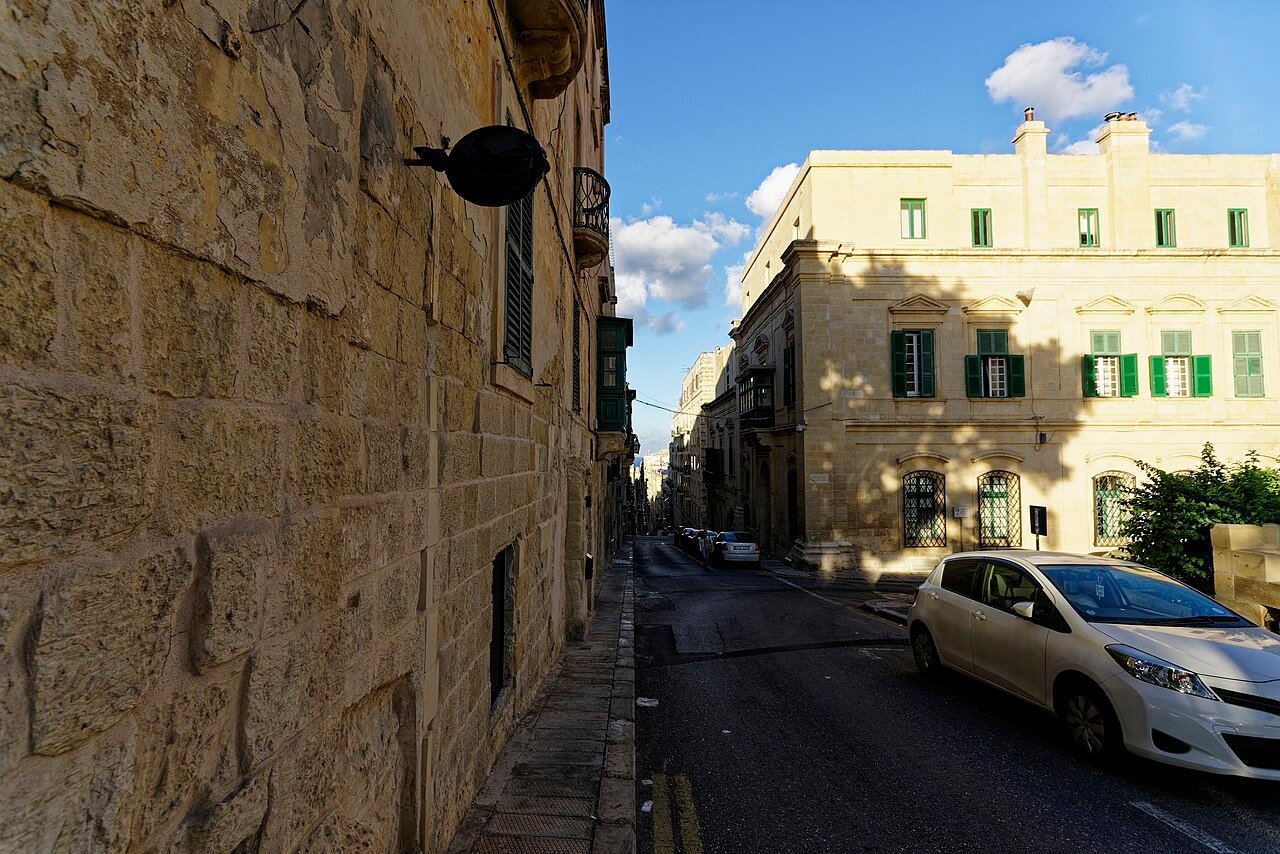
Featured photo: Old Mint Street, Valletta, by Txllxt TxllxT, CC BY-SA 4.0, via Wikimedia Commons.